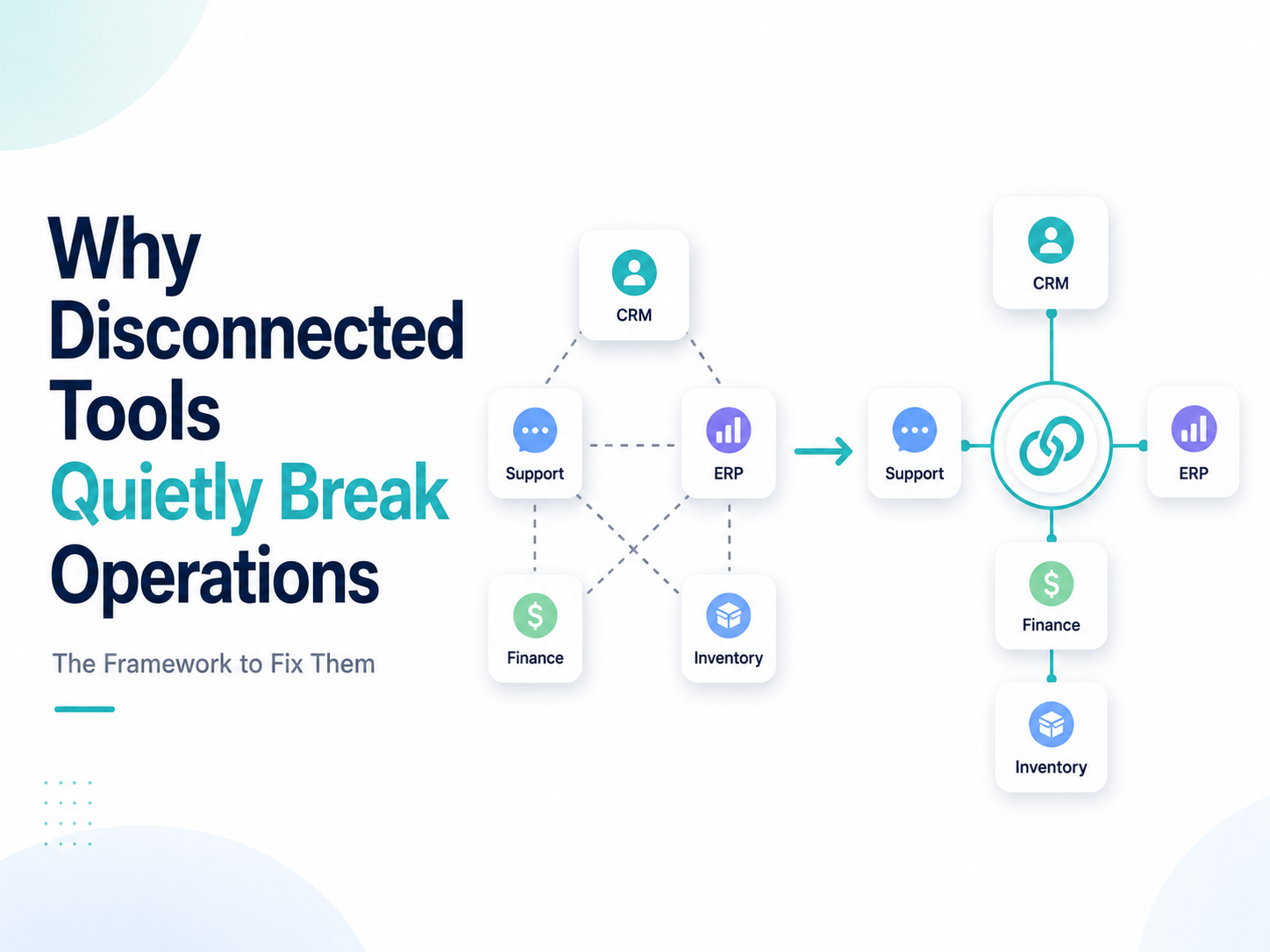
Why disconnected tools quietly break operations—and the framework to fix them
Most startups aren't failing because they lack tools. They're failing because they have too many silent tools — apps that exist in isolation, hoarding data, duplicating effort, and quietly eroding the operational speed founders thought they were buying. System integration in business is no longer a back-office IT concern. It is the structural backbone that …
Most startups aren’t failing because they lack tools. They’re failing because they have too many silent tools — apps that exist in isolation, hoarding data, duplicating effort, and quietly eroding the operational speed founders thought they were buying. System integration in business is no longer a back-office IT concern. It is the structural backbone that determines whether your company can make decisions, scale operations, and compete in an AI-driven market. This article is a field guide for founders and operators who sense something is broken but can’t yet name it.
Introduction: The Disconnection Paradox
In 2026, the average company runs on more than 130 SaaS applications. Founders adopt each one with the best intentions — a better CRM here, a smarter project tracker there, a dedicated tool for every function. The logic is intuitive: specialized tools do specialized things well. But specialization without connection creates a structural paradox.
Each new application becomes an island. And when your islands don’t have bridges, you don’t have an archipelago — you have a fragmented map that nobody can read in real time.
Business process integration is not a technical luxury reserved for enterprises. It is the connective tissue of any business that intends to grow without adding proportional chaos. The question is no longer which tools you use — it’s whether those tools are part of a coherent system or just an expensive collection of isolated subscriptions.
You Have the Tools. But Your Business Still Feels Slow and Disconnected
You hired more people. You added more software. Yet somehow, decisions still take too long, reports are still delayed, and the Friday standup still ends with, “Let me check and get back to you.”
This is startup friction—and it’s remarkably common. Headcount grows, software spend climbs, but output plateaus. The culprit isn’t your team’s work ethic or the quality of your tools. It’s the invisible gap between them.
According to MuleSoft’s 2026 Connectivity Benchmark Report, only 27% of business applications are currently connected—meaning roughly 73% remain isolated, creating persistent “data blind spots.” Every time a sales rep manually updates a spreadsheet that a different team is also maintaining, a blind spot is born. Every time a support ticket closes without updating the CRM, a blind spot compounds.
The result: your team works hard, but the system works against them.
The Biggest Misconception: More Tools = Better Operations
There is a seductive logic to buying new software. Something feels broken, so you search for an app that fixes it. And initially, it often does—locally, temporarily, for that one team.
The structural problem is this: a tool is a container, not a process. It holds data, enables actions, and generates outputs. What it cannot do, on its own, is connect those outputs to the next step in your workflow. That logic—the “and then what happens?”—is what separates a tool from a system. When organizations treat every operational gap as a software-procurement problem, they end up with a stack where every tool is functional but nothing is assembled.
The shift founders need to make is from “What tool do I need?” to “What does this data need to do next—and is my current stack built to let it move?”
Why Businesses End Up With Disconnected Systems
Disconnection rarely happens by design. It accumulates through two well-documented patterns:
Shadow IT is the first. Employees, frustrated by slow procurement or inadequate tools, purchase subscriptions independently—often on personal or team credit cards. According to Gartner, shadow IT can account for 30–40% of total IT spend in large enterprises. Each of these tools enters the stack without any consideration for how it will connect to existing systems.
The Best-of-Breed Trap is the second. This is the enterprise equivalent of assembling a dream team where no one speaks the same language. Leaders evaluate tools on feature richness — “it has the best pipeline view,” “the reporting is unmatched” — but never ask the critical question: Does it integrate natively with what we already use? A tool chosen for its features but isolated by its architecture is a liability dressed as a solution.
Together, these two patterns produce the modern disconnected stack: a collection of genuinely capable tools that cannot collaborate.
Operations Depend on Systems, Not Just Tools
Consider a lead capture process. Your marketing tool captures a lead from a webinar. That’s the tool working. The system is what happens next: Does that lead automatically appear in your CRM? Does it trigger a qualification score? Does it notify the right sales rep within minutes? Does it create a follow-up task with a deadline?
Without system logic, the tool captures the lead—and then nothing. Someone manually exports a CSV at the end of the week, pastes it somewhere, and hopes the sales team notices.
Software integration for business is not about making tools talk to each other for its own sake. It’s about encoding the operational logic of your business into a structure that executes reliably. That distinction—between owning tools and operating a system—is where most early-stage companies leave significant value on the table.
Your Data Is Scattered Across Systems
Ask your Head of Marketing how many leads came in last month. Then ask your Head of Sales the same question. Prepare for two different numbers — and an awkward silence.
This is the “Multiple Versions of the Truth” problem, and it is one of the most operationally damaging consequences of disconnected software. When data lives in isolated tools, it gets updated in isolation. Timestamps differ. Definitions drift. Marketing counts a “lead” differently from how Sales counts a “prospect.” No one is lying. Everyone is working from an incomplete picture.
The financial stakes of this fragmentation are substantial. Poor data quality — a direct consequence of inadequate software integration for business — costs organizations an average of $12.9 million annually, according to Gartner’s 2026 data quality research. That figure compounds in organizations that are growing quickly, where data volumes increase faster than the informal processes meant to keep them consistent.
A business making decisions on fragmented data is not making informed decisions. It is making confidently wrong ones.
Manual Work Becomes Your Default Process
When systems don’t communicate, people fill the gap. A team member becomes the de facto integration layer—exporting, copying, formatting, and re-entering data across platforms. This is not a workflow. It is an organizational workaround dressed as one.
Common symptoms:
• CSV exports sent via email because two tools won’t sync
• Copy-pasting lead data from a form tool into a CRM
• Slack messages used as a makeshift handoff mechanism between teams
• Weekly “data compilation” tasks that exist only because no system compiles automatically
This manual glue work is the highest-cost, lowest-value activity in any organization. It consumes skilled employees’ time, introduces transcription errors, and creates a false sense of process—masking the underlying problem until the cracks are too wide to paper over.
You Don’t Have Real-Time Visibility
Decision-making speed is a competitive asset. A founder who knows—right now—that conversion rates dropped this week can act before it becomes a quarterly problem. A founder who finds out three weeks later, through a manually compiled report, is responding to history, not managing the present.
Disconnected systems disable real-time visibility. Dashboards that pull from siloed tools are only as current as the last manual refresh. Reports are scheduled, not live. In 2026, this is an existential limitation. If your operating data is last week’s, your strategy is last week’s. Integration creates the infrastructure for live intelligence—the kind that lets you manage your business as a dynamic system, not a rearview mirror.
Your Workflows Are Broken
Every workflow is a chain of handoffs—from one tool, one team, or one step to the next. When one link fails to pass data forward, the chain breaks. Consider a standard post-sales sequence:
1. Contract signed in DocuSign
2. Invoice generated in accounting software
3. Onboarding task created in project management tool
4. Customer record updated in CRM
5. Success team notified via email
In a disconnected stack, each step requires a human trigger. If the salesperson forgets to notify finance, step two doesn’t happen. If finance doesn’t update the CRM, step five is based on stale data. The workflow exists as a policy—not as a functioning system.
How to integrate business systems effectively often starts here: map your workflows as chains, identify every manual handoff, and ask whether each one could be automated through an integration. The links that break most often are almost always manual ones.
Scaling Becomes Chaotic Without Integration
Growth is the ambition of every startup. But growth is also a stress test—and manual processes fail that test comprehensively.
A process that works with ten customers through sheer effort becomes operationally catastrophic at a thousand. Volume doesn’t increase linearly; the complexity of coordinating disconnected tools, inconsistent data, and manual handoffs compounds exponentially. Headcount grows disproportionately to revenue, because teams hire people to do what systems should be doing. Customer experience degrades. Founders find themselves managing operational fires instead of building toward the next stage.
Growth acts as a chaos multiplier. Whatever friction exists in your current system—every manual step, every disconnected tool, every spreadsheet that “someone keeps updated”—will be amplified by scale. Integration is not something you add when you’re big. It’s what determines whether getting big is an achievement or a crisis.
Why Disconnected Systems Become a Bigger Risk as You Grow?
The stakes of disconnection aren’t static. As your business grows, the consequences intensify — and nowhere more sharply than in your organization’s ability to leverage AI.
AI is the defining competitive differentiator of this decade. But AI does not operate on siloed data and fragmented workflows. It requires clean, connected, real-time information pipelines to function at the level that delivers business value. According to Gartner and Peliqan’s 2026 research, 95% of IT leaders cite integration issues as the primary barrier to AI adoption within their organizations.
Put plainly: you cannot build an AI-ready business on a disconnected stack. The organizations investing in AI capabilities while neglecting system integration are not accelerating — they are building on an unstable foundation. Integration is the prerequisite that most AI strategies quietly assume but rarely explicitly address.
The Real Cost of Poor System Integration in Business Operations
The financial impact of disconnected systems extends well beyond wasted SaaS subscriptions. Two underestimated cost categories deserve specific attention:
Context Switching Costs. Research by the American Psychological Association estimates that switching between tasks and tools reduces productivity by as much as 40%. When employees navigate between five or six disconnected tools to complete a single workflow, cognitive load accumulates. Decisions take longer. Errors increase. Energy that should drive output drains into navigation.
Revenue Leakage. Disconnected systems create invisible gaps where revenue opportunities disappear: leads not followed up because the CRM wasn’t updated, renewal reminders not sent because the billing tool doesn’t sync with the success platform, upsell triggers missed because no system is connecting usage data to the sales pipeline.
The inverse picture is equally compelling. According to IDC’s 2026 analysis, organizations with integrated systems see up to 10.3x ROI on their AI initiatives, compared to just 3.7x for poorly integrated counterparts. The integration gap is not a technical footnote — it’s a multiplier that determines the return on virtually every other technology investment you make.
A Practical Framework to Fix Disconnected Business Tools
Fixing a fragmented stack does not require replacing everything. It requires a structured approach: Audit → Cleanse → Connect.
Step 1: Audit Your Stack: Map every tool currently in use — including shadow IT. For each one, document: What data does it hold? Who uses it? What does it connect to today? Where does data leave this tool, and how? This audit frequently reveals redundancy, orphaned tools, and surprising gaps.
Step 2: Cleanse (Eliminate SaaS Waste): Research consistently shows that approximately 44% of SaaS licenses go unused or underutilized. Before connecting anything, eliminate redundancy. Two tools doing the same job create integration complexity, not value. Consolidate where functions overlap and retire tools that no team actually depends on.
Step 3: Connect (Prioritize API-First Tools): When evaluating new tools — or re-evaluating existing ones — prioritize native API availability. An API is the technical mechanism that allows two systems to exchange data automatically. Tools without open APIs will always require manual intervention or expensive custom middleware. Build your stack around API-first software, and integrations become a configuration task rather than a development project.
This framework is not a one-time exercise. It’s a quarterly discipline.
When Integrations Stop Working
Integration is not a “set and forget” infrastructure. APIs change. Vendors deprecate endpoints, update authentication requirements, or alter data structures with version releases. An integration that worked in January may silently break in March—and the failure often isn’t noticed until downstream teams report missing data.
This fragility has driven the rise of iPaaS (Integration Platform as a Service) solutions—platforms like Zapier, Make, Boomi, and MuleSoft that manage the connectivity layer between your tools and alert teams when an integration fails. For organizations without dedicated engineering resources, these platforms offer a practical path to reliable system connectivity without custom code.
Treat integrations as infrastructure, not one-time configurations. Assign ownership, set up monitoring, and build a review cadence into your operations calendar.
Signs Your Business Needs a Centralized System
Some indicators of disconnection are subtle. Others are hiding in plain sight within everyday conversations. If any of the following sound familiar, your business has a system integration problem, not a people problem:
“Let me get back to you with those numbers.” — Real-time data should never require a callback.
“Who updated this spreadsheet?” — When a spreadsheet is the source of truth, it’s already a warning sign.
“Our CRM doesn’t show the invoice status.” — A customer-facing system that can’t answer billing questions is operationally blind.
“Can you resend that lead? I think it fell through.” — Leads should never depend on manual forwarding.
“I’ll have the report ready by Thursday.” — If a report requires manual preparation, it’s not operational intelligence. It’s archaeology.
These phrases signal workflows that depend on human memory and manual coordination — the exact conditions that integration is designed to eliminate.
What an Integrated System Actually Does for Your Business
An integrated business system delivers a capability that no individual tool can: a Single Source of Truth—one authoritative view of your customer, your pipeline, your operations, and your finances that every team accesses in real time.
• Faster decisions. When leadership can query live, connected data, strategic decisions happen in hours, not days.
• Reduced errors. Automated data flows eliminate the transcription mistakes inherent in manual processes.
• Cross-departmental alignment. When Marketing, Sales, Finance, and Operations share a consistent data layer, the “multiple versions of the truth” problem disappears.
• Productivity gains. Research on integrated business environments consistently demonstrates a 20–30% improvement in cross-departmental productivity, driven by eliminating manual handoffs and reducing context switching.
• Customer experience. An integrated stack means a customer’s history and needs are visible to every team member at every touchpoint—no more asking a customer to repeat information they’ve already provided.
Integration doesn’t add features to your business. It makes the features you already have work together.
“If your business depends on people remembering what to do next, you don’t have a system. You have a workaround.”
Disconnected Tools Don’t Scale. Systems Do.
Here is the insight that most scaling founders arrive at too late: software is a commodity. The architecture of your business is your intellectual property.
Any competitor can subscribe to the same CRM, the same analytics platform, the same project management tool. What they cannot replicate is the system logic you’ve built — the workflows, the integration rules, the data flows that encode how your business actually operates. That architecture is proprietary. It is compounding. And it is what separates businesses that scale cleanly from those that scale chaotically.
The founders who treat system integration in business as a strategic priority — not an IT afterthought — build organizations that respond faster, decide smarter, and grow without proportional increases in operational overhead. They are not better at buying software. They are better at assembling it into something that works.
In 2026, the operational question is not “What tool should we add?” It is: “Does our system know what to do next — without someone telling it?”
If the answer is consistently no, the tools are not the problem. The architecture is.
Ready to stop patching workflows and start building systems?
Splitbit Innovative Solutions works with founders and operators to audit disconnected stacks, eliminate operational drag, and build integration architecture that compounds as you grow.
→ Book a free systems audit. Walk away with a clear map of where your operations are leaking—and a prioritized plan to fix it.
Frequently Asked Questions
No — and this is one of the most common misconceptions about system integration.
All-in-one suites provide convenience, but they often sacrifice flexibility and depth for simplicity.
Best-of-Breed via API: Choose the best tool for each function and connect them through APIs or integration platforms.
Future Scalability: Tools with strong API support are easier to integrate and expand later.
Early-Stage Simplicity: All-in-one suites can work well for smaller teams prioritizing simplicity over specialization.
For growing teams, integration is usually about connecting the right systems — not replacing everything with one platform.
Most small to mid-sized organizations begin seeing measurable ROI within 1–3 months after implementation.