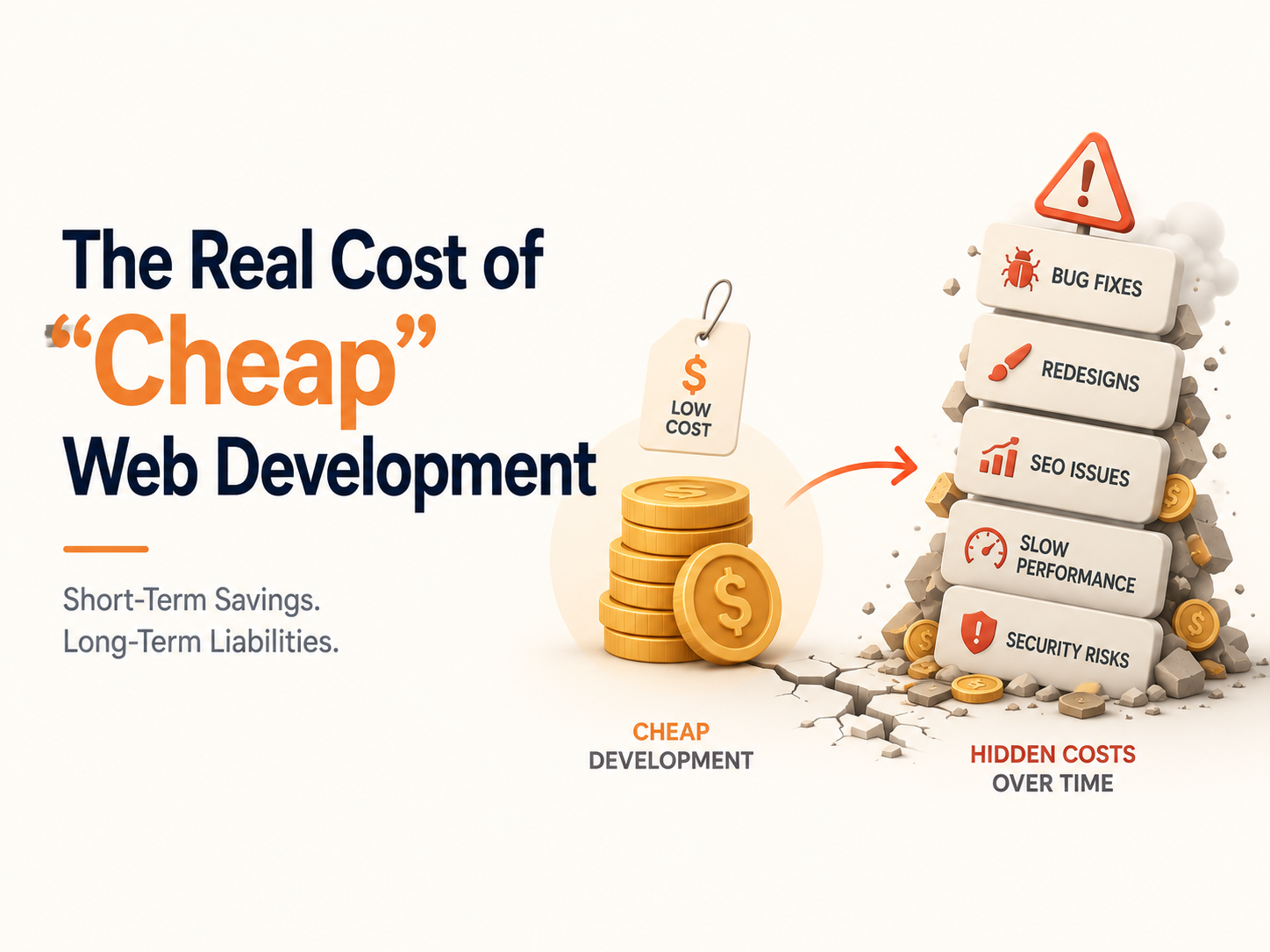
The Real Cost of “Cheap” Web Development: Why Initial Savings Are Long-Term Liabilities
Cheap Development Feels Affordable — Until It Starts Breaking Your Business Picture this: a B2B SaaS startup, 18 months old, has just landed a meeting with a Series A investor. The product works — mostly. The team has 3,000 users, decent churn numbers, and a credible deck. Then comes the technical due diligence audit. The …
Cheap Development Feels Affordable — Until It Starts Breaking Your Business
Picture this: a B2B SaaS startup, 18 months old, has just landed a meeting with a Series A investor. The product works — mostly. The team has 3,000 users, decent churn numbers, and a credible deck. Then comes the technical due diligence audit.
The investor’s engineering team spends 72 hours reviewing the codebase. What they find ends the conversation before it begins: hardcoded credentials in production, zero automated test coverage, a monolithic architecture that would require a full rebuild to handle 10× current load, and no documentation for any of the core modules. The round falls through. Not because the business model was wrong — but because the engineering foundation was a liability, not an asset.
This story repeats across thousands of startups every year. The founder saw a $12,000 development quote and celebrated. They did not see the $200,000+ in future refactoring, the lost Series A, or the six months of engineering paralysis it would take to make the platform investable.
KEY TAKEAWAY: Low initial invoices are not budget wins — they are masked liabilities dressed up as savings. The check you write today is only the down payment. Technical debt accrues interest on every line of code that was written fast instead of right.
What This Blog Covers :
A decision-maker’s guide to understanding the true cost of web development—before it costs more to fix it than it did to build it.
The 3–5 Year Horizon: Why “cheap” development is actually a high-interest loan that almost always costs more in the long run.
The 80% Rule: Identifying the hidden costs that make up the vast majority of your software’s total lifetime spend.
Breaking the Debt Cycle: How technical debt compounds like interest—and the strategic steps required to stop it from stalling your growth.
The High-Quality MVP: Defining the non-negotiable standards that separate a scalable foundation from a “disposable” prototype.
The Overhaul Audit: A practical checklist to identify if your current codebase is an asset or a liability that needs a professional intervention.
Efficiency Without Compromise: Actionable guidance on how to build correctly from Day 1 without overspending.
The Biggest Misunderstanding About Development Cost
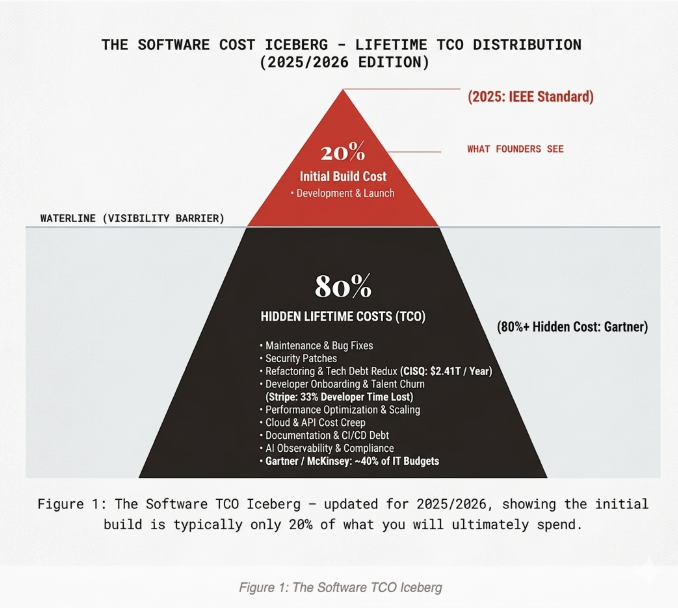
Price is the number on the invoice you receive today — finite, visible, and easy to compare across vendors. Total Cost of Ownership (TCO) is the total capital your business will spend to keep that software functional, secure, and competitive over a 3–5 year horizon: maintenance, bug fixes, security patches, refactoring, onboarding new developers, and the compounding interest of every shortcut taken during the initial build.
40% of IT budgets are consumed by maintaining technical debt rather than building new features, Gartner / McKinsey, 2025
$2.41T Annual cost of poor software quality to US companies alone, CISQ Report
33%of developer time wasted on technical debt instead of shipping features, Stripe Developer Survey
Think of software investment as an iceberg. The build itself — what’s visible above the waterline — represents only about 20% of a software product’s total lifetime cost. The remaining 80% sits submerged: maintenance, security patches, performance tuning, onboarding, and the compounding cost of refactoring poor early decisions.
KEY TAKEAWAY: The vendor who quotes $15,000 with clean architecture will almost always cost less over 3 years than the vendor who quotes $6,000 with none. Evaluate TCO, not the invoice.
Why Low-Cost Development Feels Like the Right Decision Early On
The instinct to minimise early engineering spend is not irrational — it is a natural product of the Scarcity Mindset that pervades early-stage startup culture. Runway is finite. Every dollar not spent on development is a dollar that buys another month to find product-market fit. The logic is emotionally compelling, even if financially destructive.
Founders frequently mistake “fast” for “reckless.” Speed-to-market is a legitimate advantage — but only if the thing you ship to market does not need to be entirely rebuilt before you reach your next funding milestone. A truly fast MVP is one built on a foundation that can evolve. A reckless MVP is one that works today and collapses tomorrow.
Short-Term Gain vs. Long-Term Pain
Decision
Short-Term Gain
Long-Term Pain
Skip automated tests
2–4 weeks faster to launch
Every new feature risks breaking existing ones; QA costs spiral
No code review
Lower hourly billing
Inconsistent quality creates a permanently fragile codebase
Monolithic architecture
Simpler to build initially
Full rebuild required at growth stage
Skip documentation
Save 10–15% on dev hours
Every new developer onboarding costs weeks; bus-factor = 1
Cheapest freelancer
Lower initial invoice
High refactoring costs, security vulnerabilities, ownership risk
No CI/CD pipeline
Faster first deployment
Manual deployments slow every subsequent release by 300–500%
KEY TAKEAWAY: The scarcity mindset optimises for today’s invoice at the expense of tomorrow’s agility. True speed-to-market means being fast today and fast next quarter, not just fast once.
Poor Code That Becomes Hard to Maintain
In software engineering, “spaghetti code” describes a codebase so entangled and undocumented that even a small change — like updating a button label — can trigger cascading failures across unrelated features. What should take two hours takes two weeks, because no one can safely predict what else might break.
The business impact is measurable: nearly 70% of developers cite technical debt as a significant drag on their productivity, and McKinsey research suggests it can account for up to 40% of the value of an entire software estate — effectively acting as a tax on every new feature you try to ship.
KEY TAKEAWAY: Spaghetti code doesn’t just slow your team down — it demoralises them and accelerates attrition. Skilled engineers refuse to work in chaos. The true cost isn’t the bug-fix hours; it’s the talent you lose.
Technical Debt That Keeps Growing
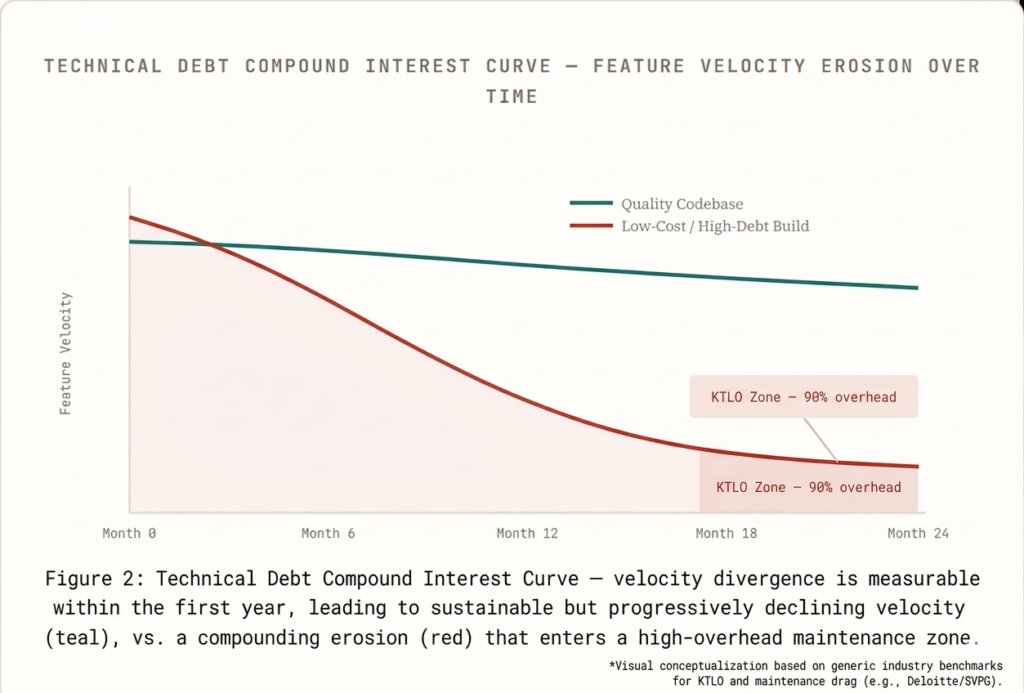
Not all technical debt is catastrophic. Like financial debt, it can be a legitimate strategic tool — borrowing against future refactoring time to accelerate a critical product launch. The problem is unmanaged debt, which compounds until an engineering team is spending the majority of its time firefighting bugs and preventing outages rather than building the features that grow the business.
“Technical debt is like dark matter: you know it exists, you can infer its impact, but you can’t see or measure it. Product delays, hidden risks, spiraling costs, and engineers leaving in frustration are all common symptoms.”— McKinsey Digital
McKinsey reports that actively managing technical debt freed up engineers to spend up to 50% more time on business-growth work. One CIO described moving from 75% of engineering time consumed by the technical debt “tax” to just 25% — a transformation that unlocked the ability to compete.
25–50%slower feature delivery for companies with high technical debt vs. peers, McKinsey Digital, 2024
50%more time on innovation when technical debt is actively managedMcKinsey
35%faster feature releases for companies with formal debt management, Gartner, 2024
KEY TAKEAWAY: Unmanaged technical debt does not stay flat — it compounds. A team that starts at 40% debt overhead will be at 70% within 18 months if nothing changes. By that point, shipping any new feature is a minor miracle.
Performance Limits That Block Growth
Low-cost development almost always produces architectures that work under the small load they were tested against — but not under real-world traffic. Then one day, a product review goes viral, a B2B prospect stress-tests your demo, or a newsletter sends 50,000 people to your landing page simultaneously. The platform collapses — not because of bad luck, but because it was never designed to handle that volume.
This is not a technical inconvenience. A single high-visibility outage can destroy the trust of enterprise buyers who were close to signing, trigger churn among early adopters, and permanently damage your brand’s reputation in niche communities where word travels fast.
Architecture built without scale in mind cannot be fixed with a weekend patch. Addressing it after the fact requires a multi-month migration while your product is already live and serving customers.
KEY TAKEAWAY: Your biggest marketing win could be your biggest engineering disaster. If your platform cannot survive its own success, cheap development has cost you the precise moment you needed most.
Security and Reliability Risks You Cannot Ignore
Security is systematically the first “feature” eliminated in low-cost builds. The reasoning is always the same: “We’ll add it later when we’re bigger.” But security is not a feature you add to a product — it is a property of the architecture. You cannot bolt good security onto a foundation that was designed without it any more than you can retrofit a seatbelt into a vehicle that has no mounting points.
IBM’s 2025 Cost of a Data Breach Report — the industry’s most comprehensive annual security benchmark — found:
• $4.44 million: the global average cost of a data breach, with US companies facing a record $10.22 million average — a new all-time high.
• 49% of organisations only invested in cybersecurity after they were breached — the equivalent of installing seatbelts after a car crash.
• Multi-environment breaches averaged $5.05 million per incident.
• Human error accounted for 26% of all breaches — a direct consequence of systems with no internal security controls.
For a startup or SME, a single data breach is not merely expensive — it can be existential. The combination of regulatory fines, customer compensation, legal fees, reputational damage, and remediation costs routinely exceeds the total annual revenue of an early-stage company.
KEY TAKEAWAY: Security is not an optional upgrade tier. It is the cost of operating responsibly with other people’s data. Any developer who prices security out of an MVP budget is not saving you money — they are transferring your risk onto your customers.
No Process, No Documentation, No Continuity
There is a quiet, underestimated form of technical debt that receives far less attention than code quality or performance: documentation debt. When your codebase has no documentation — no architecture decision records, no inline comments, no API references, no runbooks — you have not just written code. You have created a hostage situation.
If the developer who built your platform is the only person who understands how the “black box” operates, then that developer effectively owns your business. They are the single point of failure for every engineering decision, every production incident, and every feature estimate. When they leave — and freelancers and low-cost contractors leave — they take with them the institutional knowledge that your entire product depends on.
Code without documentation is legacy code the day it is written. It is not a technical debt you will pay later — it is a tax you are already paying, silently, on every hour your team spends trying to understand what already exists.
KEY TAKEAWAY: A codebase with no documentation is not an asset — it is a liability with a single point of failure. The moment your key developer leaves, your product’s operational continuity leaves with them.
Constant Rework That Slows Everything Down
The financial case against cheap development is straightforward: a cheap build costs $10,000 and fails within 18 months, requiring a full rebuild at another $10,000 — $20,000 total. A quality build would have cost $15,000 and not required a rebuild. You’ve paid 33% more for an inferior outcome, and lost 18 months of competitive time.
But this understates the real cost. Rebuilds happen under duress — your team is distracted, your customers are frustrated, your investors are watching. Decisions made under that pressure are frequently more expensive than the original build, not less. Companies that actively manage technical debt see 20–40% higher productivity and significantly faster time-to-market; those operating in reactive rebuild mode consistently struggle with burnout and lower reliability.
KEY TAKEAWAY: Paying $10,000 twice, 18 months apart, is not the same as paying $20,000 once. The second payment comes with months of lost momentum, damaged trust, and a team in crisis mode. The real cost multiplier is far higher than 2×.
How Weak Foundations Become Critical as You Scale
Scaling is not “adding more servers.” Scaling is a property of the code itself — its ability to handle increasing volumes of concurrent requests, maintain data integrity under simultaneous writes, and route traffic intelligently across distributed infrastructure. These properties must be designed in from the beginning. They cannot, in any meaningful sense, be retrofitted.
A classic cheap-development antipattern: a single-server deployment that handles 500 concurrent users adequately becomes a liability the moment you exceed 2,000. A database schema designed for simple CRUD operations becomes a performance bottleneck when 10,000 records need to be joined and filtered in real-time. Authentication logic that works with 100 users becomes a security gap when session management is not designed to handle token invalidation at scale.
Gartner predicts that by 2026, the compounding nature of technical debt—exacerbated by rapid, unmanaged AI-generated code—will consume up to 80% of software engineering budgets, leaving only 20% for actual innovation.
KEY TAKEAWAY: Scalability is not a post-launch optimisation — it is an architectural prerequisite. A system that requires a full rebuild to scale is not a startup’s product; it is a prototype masquerading as one.
Where Cheap Development Actually Costs You Money
Every hour your engineering team spends firefighting a legacy bug is an hour not spent building the feature your competitor shipped last week. This is the Opportunity Cost of technical debt — and it is the dimension most founders find hardest to see on a spreadsheet, because it appears as absence rather than expenditure.
Consider the compounding effect: a team spending 60% of its time on KTLO tasks is only producing 40% of its theoretical competitive output. Over 12 months, while a well-architected competitor’s team ships 30 features, your debt-laden team ships 12. That gap does not just represent slower development — it represents 18 features your competitor owns in the market that you do not.
Accenture’s research demonstrates that ‘high-resilience’ companies—which maintain a strong digital core by actively managing technical debt—achieve revenue growth rates 6 percentage points higher than their peers. By allocating roughly 15% of IT budgets to debt remediation, these leaders achieve 32% faster time-to-market, allowing them to pivot to new opportunities more effectively than low-resilience competitors.
KEY TAKEAWAY: Technical debt is not just a cost on your balance sheet — it is a tax on your competitive velocity. Every hour lost to bug-fixing is a market position you are ceding to a competitor who built their foundation right the first time.
What Good Development Actually Looks Like
Quality development is not expensive development. It is principled development — a set of non-negotiable practices that protect the long-term value of every dollar invested in the build.
Clean, Modular Architecture
Systems designed with clear separation of concerns — where individual components can be updated, replaced, or scaled independently — dramatically reduce the blast radius of any single failure. Fixing a payment service does not require touching the notification service.
Automated Testing and CI/CD Pipelines
A CI/CD (Continuous Integration/Continuous Deployment) pipeline ensures that new code cannot break existing features without detection and reduces the time from “feature complete” to “live in production” from days to hours.
Comprehensive Documentation and Code Reviews
Inline documentation, architecture decision records (ADRs), API references, and runbooks are the difference between a codebase that one person understands and a codebase that an entire team can own.
Security by Design
Authentication, authorisation, input validation, secrets management, and dependency auditing are not features — they are responsibilities. They must be embedded in the development process from day one.
KEY TAKEAWAY: Quality engineering is not defined by the hourly rate of the developer — it is defined by the presence of processes that protect code quality over time. A disciplined $80/hr developer will always outperform a careless $200/hr developer on a 3-year TCO basis.
How to Build Right Without Overpaying
The answer to the false economy of cheap development is not to spend recklessly. It is to practise Value Engineering: the discipline of being lean on features but heavy on code quality, architecture, and process. The goal is a Robust MVP — minimal in scope, uncompromising in foundation.
• Define a clear architectural boundary; even a simple system benefits from separation between data access, business logic, and presentation layers.
• Insist on a test coverage minimum — even 70–80% automated test coverage on core business logic dramatically reduces regression risk in an AI-accelerated development environment.
• Use managed infrastructure — cloud-native, managed services eliminate entire categories of infrastructure debt.
• Write the README before the code — forcing documentation of intent before implementation improves both the quality of the code and the documentation.
• Set up CI/CD from day one — a basic CI pipeline takes one day to configure and returns its investment within the first two weeks of development.
• Define your data model carefully — spend extra time upfront to model your data with the next 12 months of product development in mind.
KEY TAKEAWAY: Value Engineering is not about spending more — it is about spending differently. A Robust MVP allocates budget to engineering practices that compound positively, rather than features that collapse under scale.
When Investing in Quality Development Becomes Non-Negotiable
THE PIVOT POINT: There is a precise moment when the cost of continuing with a low-quality codebase exceeds the cost of a full professional overhaul. That moment is when the cost of fixing a bug exceeds the cost of building a new feature. When your team spends more time maintaining what exists than creating what could exist, you have passed the Pivot Point. Every day you delay the investment after that moment makes the eventual remediation more expensive.
Indicators that the pivot point has been reached or is approaching:
• A senior engineer joins and immediately escalates concerns about structural integrity
• You are preparing for institutional investment and anticipate a technical due diligence review
• A competitor launches a feature your architecture cannot accommodate without a major refactor
• You have experienced two or more production outages caused by architectural limitations
• Engineering sprint velocity has declined for three or more consecutive sprints
• A new developer’s estimated ramp-up time exceeds six weeks
• A security audit returns findings that require architectural remediation, not just patching
KEY TAKEAWAY: The pivot point is not a sign of failure — it is a natural milestone in a startup’s engineering evolution. The failure is not reaching it; the failure is reaching it and choosing to delay.
Build Once, Scale Without Rebuilding
The ultimate competitive advantage of strategic engineering investment is deceptively simple: it allows you to move. Companies with clean, well-documented, modular codebases can pivot when the market shifts, launch a new feature in days rather than weeks, and pass a Series A technical audit with confidence, not dread.
Meanwhile, their competitors — the ones who saved $8,000 on the initial build — are stuck in bug-fix hell. They are paying senior engineers $150/hour to reverse-engineer undocumented code. They are declining enterprise partnerships because their platform cannot meet basic security or reliability SLAs.
Strategic engineering is not a cost centre. It is a compound interest machine — every good decision made early returns value across every subsequent decision. The startup that builds on a quality foundation spends its engineering budget on growth. The startup that builds cheaply spends its engineering budget on survival.
The best time to invest in engineering quality was at the beginning of your project. The second best time is today — before the pivot point becomes a crisis point.
KEY TAKEAWAY: The goal is not to build the cheapest product — it is to build the last product you’ll ever need to rebuild. Strategic engineering is the only development strategy that creates sustainable competitive advantage.
Frequently Asked Questions
No. Price does not equal quality — process equals quality.
A high-cost developer without structure can produce worse outcomes than a lower-cost developer in a strong engineering environment.
Evaluate based on:
Code Review Process
Testing Discipline
Documentation Standards
CI/CD Setup
These are the real indicators of long-term quality—not hourly rate.
Use practical validation instead of surface-level evaluation:
Request a code sample or run a paid technical test
Review Git history for commit quality and consistency
Ask about a real production incident they handled
Confirm use of automated testing
Request a README or architecture diagram
Strong developers answer clearly; low-quality ones tend to avoid specifics.
In theory, yes. In practice, rarely.
Refactoring later requires time, budget, and stability—conditions most startups don’t have simultaneously.
If starting lean, protect these critical layers:
Data Model
Authentication System
CI/CD Pipeline
These are the hardest and most expensive to fix later.
A defensible MVP should include:
Version-controlled codebase with clear branching
70%+ test coverage on core logic
Basic CI/CD pipeline
Documented data model
Separated environment configurations
No hardcoded secrets or credentials
A README enabling setup within 30 minutes
A practical Total Cost of Ownership (TCO) includes: