Why Businesses Struggle to Make Confident Decisions Without Data Visibility
Most businesses today don’t fail because they lack data — they fail because they lack clear, trustworthy visibility into what the data actually means. Leaders operate in environments filled with fragmented dashboards, conflicting metrics, delayed insights, and opinion-driven decisions. Instead of enabling faster action, data often creates uncertainty, slows execution, and increases the risk of costly mistakes. The real challenge isn’t collecting more information — it’s turning data into decision-ready intelligence at the exact moment it’s needed.
This lack of data clarity carries measurable financial impact. Gartner estimates that poor data quality costs organizations an average of $15 million per year, driven by flawed decisions, wasted effort, and missed growth opportunities. When teams don’t share a single source of truth, alignment breaks, trust erodes, and competitive advantage weakens. The solution isn’t more reports or dashboards — it’s data-driven apps: systems that transform real-time business data into actionable recommendations, faster decisions, and confident execution. This guide explores why decision confidence breaks at scale — and how modern data-driven systems restore clarity, speed, and strategic control.
From Data Overload to Decision Clarity: The Real Problem with Reports
Most companies already have a lot of data.
The problem isn’t collection — it’s interpretation and alignment.
Common symptoms:
- Too many dashboards, not enough answers
- Metrics without context or ownership
- Weekly reports no one acts on
- Analytics that explain the past but don’t guide the next move
Fragmented data creates fragmented leadership. Teams prioritize different metrics, departments optimize for conflicting goals, and reactions to emerging problems are delayed because no single view shows the full picture. As the business scales, this fragmentation slows decision cycles and magnifies risk.
Reports often describe what happened, but founders need clarity on:
- Why it happened
- What will likely happen next?
- What action should be taken now?
Data becomes valuable only when it reduces uncertainty and accelerates decisions — not when it simply increases information volume.
What “Data-Driven Decision Making” Actually Means in Business Contexts
The phrase data-driven decision making is often misunderstood as “trust numbers more than people.” In reality, it means:
- Using data to inform judgment, not replace it
- Reducing bias and guesswork, not eliminating human insight
- Replacing opinions with evidence when stakes are high
- Making decisions faster with greater confidence
- Treating data as decision support, not automation
It doesn’t eliminate intuition — it strengthens it. Data matters only when it changes what leaders do next. Collecting more metrics without altering decisions is not data-driven; it is data accumulation.
Founder Insight:
The goal isn’t to replace leadership instinct. It’s to support it with evidence that reduces risk, clarifies priorities, and enables timely action.
What Are Data-Driven Apps and How They Support Better Business Decisions
At their best, data-driven apps are not software features or analytics layers—they are decision infrastructure that shapes how organizations think, align, and act.
They help businesses move from reactive reporting to confident, timely decision-making by:
- Integrating data from multiple sources to create a shared, reliable view of reality
- Processing information in real time or near real time, reducing lag between insight and action
- Reducing ambiguity by translating complex data into clear, contextual signals
- Aligning teams around shared facts, minimizing opinion-driven conflict and guesswork
- Enabling faster responses through recommendations, alerts, or automated actions
Instead of asking, “What does the data say?” Leaders and founders can ask, “What should we do next?”
This shift transforms analytics from passive reporting into active decision support, where data doesn’t just inform strategy—it drives execution.
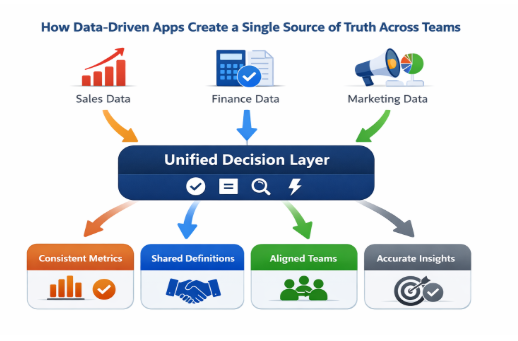
How Data-Driven Apps Create a Single Source of Truth Across Teams
One of the biggest operational risks in scaling companies is misaligned data.
Sales tracks revenue one way.
Finance calculates it another way.
Marketing reports pipeline with a different definition.
A unified data system creates:
- Consistent metrics across teams
- Shared definitions of success
- Faster cross-functional alignment
- Fewer internal debates about accuracy
Turning Business Data into Actionable Insights, Not Just Dashboards
Dashboards alone don’t create action. Visibility becomes valuable only when it changes decisions and surfaces risks early — not when it simply reports history.
Actionable insights require:
- Clear framing around business questions so leaders know which decision the data supports
- Centralized and consistent data views that reduce internal debates and conflicting numbers
- Highlighting trends, anomalies, and early warning signals that reveal emerging risks before they escalate
- Prioritization of what matters most so teams focus on high-impact actions instead of metric overload
- Contextual recommendations, not raw numbers that indicate the next logical step
Each of these capabilities directly influences outcomes:
- Centralization → makes cross-team decisions faster and prevents misalignment
- Trend and anomaly detection → enables earlier intervention in revenue, churn, or cost issues
- Early signals and alerts → help leadership act before small problems become expensive setbacks
Bad insight: “Revenue dropped 8% last month.”
Actionable insight: “Revenue dropped 8% primarily due to churn among mid-tier customers. Targeted retention campaigns for this segment could recover an estimated 5–7% within 60 days.”
The difference is direction and timing. One reports the past; the other clarifies what to do next and how quickly to respond. True data visibility is not about producing more dashboards — it is about enabling earlier, clearer, and more confident decisions.
Core Business Decisions Improved by Data-Driven Apps
High-impact data-driven apps strengthen core business decisions that directly influence revenue, cost efficiency, customer trust, and leadership confidence. Their value compounds over time—not through one-time wins, but through consistently better judgment.
Growth & Marketing
Better decisions here drive sustainable revenue growth and smarter budget allocation:
- Channel ROI optimization → Invest more in high-performing channels, reduce wasted spend
- Campaign performance forecasting → Shift budgets early to maximize returns
- Customer acquisition cost (CAC) control → Scale growth without eroding profitability
Sales & Revenue
Improved decisions accelerate predictable revenue and stronger sales execution:
- Pipeline health prediction → Identify revenue risks before they impact targets
- Lead scoring and prioritization → Focus sales effort on the highest-converting prospects
- Pricing and discount optimization → Protect margins while staying competitive
Product & Customer Experience
Smarter product decisions build customer trust, retention, and long-term value:
- Feature prioritization based on usage data → Build what customers actually need
- Churn risk prediction → Act early to retain high-value users
- Customer lifetime value (CLV) forecasting → Allocate resources toward the most valuable segments
Operations & Finance
Data-driven operational decisions improve cost control, cash flow stability, and organizational resilience:
- Demand planning → Reduce stockouts, overproduction, and revenue loss
- Cash flow forecasting → Support confident financial planning and investment decisions
- Cost leakage detection → Identify inefficiencies before they compound into major losses
Over time, these decision improvements create a compounding advantage—stronger margins, clearer priorities, faster execution, and more confident leadership.
Essential Features of High-Impact Data-Driven Business Apps
High-performing data-driven apps are effective because they enable better decisions, reduce uncertainty, and enforce accountability—not because they offer more dashboards.
1. Decision-First Design
Supports: Strategic prioritization
Eliminates: Data overload and unclear next steps
These systems start with “What decision needs to be made?” rather than “What data do we have?”
2. Real-Time or Near-Real-Time Signals
Supports: Faster execution and risk mitigation
Eliminates: Delays that lead to missed revenue or late reactions
Timely insight shortens the gap between awareness and action.
3. Business-Context Metrics
Supports: Goal-aligned decision-making
Eliminates: Vanity metrics and misaligned incentives
Every metric ties directly to revenue, cost, retention, or growth priorities.
4. Explainable Insights
Supports: Leadership confidence and accountability
Eliminates: Blind trust in black-box recommendations
Decision-makers understand why an insight exists before acting on it.
5. Role-Based Decision Views
Supports: Clear ownership and faster alignment
Eliminates: Cross-team confusion and miscommunication
Each team sees only what they need to decide well—nothing more, nothing less.
6. Secure, Permissioned Access
Supports: Responsible data use and governance
Eliminates: Risk of misuse while maintaining decision agility
Sensitive data stays protected while remaining accessible to the right decision-makers.
Common Data and Analytics Mistakes That Undermine Decision-Making
Even data-rich companies fail when strategy and ownership are unclear. The issue is rarely the absence of data — it is the absence of focus, accountability, and trust.
A typical failure pattern looks like this: growth increases → data tools multiply → ownership becomes unclear → decisions slow or conflict.
Over time, teams stop trusting numbers, leadership reverts to intuition, and analytics becomes noise instead of guidance.
Mistake 1: Measuring Everything Instead of What Matters
What breaks: Teams chase vanity metrics and lose sight of core business drivers.
Impact on trust: Conflicting KPIs create confusion about which numbers are “right.”
Decision impact: Leaders hesitate or optimize for the wrong outcomes.
More metrics ≠ better decisions; relevance and prioritization matter more than volume.
Mistake 2: Treating Analytics as a Reporting Function
What breaks: Data becomes backward-looking documentation instead of forward-looking guidance.
Impact on trust: Teams view analytics as administrative rather than strategic.
Decision impact: Insights arrive too late to influence direction.
Analytics should shape strategy, not just summarize performance.
Mistake 3: Ignoring Data Quality and Governance
What breaks: Inconsistent definitions, duplicate records, and unreliable sources.
Impact on trust: Stakeholders question every dashboard and eventually disengage.
Decision impact: Leaders delay or avoid data-backed actions due to credibility concerns.
Inaccurate data doesn’t just mislead — it erodes adoption entirely.
Mistake 4: Overengineering Too Early
What breaks: Complex pipelines and tools outpace actual business needs.
Impact on trust: Systems feel opaque and difficult to validate.
Decision impact: Delivery slows, and insights become harder — not easier — to access.
Sophistication without alignment creates friction, not advantage.
Mistake 5: No Ownership for Insights
What breaks: Insights exist, but no one is responsible for acting on them.
Impact on trust: Data is seen as informative but inconsequential.
Decision impact: Nothing changes, even when clear opportunities are identified.
Accountability turns insights into outcomes.
How to Build Data-Driven Apps That Align with Real Business Questions
Effective data-driven systems prioritize discipline over sophistication. The goal is not to build the most advanced analytics stack — it is to improve a small number of high-impact decisions and iterate from there.
Start with the decisions that materially affect revenue, cost, customer retention, or operational efficiency. Alignment with real business questions prevents wasted engineering effort and unused dashboards.
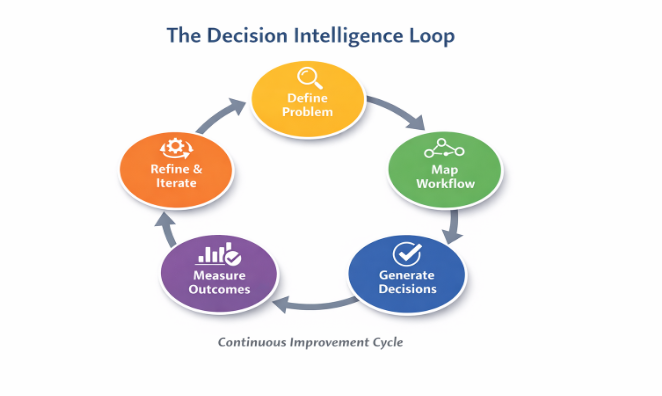
The Decision Intelligence Loop
Problem → Workflow → Decision → Outcome → Measurement
- Define the decision to improve. Focus on one or two high-impact decisions first.
- Map the workflow influencing that decision. Identify where delays, assumptions, or blind spots occur.
- Identify required data inputs. Prioritize essential signals over exhaustive data collection.
- Build logic that generates recommendations. Aim for clarity and usability, not algorithmic perfection.
- Measure outcomes and refine. Iterate continuously; improvement compounds over time.
Real-World Use Cases: Data-Driven Apps in Action Across Functions
Each example below highlights a real business uncertainty, the insight gained, the decision made, and the measurable outcome—showing how data-driven apps turn information into action.
Case 1: Reducing Customer Churn (SaaS)
- Uncertainty: Which customers are most likely to cancel—and why?
- Insight: Behavioral data revealed early churn signals based on usage drop-offs
- Decision: Prioritized proactive outreach to high-risk accounts
- Result: Improved retention through timely, targeted interventions
Case 2: Improving Marketing Spend Efficiency (Startup)
- Uncertainty: Which ad channels actually drive high-quality leads?
- Insight: Analysis showed 40% of ad spend generated low-intent prospects
- Decision: Reallocated budget to high-conversion channels
- Result: Higher ROI and lower customer acquisition cost
Case 3: Inventory Forecasting for Retail
- Uncertainty: How to balance stock availability without over-investing in inventory?
- Insight: Demand prediction models identified patterns driving overstock and stockouts
- Decision: Adjusted purchasing and replenishment cycles
- Result: Reduced working capital tied up in inventory and fewer lost sales
Case 4: Sales Pipeline Optimization
- Uncertainty: Where should sales teams focus limited time for maximum impact?
- Insight: Lead scoring surfaced high-intent prospects earlier in the funnel
- Decision: Prioritized outreach based on intent and conversion likelihood
- Result: Higher close rates with fewer wasted sales hours
These cases demonstrate how data-driven apps improve decision quality—reducing guesswork, accelerating action, and creating compounding business advantage over time.
When to Involve a Technology Partner for Data-Driven App Development
Not every organization needs a large in-house data team early on. A technology partner is most valuable when they accelerate execution, reduce risk, and strengthen decision quality—while leadership retains ownership of strategy and outcomes.
A partner becomes useful when:
- Internal bandwidth is limited → They speed up delivery without slowing momentum
- Business logic requires custom modeling → They translate strategy into scalable decision systems
- Security, governance, or compliance must mature → They reduce operational and regulatory risk
- Systems must scale beyond spreadsheets and off-the-shelf dashboards → They future-proof decision infrastructure
The goal is not to outsource thinking, but to leverage external expertise to make faster, more reliable, and higher-confidence business decisions—while leadership remains accountable for direction and results.
How Splitbit Delivers Business-First Data-Driven App Solutions
Splitbit’s approach is decision-first, not tool-first. The focus is on improving how leaders decide, not on expanding technology stacks. This keeps solutions aligned with real business needs rather than technical complexity.
Our operating principles emphasize:
- Starting with real business questions before discussing data or features
- Mapping workflows and decision paths before building pipelines or dashboards
- Designing applications that surface actionable insights — not noise
- Building explainable, secure, and scalable systems that leaders can trust
- Keeping solutions simple first, then scaling complexity only when justified
Instead of delivering generic analytics layers, the emphasis is on purpose-driven decision systems that evolve with growth-stage teams. The goal is clarity and execution speed, not feature volume.
How to Measure the ROI and Success of Data-Driven Decision Systems
The true value of analytics is measured by behavioral and business outcomes, not by the number of dashboards created. A system is successful only when it changes how decisions are made and how quickly teams can act.
Key Measurement Categories
| Category | What to Measure | Why It Matters |
|---|
| Decision Speed | Time from insight to action | Indicates whether analytics reduces hesitation and debate |
| Financial Impact | Revenue lift, cost reduction, margin improvement | Connects analytics directly to business performance |
| Operational Efficiency | Reduction in manual analysis hours | Shows productivity and focus gains |
| Accuracy & Reliability | Forecast precision, error reduction | Builds long-term trust in data systems |
| Adoption & Usage | Frequency of insight-driven decisions | Reveals whether analytics influences real workflows |
However, adoption without impact is failure. High usage metrics mean little if decisions remain slow, priorities stay unclear, or outcomes do not improve. Success is visible when:
- Decisions happen faster with fewer internal debates
- Team priorities align more quickly
- Leadership confidence increases
- Execution cycles shorten
Founder Insight: If insights don’t change behavior, they aren’t valuable — no matter how sophisticated they look.
Closing Perspective
Great companies don’t win by collecting more data—they win by making clearer, faster, and more confident decisions.
Data alone creates no advantage. Decision speed, clarity, and consistency are what separate market leaders from followers. The strongest organizations build decision systems that:
- Clarify priorities so teams focus on what truly matters
- Reduce guesswork by replacing opinion with evidence
- Align teams around shared truth, minimizing friction and rework
- Turn insight into action, not just reports
Over time, better decisions compound—improving margins, strengthening customer trust, accelerating growth, and increasing leadership confidence.
For founders and business leaders, the real opportunity isn’t analytics. It’s building a decision-driven organization where every critical move is guided by evidence, context, and conviction—and where leadership sets the standard for disciplined, high-quality decision-making.
At Splitbit Innovative Solutions, this philosophy shapes how we build digital systems: simplifying complexity, enabling faster execution, and helping organizations move from fragmented data to structured, actionable outcomes. The goal isn’t more dashboards—it’s creating operational clarity that supports real-world decisions, at scale.