Most companies think digital transformation is a tech upgrade. That’s why many get it wrong. They treat it as new software, new tools, and new dashboards—while leaving broken processes, slow decision-making, and outdated operating models untouched. Real transformation is not about what technology you buy. It’s about how your business actually works.
The pressure is building. Customers increasingly expect fast, personalized, and seamless experiences as a baseline, not a bonus. Meanwhile, competitors are becoming leaner, quicker to act, and more data-driven in how they operate. As companies grow, inefficiencies that once seemed manageable often begin to cut into margins, slow execution, and weaken customer trust.
This article cuts through the noise to explain what digital transformation actually means in practice—and why operational breakdowns often surface during growth, when systems, workflows, and decision structures can’t keep up. The focus isn’t on hype or tools, but on redesigning how a business operates to sustain speed, resilience, and long-term growth.
Why Outdated Systems Are Slowing Business Growth Today
Most businesses don’t fail because of bad ideas.
They struggle because their internal systems can’t keep up with external reality.
Outdated systems show up quietly:
- Manual approvals that slow decisions.
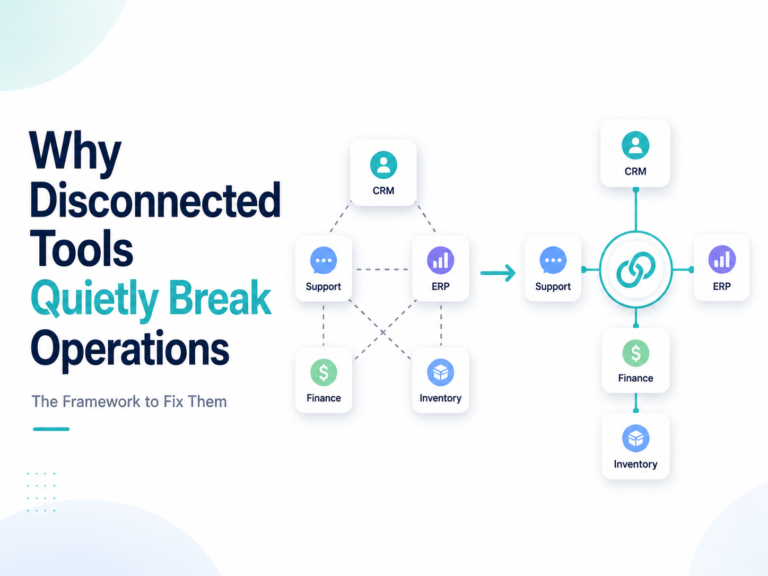
- Data scattered across tools with no single source of truth
- Customer issues that repeat because teams lack context
- Growth that adds headcount instead of efficiency
These aren’t “IT problems.”
They are growth bottlenecks disguised as operations—reducing execution speed, inflating operational costs, and increasing decision risk.
The longer these systems remain untouched, the more expensive and disruptive the eventual correction becomes.
Founder Insight: If scaling your business feels like adding people instead of increasing output, the problem is usually structural—not market-driven.
So what does digital transformation actually mean in business terms?
At its core, digital transformation is not a workflow upgrade — it is a fundamental shift in a company’s operating model and decision model. It changes how decisions are made, how work flows across teams, how value is delivered to customers, and how the organization learns and adapts at scale.
A strong real-world example is Microsoft’s transformation under Satya Nadella. The company’s turnaround was not driven by simply adding more technology — it was shaped by restructuring collaboration across teams, redefining decision-making processes, and shifting toward a cloud-first, data-informed execution model. These operating and cultural changes helped Microsoft accelerate innovation, expand Azure, and materially increase long-term business value, as documented in Harvard Business Review, Microsoft investor reports, and major business publications.
In practical business terms, digital transformation means intentionally redesigning how a company runs in order to:
- Improve decision speed and quality using real-time data and analytics
- Reduce operational friction by eliminating manual handoffs and process inefficiencies
- Deliver more consistent and personalized customer experiences
- Enable scalable growth without proportional increases in cost or headcount
What it does not mean:
- Buying more tools without changing how work gets done
- Migrating to the cloud without rethinking accountability, processes, and decision rights
- Automating broken workflows
- Treating transformation as an IT project instead of a business strategy
In simple business terms, digital transformation is about running the same organization with fewer bottlenecks, stronger visibility, faster feedback loops, and more disciplined decision-making — so the company can operate leaner, move faster, and scale with control.
Markets now reward speed, clarity, and adaptability.
Businesses that delay digital business transformation often face:
- Slower time-to-market
- Higher customer churn
- Poor visibility into performance
- Increased operational risk
Meanwhile, digitally mature companies:
- Adjust pricing faster
- Respond to customer behavior in real time
- Launch new offerings with lower marginal cost
Digital transformation is no longer about survival alone; it is about remaining relevant while competitors evolve quietly and compound structural advantages. Delaying modernization increases switching costs, widens efficiency gaps, and makes recovery progressively harder with each growth cycle.
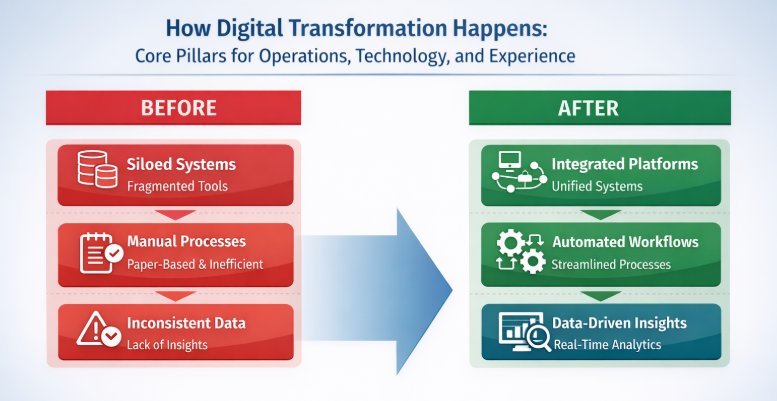
Digital transformation succeeds when three pillars move together. Neglecting one breaks the system.
Pillar 1: Operations (How Work Gets Done)
This is the foundation.
Key questions:
- Where are handoffs slowing decisions?
- Which tasks depend on individuals instead of systems?
- What work is repeated because data isn’t shared?
Transformation here focuses on simplification before automation.
Pillar 2: Technology (How Systems Support Decisions)
Technology transformation for business is not about complexity. It’s about fit-for-purpose systems.
Good technology:
- Makes data accessible, not buried
- Integrates naturally with workflows
- Supports growth without constant patching
Bad technology creates dependency, silos, and vendor lock-in.
Pillar 3: Experience (How Customers and Teams Interact)
Experience isn’t just UX design. It includes:
- How fast customers get answers
- How easily teams collaborate
- How predictable service delivery feels
Experience improves when systems remove friction instead of adding steps.
Most businesses wait too long because the signs look “normal.”
Watch for these signals:
- Decisions rely on gut more than data
- Teams maintain their own spreadsheets
- Customers repeat the same issues
- Reporting takes days, not minutes
- Scaling increases errors, not output
These aren’t growing pains.
They’re structural limitations—and the longer they persist, the more they erode speed, raise operating costs, and reduce leadership visibility into risk and performance.
Not everything should be transformed at once.
Start with leverage points.
High-Impact Process Candidates
- Revenue operations
- Customer onboarding
- Order-to-delivery workflows
- Support resolution loops
Critical Data Assets
- Customer behavior data
- Revenue and cost visibility
- Product usage signals
Experience Moments That Matter
- First-time user journeys
- Failure or complaint handling
- Renewal or repeat purchase points
Founder Insight: Transform the moments where friction hurts trust or speed—not the areas that merely look outdated.
For founders, transformation only earns its keep if it moves core business metrics. If it doesn’t improve profitability, execution speed, customer retention, or scalability, it’s not a strategic investment — it’s operational drag.
Strong companies anchor transformation to measurable business impact, not vague modernization goals. McKinsey research consistently finds that fewer than one-third of transformation efforts deliver lasting performance gains, with failures most often tied to unclear ownership, weak value definition, and poor execution discipline.
Outcomes That Actually Move the Business
| Business Priority | What Digital Transformation Enables |
|---|
| Faster, higher-quality decisions | Live performance data, predictive insights, and automated reporting |
| Lower operating costs and burn | Process automation, fewer manual dependencies, and efficiency gains |
| Improved customer retention | More reliable, consistent, and personalized experiences |
| Scalable growth | Systems and workflows that reduce reliance on individual effort |
| Risk and error reduction | Stronger controls, transparency, and monitoring |
| Execution velocity | Shorter cycle times, fewer handoffs, and clearer accountability |
If digital initiatives can’t be traced back to growth, margins, cost efficiency, or execution speed, they should be challenged. Capital should fund leverage — not complexity.
Use this checklist to evaluate whether transformation is driving real business value:
- Can we point to direct financial or operational ROI from transformation spend?
- Are we making faster, better decisions than we were a year ago?
- Has automation reduced dependency on manual work or key individuals?
- Can the business scale volume without scaling chaos or headcount?
- Do we have real-time visibility into performance, risk, and operations?
- Are teams shipping faster with fewer blockers and rework loops?
- If we paused transformation efforts, would business momentum slow?
If these answers are unclear, transformation isn’t failing because of technology — it’s failing because of unclear priorities, weak ownership, or poor outcome alignment.
Many initiatives fail quietly—not dramatically.
Mistake 1: Tool-First Thinking
Buying software before fixing workflows locks inefficiency into systems.
Mistake 2: Overengineering Early
Complex architectures slow learning and adoption.
Mistake 3: Ignoring Change Management
Teams resist systems they don’t understand or trust.
Mistake 4: Measuring Activity, Not Impact
Dashboards without decisions don’t create value.
Real-world lesson: A scaling retail company added multiple tools without process redesign. Reporting slowed, data conflicted across teams, and leadership made pricing decisions on inaccurate numbers. Revenue dipped for two consecutive quarters not from market demand, but from internal misalignment.
Digital transformation works best as controlled evolution, not disruption.
Phase 1: Diagnose
- Map workflows
- Identify bottlenecks
- Clarify business goals
Phase 2: Design
- Redesign processes
- Define data ownership
- Choose minimal viable systems
Phase 3: Implement
- Roll out in small increments
- Train teams early
- Monitor adoption
Phase 4: Optimize
- Improve based on usage
- Retire redundant tools
- Embed continuous improvement
Not every business needs a partner—but many benefit from one.
Consider external help when:
- Internal teams are execution-focused, not strategic
- Transformation spans multiple departments
- Legacy systems create risk
- Founders need speed without missteps
The right partner reduces blind spots, not ownership.
Success isn’t defined by adoption alone.
Track:
- Decision cycle time
- Process completion speed
- Error or rework rates
- Customer satisfaction trends
- Revenue per employee
If metrics don’t change, transformation hasn’t happened regardless of tooling.
A strong digital transformation strategy is:
- Business-led, not IT-led
- Outcome-driven, not tool-driven
- Incremental, not disruptive
- Designed for learning, not perfection
Digital transformation is not a one-time project. It is an ongoing leadership discipline that determines how reliably a business can adapt, execute, and scale under pressure.
Founder Insight: The most successful companies don’t “complete” digital transformation — they make it part of how they think.
Final Thought
Digital transformation is not about becoming a tech company. It is about becoming a resilient, adaptable, and scalable business in a digital economy where structural efficiency increasingly determines competitive advantage.
This is not an IT initiative—it is a leadership decision. Delaying it does not preserve stability; it compounds inefficiencies, raises operating costs, and weakens decision confidence as the business grows. A business-first, phased, and outcome-driven approach reduces risk while preserving momentum.
From Splitbit‘s perspective, effective transformation starts with clarity of business goals, progresses in controlled stages, and prioritizes measurable outcomes over tool adoption or technical complexity. In practice, the companies that move early build structural advantages. Those who wait inherit structural friction that’s expensive to undo.