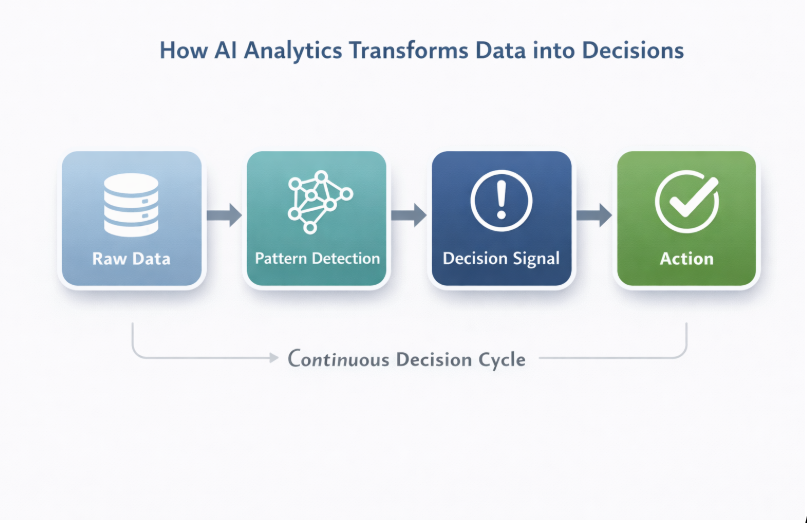
The real shift is not purely technical — it is cognitive. Decision intelligence moves organizations from manual interpretation toward guided reasoning, where data highlights what deserves attention and why.
Why More Data Hasn’t Led to Better Business Decisions
Most founders and business leaders today aren’t short on data—they’re overwhelmed by it. CRMs log every interaction. Analytics dashboards refresh in real time. Product metrics expand with every release. Yet critical business decisions still rely on gut instinct, outdated reports, or internal politics rather than timely, actionable insight.
The real cost isn’t missing data. It’s making slow or misinformed decisions despite having it. Delayed insights lead to lost revenue, wasted spend, misaligned priorities, and missed market opportunities.
This isn’t a technology problem—it’s a leadership and decision-making problem. As business complexity accelerates, the gap between knowing and acting continues to widen. AI and modern analytics aren’t about collecting more data; they exist to help leaders move faster, reduce uncertainty, and make better decisions at scale.
This growing decision gap is where modern analytics either unlock competitive advantage—or quietly fail.
The Structural Limits of Traditional Analytics in 2026
Traditional analytics was built to explain the past, not to guide real-time, high-stakes decisions. Most reporting systems are still designed to answer questions like:
- What happened last quarter?
- Which channel performed best?
- Where did costs increase?
These insights are retrospective by nature. They assume stable markets, predictable behavior, clean datasets, and sufficient time for human interpretation—assumptions that no longer hold in 2026.
Today, markets shift faster than reporting cycles. Customer behavior fragments across platforms. Competitive pressure intensifies. Decision windows shrink. Meanwhile, static dashboards and manual analysis slow teams down, forcing leaders into reactive management instead of proactive strategy.
Even advanced BI (Business Intelligence) tools begin to fail when:
- Signals are subtle but strategically meaningful
- Data is incomplete, noisy, or fast-changing
- Decisions require probabilistic thinking rather than certainty
- Scale and complexity exceed what human-led analysis can process in time
At scale, analytics doesn’t fail because of insufficient data—it fails because decision velocity can’t keep up with business reality.
What AI-Powered Analytics Actually Is (And What It Isn’t)
AI-powered analytics is not about replacing dashboards with opaque, black-box predictions. It is about supporting better decisions under uncertainty by learning from patterns, context, and outcomes over time.
At its core, AI analytics augments human judgment — it does not automate leadership or eliminate expertise. The value lies in reducing cognitive load, clarifying trade-offs, and enabling earlier, more confident action.
What It Is
- Pattern recognition across large, messy datasets that humans cannot efficiently process alone
- Probabilistic forecasting that presents likelihoods and scenarios rather than fixed projections
- Automated insight surfacing aligned with defined business goals and decision points
- Continuous learning from outcomes so recommendations improve over time
What It Isn’t
- A magic accuracy engine that guarantees perfect predictions
- A replacement for human judgment or domain expertise
- A one-time model deployment that works indefinitely without refinement
- Advanced reporting disguised as intelligence
- Faster responses: Flagging operational anomalies while they are still small and inexpensive to correct
This is where artificial intelligence analytics changes the tempo of decision-making — shifting organizations from reactive reporting to anticipatory action. The advantage is not speed alone, but reduced hesitation between signal and response.
Founder Insight: Speed is not about moving faster. It’s about removing unnecessary thinking steps between signal and action.
Core Business Decisions AI Analytics Improves the Most
Not all business decisions benefit equally from AI. The strongest returns show up in decision areas where:
- Decisions are made frequently
- The impact compounds over time
- Human bias subtly distorts judgment
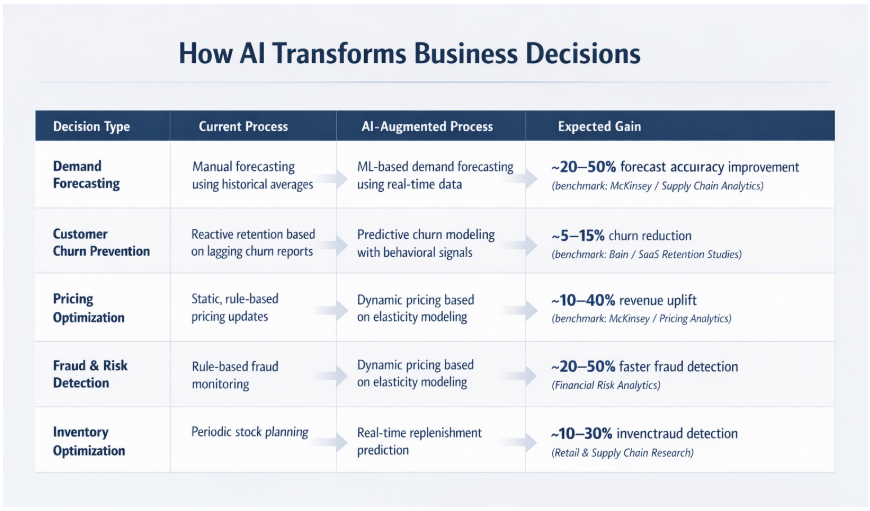
In these scenarios, how AI improves business decisions becomes measurable—not theoretical.
High-impact decision areas include:
- Growth prioritization
AI identifies which channels, segments, or product features are compounding growth—and which are underperforming—enabling faster decisions and quicker execution.
- Pricing and monetization
Instead of relying on static pricing models, AI learns demand elasticity over time, leading to revenue optimization and improved profit margins.
- Operational forecasting
By modeling uncertainty in demand, inventory, and staffing, AI enables better forecasting, lower operational risk, and more efficient resource allocation.
- Early risk and opportunity detection
AI surfaces emerging trends, anomalies, or performance shifts sooner, supporting prevention over reactive firefighting.
This is where AI-driven decision intelligence creates tangible business value—through speed, accuracy, reduced risk, and stronger financial outcomes.
Industry-Relevant Use Cases of AI in Business Decision Making
Across industries, AI creates value when it improves operational decisions—not abstract strategy. Below are industry-relevant examples showing the problem, what AI revealed, the decision shift, and the outcome.
SaaS: Reducing Churn and Driving Expansion
- Uncertainty: Which accounts are likely to churn vs. expand?
- AI surfaced: Usage drop patterns and expansion signals at the account level
- Decision changed: Proactive retention or upsell outreach
- Outcome: Lower churn and higher net revenue retention
- Uncertainty: Which products to stock and discount without hurting margins?
- AI surfaced: Real-time demand trends and price sensitivity
- Decision changed: Dynamic assortment planning and targeted promotions
- Outcome: Higher sell-through and improved profit margins
Fintech: Preventing Loan Defaults
- Uncertainty: Which customers are at risk before delinquency occurs?
- AI surfaced: Early behavioral and transaction risk signals
- Decision changed: Adjusted credit limits and early intervention
- Outcome: Reduced defaults and improved portfolio stability
Healthcare Operations: Managing Capacity and Wait Times
- Uncertainty: Where bottlenecks and patient backlogs will emerge
- AI surfaced: Predicted patient flow and resource strain
- Decision changed: Staff reallocation and scheduling optimization
- Outcome: Shorter wait times and better resource utilization
These examples demonstrate AI in business decision making as a practical execution layer—turning uncertainty into faster, smarter, and more profitable decisions.
Common AI Analytics Failures That Undermine Business Value
Most AI analytics initiatives don’t fail because of technology limitations — they fail because of decision-making breakdowns inside the organization. The cost is not just technical waste; it is lost trust, stalled adoption, and missed revenue opportunities.
Common pitfalls include:
- Treating AI as an IT project instead of a decision system
When ownership stays only with technical teams, insights rarely reach the people who actually make business decisions. Over time, leadership stops expecting value from analytics initiatives.
- Overfitting models to historical data without feedback loops
Models may look accurate in testing but fail in real-world conditions. When predictions repeatedly miss changing market realities, confidence in AI outputs erodes quickly.
- Deploying insights without accountability for action
If no team is responsible for acting on recommendations, analytics becomes reporting rather than decision support — resulting in zero measurable impact.
- Mistaking prediction accuracy for business impact
A highly accurate model that no one trusts, understands, or uses delivers no return on investment. Accuracy without adoption is operationally irrelevant.
A frequent failure pattern looks like this: AI is built → insights are delivered → no clear ownership exists → decisions remain unchanged. In this scenario, the organization does not reject AI — it simply ignores it, which is often more damaging because resources continue to be spent without outcomes.
A Business-First Framework for Implementing AI-Powered Analytics
Sustainable success comes from discipline rather than sophistication. Organizations that extract value from AI analytics focus less on complex models and more on improving a small number of high-impact decisions first.
A practical decision-first sequence:
- Identify a limited set of repeatable, high-impact decisions
Starting small increases clarity, accountability, and adoption.
- Define what a better decision would look like
Establish measurable criteria such as reduced cost, faster response time, or higher conversion.
- Map required signals — not just available data
This prevents teams from building models based solely on convenience instead of relevance.
- Build feedback loops to learn from outcomes
Iteration improves accuracy, usability, and stakeholder trust over time.
- Prioritize simplicity over perfection
Straightforward models that teams understand are more likely to be used consistently than complex systems that appear opaque. This approach ensures AI data analysis for business aligns with operational realities, user confidence, and measurable value creation rather than theoretical performance.
Founder Insight: If you can’t clearly name the decision you want to improve, AI will only automate confusion.
When Internal Teams Struggle: Signals You Need an AI Analytics Partner
Internal friction does not necessarily indicate lack of capability — it often reflects competing priorities, bandwidth limitations, or unclear ownership structures.
Common signals include:
- Data scattered across too many disconnected systems
- Models built but never operationalized into workflows
- Insights produced but rarely influencing leadership decisions
- Prolonged experimentation without measurable outcomes
In these cases, the issue is rarely technical skill alone. Most internal teams are optimized for delivery and maintenance, not for redesigning decision architecture.
An external AI analytics partner can help by acting as:
- An accelerator — shortening experimentation and deployment cycles
- A risk reducer — introducing proven frameworks and governance practices
- A translator — bridging business objectives with analytical execution
The goal is not replacement of internal capability, but alignment and momentum — enabling strategy, modeling, and execution to move in the same direction without creating long-term operational overhead.
How Splitbit Designs AI-Powered Analytics for Real-World Decisions
At Splitbit, analytics systems are designed backward from decisions — not dashboards. The emphasis is principle-driven and business-led, ensuring that technology follows intent rather than the other way around.
The focus is on:
- Embedding insights into existing workflows instead of creating parallel reporting systems
- Translating probabilities into clear trade-offs so teams can act with confidence, not ambiguity
- Prioritizing simplicity before complexity to increase usability and long-term adoption
- Designing for trust, not just performance so insights are consistently acted upon
This approach ensures AI analytics for business growth is grounded in how teams actually operate, decide, and learn — not in theoretical model sophistication or isolated dashboards.
Measuring Success: KPIs That Prove AI-Driven Decision Impact
Success in AI analytics is less about technical precision and more about observable decision behavior. Metrics should reflect how choices improve, not how complex the model becomes.
Meaningful indicators include:
- Reduction in decision cycle time — faster movement from insight to action
- Higher confidence ranges in forecasts and recommendations
- Fewer high-cost reversals or reactive corrections
- Consistent usage of insights in leadership discussions and planning
Lagging metrics such as revenue growth or churn reduction still matter — but only when they can be clearly traced back to specific decision improvements. Model accuracy without decision impact is operational failure, not success.
AI as a Strategic Decision Partner – Not a Replacement
AI does not remove responsibility from leaders; it sharpens it. By making uncertainty explicit, surfacing trade-offs, and keeping outcomes traceable, analytics systems strengthen — rather than replace — human judgment.
The long-term advantage does not come from automation alone. It comes from teams that can:
- Think probabilistically instead of reactively
- Act decisively with informed trade-offs
- Learn continuously from outcomes and feedback
Organizations that treat AI as a thinking and decision partner — not merely a reporting tool or leadership substitute — build a compounding edge where better decisions consistently translate into sustainable business growth.
Final Note
This guide is designed to be reused mentally, not just read once. The frameworks here apply whether you’re a 5-person startup or a scaling product org navigating uncertainty.