Why Growing Businesses Outgrow Their Current Tech Stack
In the early days of a company, technology decisions are usually made for one reason: speed. Founders need to launch fast, test ideas, and get to market before resources run out. This trade-off makes sense when survival depends on momentum.
But as the business grows, those same early infrastructure choices often start to hold it back. What once felt lean and efficient can slowly become a source of friction. Product releases take longer. Systems feel fragile. Teams spend more time fixing issues than building new value. Over time, technology stops supporting growth and starts limiting it.
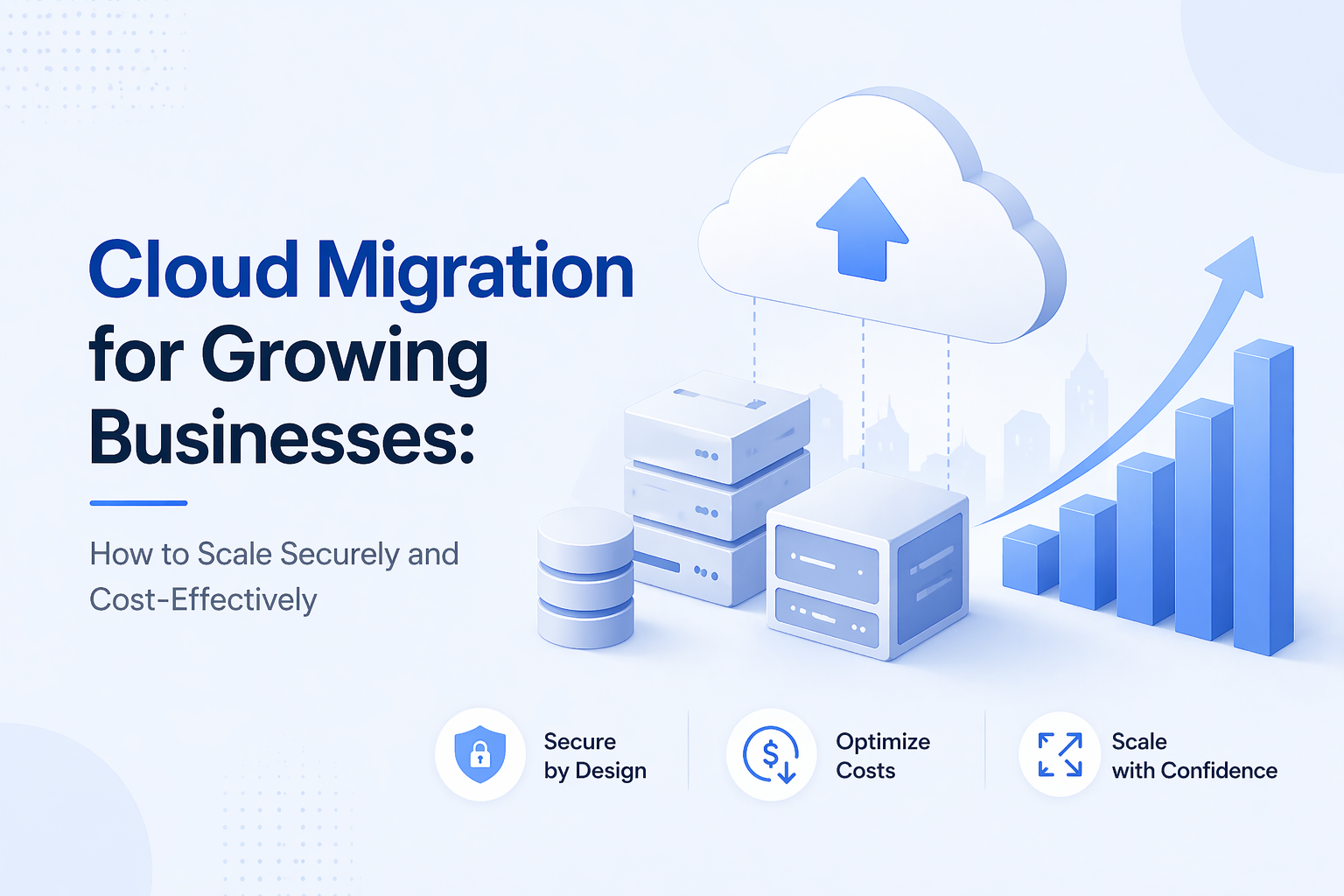
For many founders, cloud migration for growing businesses becomes relevant at the moment infrastructure stops supporting growth and starts shaping business decisions. This shift is usually felt through outcomes that matter at the leadership level:
- Revenue opportunities lost because systems can’t scale quickly
- Product launches delayed due to fragile deployment pipelines
- Customer trust eroded by performance or reliability issues
- Engineering capacity consumed by maintenance instead of innovation
- Expansion plans stalled by infrastructure uncertainty
- Strategic decisions limited by system constraints rather than market potential
This challenge isn’t limited to startups or digital-first firms. Even established manufacturing and retail enterprises are moving legacy systems to the cloud to modernize operations, reduce infrastructure costs, and remain competitive in data-driven markets.
At this stage, infrastructure is no longer a background concern—it becomes a growth lever or a growth bottleneck, depending on how deliberately it’s managed.
Founder Insight: When infrastructure begins to influence revenue, velocity, or market expansion, it stops being an engineering problem and becomes a leadership decision.
What Cloud Migration Really Means — In Simple Business Terms
Cloud migration is not simply “moving servers to the internet.” It represents a fundamental shift in how a business owns, operates, and scales its technical foundation.
At its core, it means moving parts of your infrastructure—applications, data systems, or computing environments—from self-managed setups (on-premise servers) to cloud platforms managed by providers like AWS, Google Cloud, or Microsoft Azure.
However, the real transformation goes beyond technology. It reshapes how teams work, make decisions, and scale the business. Instead of treating infrastructure as a fixed asset you maintain, cloud adoption turns it into a variable capability you can scale, adjust, and optimize over time.
The Business Impact
Enterprises that adopt cloud report up to 30% faster time to market for new products and significantly higher product iteration velocity — giving cloud-native firms a measurable execution advantage over traditional infrastructure models. Additionally, 85% of enterprises believe cloud adoption is necessary to innovate, with many reporting they can launch new products up to twice as fast after migrating to cloud environments.
What cloud migration does not mean:
- Rebuilding your entire product from scratch
- Losing control over performance, data, or security
- Automatically reducing costs without governance or discipline
- Abandoning all existing systems immediately
In business terms, cloud migration is best understood as a change in operating model — one that trades fixed infrastructure ownership for flexibility, adaptability, and faster decision-making.
Why Cloud Migration Becomes a Growth Advantage
Cloud migration is rarely a pure cost optimization. At its best, it becomes a growth enabler that removes structural constraints on scale, speed, and experimentation.
Execution Leverage
The real advantage is execution leverage. Teams can:
- Launch features faster without waiting for infrastructure provisioning
- Enter new markets without rebuilding infrastructure
- Absorb demand surges without operational fire drills
- Test and iterate rapidly without capacity planning delays
This shortens time-to-revenue and lowers the cost of missed opportunities.
Reduced Growth Risk
Cloud infrastructure reduces growth risk through:
- Built-in redundancy that prevents single points of failure
- Automated recovery that minimizes downtime
- Mature security frameworks that decrease breach exposure
- Compliance certifications that accelerate enterprise sales
These capabilities protect both revenue and brand trust as the company scales.
Expanded Organizational Capacity
Cloud migration expands organizational capacity by:
- Freeing engineering time from infrastructure maintenance
- Enabling product focus on differentiation, not operations
- Reducing operational overhead as the company grows
- Creating compounding velocity through improved tooling
Founder Insight: Cloud migration doesn’t just modernize infrastructure—it removes the friction that slows growth compounding.
Key Signs Your Business Is Ready for Cloud Migration
The right time to move to the cloud isn’t driven by hype—it’s when infrastructure starts constraining growth, revenue, or execution speed.
Execution Bottlenecks
- Engineering time is spent maintaining servers instead of shipping product
- Release cycles slow because infrastructure changes require manual coordination
- Infrastructure limits experimentation, A/B testing, or rapid iteration
- Deployment processes are fragile and error-prone
Revenue & Growth Constraints
- Performance issues reduce conversion rates or increase churn
- Downtime or latency impacts customer trust, renewals, or enterprise deals
- Expansion into new regions or customer segments requires heavy infrastructure rework
- Scaling costs are unpredictable and limit growth investments
As of 2024-2026, around 60% of enterprises run over half their workloads in cloud, and 88% operate hybrid or multi-cloud environments, signaling that cloud adoption has become a mainstream execution standard.
Go-To-Market & Sales Friction
- Infrastructure limits onboarding speed or customer provisioning
- Enterprise prospects demand compliance, reliability, or scalability guarantees you can’t confidently provide
- Product launches are delayed due to backend capacity planning
- Sales cycles stall on infrastructure questions
Financial & Margin Signals
- Infrastructure costs grow faster than revenue or usage
- Spending is unpredictable, making forecasting and margin planning difficult
- Capital is tied up in maintenance instead of growth initiatives
- Hidden costs (power, cooling, facility rent) erode margins
Risk & Governance Pressure
- Security, compliance, or data governance requirements are increasing
- Disaster recovery or business continuity plans are inadequate
- Insurance or legal teams flag infrastructure as a liability
- Board or investors question operational maturity
Founder Insight: Migration becomes strategic when infrastructure friction appears in investor updates, customer calls, or product roadmaps—not just engineering retrospectives.
Migration Readiness Scorecard
These categories evaluate key migration factors on a 1-5 scale (1=low readiness/poor outlook, 5=high readiness/strong outlook). Scores determine urgency: average 4+ = low urgency; 2-3 = medium; <2 = high.
| Category | Description | Typical Score Example (Mid-Size Firm) |
|---|
| Execution | Ability to implement migration: skills, processes, tools, timelines. | 3 (Some automation, skill gaps) |
| Revenue Impact | Expected positive/negative effect on revenue streams post-migration. | 4 (Scalability boosts sales) |
| Sales Friction | Disruptions to sales processes, customer acquisition during transition. | 2 (Temporary downtime risks) |
| Cost Predictability | Confidence in forecasting and controlling migration/ongoing costs. | 3 (TCO tools available, overruns possible) |
| Risk | Overall risks: technical, compliance, operational, business continuity. | 3 (Mitigations in place, some unknowns) |
Urgency Calculation
Average score: (3+4+2+3+3)/5 = 3.0 (medium urgency – plan gaps before proceeding). Adjust scores based on your organization’s specifics using checklists from AWS MRA or maturity models.
Types of Cloud Migration Strategies for Businesses
Not all migrations are the same. The right strategy depends on your current systems, business goals, and risk tolerance. Here are the six primary approaches:
Rehost (“Lift and Shift”)
- What it is: Move applications to the cloud with minimal changes
- Best for: Quick migrations, legacy systems, proving cloud ROI
- Business value: Fastest path to cloud, immediate infrastructure benefits
- Tradeoff: Doesn’t optimize for cloud-native features
- What it is: Minor optimizations during migration (e.g., switching to managed databases)
- Best for: Balancing speed with some cloud optimization
- Business value: Moderate improvements without full rebuilds
- Tradeoff: Still doesn’t fully leverage cloud capabilities
Refactor (Re-architect)
- What it is: Redesign applications to be cloud-native
- Best for: Long-term scalability, competitive differentiation
- Business value: Maximum performance, cost efficiency, and features
- Tradeoff: Requires significant time and engineering investment
Repurchase (Replace)
- What it is: Replace existing software with cloud-based SaaS alternatives
- Best for: Outdated custom tools, commodity functions
- Business value: Reduced maintenance burden, faster deployment
- Tradeoff: Less customization, potential vendor lock-in
Retire
- What it is: Decommission systems that are no longer needed
- Best for: Redundant or obsolete applications
- Business value: Cost savings, reduced complexity
- Tradeoff: None—this is pure efficiency gain
Retain (Revisit)
- What it is: Keep certain workloads on-premise temporarily or permanently
- Best for: Systems with specific compliance needs, recent investments, low migration ROI
- Business value: Strategic patience, phased approach
- Tradeoff: Maintains hybrid complexity
Choosing Your Strategy
Most businesses use a combination of strategies across different systems. The key is prioritizing based on:
- Business impact (revenue, growth, risk)
- Technical complexity (dependencies, data volume)
- Resource constraints (budget, engineering capacity)
- Risk tolerance (downtime acceptance, rollback capability)
Founder Insight: Start with high-impact, low-complexity workloads to build momentum and prove value before tackling core systems.
Decision Framework — Choosing the Right Migration Strategy
| Business Priority | Best-Fit Strategy |
|---|
| Fastest time-to-value | Rehosting |
| Cost optimization with low risk | Replatforming |
| Long-term scalability & margin expansion | Refactoring |
| Compliance or legacy constraints | Hybrid |
| Reduce internal maintenance load | SaaS Replacement |
Premise vs Cloud: Key Differences for Growing Businesses
| Category | On-Premise | Cloud |
|---|
| Who Owns the Infrastructure? | You own and manage servers, storage, and data centers. | The cloud provider owns and manages infrastructure. |
| Cost Model | High upfront investment (CapEx). | Pay-as-you-go (OpEx). |
| Upfront Costs | Hardware, licenses, facilities required. | Minimal or no upfront cost. |
| Ongoing Costs | Power, cooling, maintenance, IT staff—mostly fixed. | Costs scale up or down based on usage. |
| Scalability | Slow—buying and installing hardware takes weeks or months. | Fast—scale in minutes with on-demand capacity. |
| Handling Traffic Spikes | Must over-provision for peak demand. | Auto-scaling handles spikes automatically. |
| Geographic Expansion | Requires new physical data centers. | Deploy globally within minutes. |
| Security Responsibility | Fully your responsibility (physical + digital). | Shared model: provider secures infrastructure; you secure data/apps/config. |
| Maintenance | Hardware failures and updates handled by internal team. | Infrastructure maintenance handled by provider. |
| Disaster Recovery | Complex and costly to design. | Built-in redundancy and backup options. |
| Best For | Stable workloads, strict data sovereignty, existing infra investments. | Growing businesses, variable workloads, rapid scaling needs. |
Hybrid Approach (Common in Growing Companies)
| Strategy | Why Businesses Choose It |
|---|
| Keep sensitive data on-premise | Regulatory or sovereignty requirements |
| Run apps in the cloud | Scalability and performance |
| Use cloud during peak demand | Avoid over-provisioning |
| Gradual migration | Reduce risk and manage costs |
Founder Insight: The decision isn’t binary. Most growing businesses benefit from a strategic mix tailored to specific workload characteristics and business requirements.
Cloud Migration Costs: What Growing Businesses Should Expect
Cloud migration involves both one-time migration costs and ongoing operational costs. Understanding both is critical for accurate budgeting.
One-Time Migration Costs
Assessment & Planning
- Infrastructure audit and inventory
- Application dependency mapping
- Migration strategy development
- Risk assessment and mitigation planning
Migration Execution
- Data transfer and synchronization
- Application reconfiguration
- Testing and validation
- Provider consulting or partner fees
- Engineering time (internal or contracted)
Cost drivers:
- Number and complexity of applications
- Data volume being migrated
- Required refactoring or re-architecture
- Downtime tolerance (parallel systems cost more)
- Compliance and security requirements
Ongoing Operational Costs
Compute Resources
- Virtual machine instances
- Container orchestration
- Serverless function execution
- Charged by: CPU, memory, hours running
Storage
- Object storage (files, backups, archives)
- Block storage (databases, applications)
- Charged by: GB stored per month, retrieval frequency
Data Transfer
- Ingress (uploading to cloud): Usually free
- Egress (downloading from cloud)
- Inter-region transfers: Variable pricing
Additional Services
- Managed databases
- Load balancers
- Monitoring and logging
- Security and compliance tools
Cost Optimization Strategies
- Right-sizing: Match resource allocation to actual usage patterns via ongoing analysis.
- Reserved Instances/Savings Plans: Commit to 1- or 3-year usage for up to 72% discounts compared to On-Demand.
- Auto-scaling: Automatically adjust compute capacity to match demand.
- Spot Instances: Bid on spare capacity for fault-tolerant workloads at up to 90% discounts.
- Lifecycle Policies: Automate transitions of infrequently accessed data to lower-cost storage classes.
- Monitoring: Use tools like Cost Explorer for continuous spend tracking and anomaly detection.
Hidden Costs to Watch For
- Egress charges when serving large files or video
- Cross-region traffic if not architected carefully
- Idle resources left running unnecessarily
- Over-provisioned instances with excess capacity
- Lack of cost governance leading to sprawl
- Training and upskilling for cloud-native practices
Cost Control Best Practices
- Set budget alerts at 50%, 75%, and 90% of limits
- Tag all resources by project, team, or customer
- Review spending weekly in early months, monthly after stabilization
- Automate shutdown of dev/test environments after hours
- Establish approval workflows for expensive resources
- Assign cost ownership to product or engineering leads
Founder Insight: Cloud can reduce total cost of ownership, but only with active cost governance. Treat cloud spend as a product metric, not just an IT expense.
Common Cloud Migration Mistakes — and How to Avoid Them
Scope Compression Driven by Urgency
Rushing a full-stack migration often signals deadline pressure rather than strategic readiness. The result is not just downtime risk, but distorted delivery roadmaps and delayed revenue features. High-performing teams sequence migration alongside product milestones, protecting customer experience and release velocity simultaneously.
Replicating Legacy Cost Structures in a New Environment
Simply relocating workloads without redesigning architecture transfers inefficiencies into a more expensive billing model. This erodes gross margins quietly. Cloud value emerges when infrastructure, scaling logic, and data pipelines are re-engineered to align with demand patterns—not when servers are merely relocated.
Configuration Blind Spots and Shared Responsibility Gaps
Most security incidents are not breaches of technology but breaches of clarity. When ownership of identity management, encryption, and audit trails is ambiguous, exposure grows faster than usage. Explicit accountability matrices and automated policy enforcement reduce both compliance risk and insurance premiums.
Adopting advanced platforms without parallel investment in team capability creates operational drag. The issue is not resistance to change—it is cognitive overload and fragmented ownership. Migration succeeds when talent readiness, documentation depth, and internal enablement scale with infrastructure complexity.
Invisible Cost Drift
Unmonitored environments rarely fail loudly; they fail financially. Idle resources, duplicate environments, and uncontrolled experimentation inflate burn without improving product quality. Mature organizations treat cloud spending as a product metric—reviewed alongside customer acquisition cost and lifetime value, not as a back-office expense.
Data Gravity and Exit Friction
As data accumulates, mobility decreases. Without early portability planning, analytics pipelines, AI models, and compliance archives become difficult to relocate, weakening negotiation leverage and slowing strategic pivots. Designing for interoperability preserves optionality and protects long-term enterprise value.
When these patterns go unchecked, they rarely create immediate crises. Instead, they compound—slowing iteration speed, inflating infrastructure ratios, and narrowing strategic flexibility over time. The most resilient migrations are those treated as business model transitions, not infrastructure projects.
When Cloud Migration Is Not the Right Move
Cloud migration isn’t always necessary—and forcing it can backfire.
It may not be ideal if:
- Workloads are stable and low-growth
- Specialized hardware dependencies exist
- Regulatory requirements mandate on-premise hosting
- Migration cost exceeds strategic benefit
- Your team lacks execution bandwidth
Alternatives include partial migration, delaying adoption, or optimizing current infrastructure.
Founder Insight: Cloud should solve a growth problem—not create one.
How the Cloud Supports SaaS and Scaling Web Applications
For SaaS and digital products, infrastructure reliability directly impacts revenue, churn, and retention.
Cloud enables:
- Load balancing for traffic spikes
- Autoscaling for demand fluctuations
- Managed databases that scale without downtime
- Global content delivery for faster user experience
- Monitoring systems to detect issues before customers notice
This makes moving to the cloud for scaling businesses especially impactful when customer experience, uptime reliability, and rapid expansion directly influence revenue growth.
Founder Insight: Performance isn’t technical—it’s a growth lever.
A Phased Cloud Migration Model Built for Capital Efficiency
A practical migration plan is less about technical order and more about sequencing risk against return. Each phase should unlock a measurable business advantage before the next dollar is spent.
Phase 1 — Readiness as a Financial Gate
Inventory systems alongside contractual obligations, compliance exposure, and vendor dependencies. The goal is not completeness; it is determining whether migration reduces operating drag or merely shifts it. Exit this phase with a quantified downside ceiling and a named executive owner.
Phase 2 — Workload Prioritization by Revenue Proximity
Select workloads closest to customer experience, transaction speed, or support burden. Prioritization is driven by revenue adjacency and maintenance tax, not technical elegance. The first wins should be visible in latency reduction, ticket volume, or infrastructure spend within a single quarter.
Phase 3 — Architecture as a Control System
Design access, encryption, backup, and observability as enforceable policies rather than guidelines. Treat architecture decisions as guardrails that prevent cost sprawl and compliance drift. Approval criteria should include recovery time objectives and performance SLOs, not just security checklists.
Phase 4 — Migration in Measured Batches
Move in batches sized to your rollback capacity, not your ambition. Every wave should produce a verifiable delta—uptime improvement, deployment speed, or support cost decline—before the next batch proceeds. Success is defined by reversibility without disruption.
Phase 5 — Optimization as Ongoing Governance
Post-migration value comes from continuous rightsizing, usage visibility, and vendor leverage. Establish quarterly reviews that tie cloud spend to product metrics and margin targets. Governance is effective only when finance, engineering, and product share the same dashboard.
Founder Insight: Migration momentum should be earned through demonstrated gains, not timelines. Each completed phase must justify the next investment with evidence, not optimism.
How to Prepare Before Partnering with a Cloud Migration Provider
Before selecting a partner, founders should clarify:
- Growth goals and expected ROI
- Acceptable downtime and risk tolerance
- Security expectations and compliance needs
- Budget guardrails
- Internal ownership structure
Smart Evaluation Questions
- Do they understand startup speed and constraints?
- Can they balance velocity with security and cost discipline?
- Will they enable internal capability—not dependency?
- Can they explain technical tradeoffs in business language?
Founder Insight: Choose a partner who supports strategy—not just execution.
How Splitbit Supports Cloud Migration for Startups and SMBs
Splitbit focuses on pragmatic, growth-aligned migration, avoiding enterprise overengineering.
Our approach emphasizes:
- Business-first infrastructure decisions
- Security aligned with modern best practices without slowing teams
- Cost governance tailored for startup budgets
- Phased execution to minimize disruption
- Knowledge transfer so teams retain long-term control
The goal isn’t just technical migration—it’s sustainable scale enablement.
Cloud Adoption as an Organizational Capability Ladder
Enduring companies do not “finish” cloud migration; they institutionalize infrastructure competence. The differentiator is not tooling—it is how decisively the organization converts infrastructure choices into operating leverage.
Stage 1 — Stabilization
Infrastructure decisions are reactive and incident-driven. Leadership time is consumed by outages, vendor surprises, and unplanned spend. The hidden cost is opportunity loss: product velocity slows because reliability is uncertain.
Stage 2 — Control
Cost visibility, uptime targets, and basic automation emerge. Teams can forecast infrastructure spend with reasonable accuracy. This stage reduces downside risk but rarely produces upside; it is defensive by design.
Stage 3 — Acceleration
Infrastructure begins to shorten release cycles and support parallel experimentation. Deployment frequency increases, rollback risk decreases, and product teams gain autonomy. The business impact appears as faster feature monetization rather than lower bills.
Stage 4 — Structural Advantage
Infrastructure decisions influence pricing flexibility, geographic expansion, and partner integrations. Due diligence becomes simpler because performance data, compliance evidence, and cost models are already systematized. At this level, infrastructure competence improves negotiating power and margin predictability.
Long-Term Outcomes
- Execution Speed: Shorter path from idea to production.
- Operational Predictability: Fewer variance shocks in cost and uptime.
- Capital Signaling: Cleaner diligence trails and stronger governance optics.
- Scalable Complexity: Growth absorbed without proportional headcount increases.
Founder Insight: Infrastructure maturity is measured by how rarely it demands executive attention—and how often it enables strategic options without new approvals.
Final Founder Takeaway
Cloud migration is ultimately a question of operating leverage. The inflection point arrives when infrastructure decisions begin to influence release cadence, margin predictability, and diligence readiness—not just uptime.
Leaders who treat infrastructure as a governed asset gain optionality: faster product bets, cleaner financial forecasts, and fewer hidden liabilities during partnerships or fundraising. The value is less about technology choice and more about reduced friction in every future decision.
If executive time is repeatedly diverted to performance issues, vendor surprises, or unplanned spend, the constraint is structural. Addressing it is not modernization—it is reclaiming strategic bandwidth.