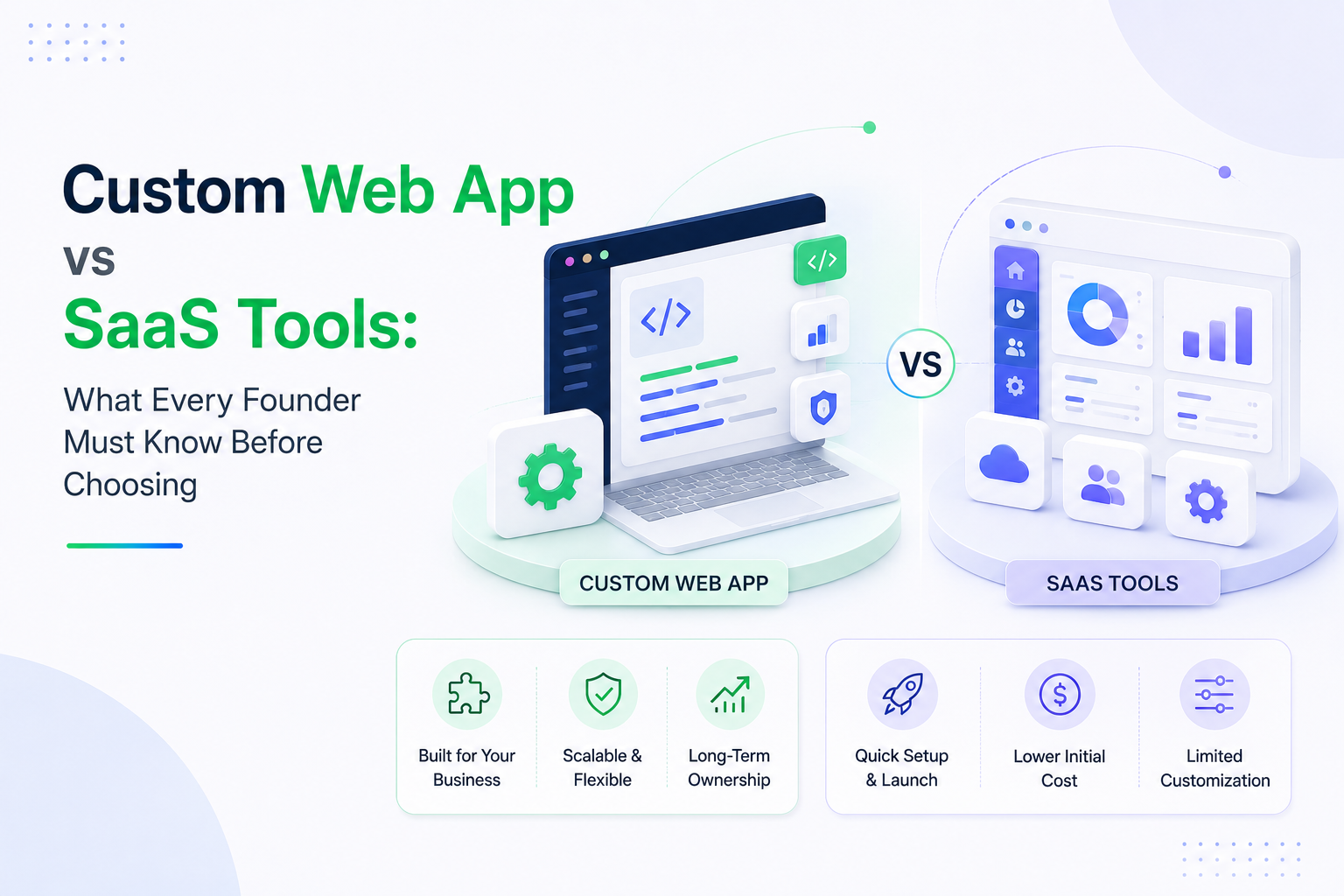
Custom Web App vs SaaS Tools: What Every Founder Must Know Before Choosing
Custom Web App vs SaaS: Why This Decision Impacts Business Growth The most expensive software decision you'll make isn't the one with the biggest price tag — it's the one that quietly boxes you in while your competitors move freely. Most founders don't see it coming. They pick a tool because it's fast and everyone …
Custom Web App vs SaaS: Why This Decision Impacts Business Growth
The most expensive software decision you’ll make isn’t the one with the biggest price tag — it’s the one that quietly boxes you in while your competitors move freely. Most founders don’t see it coming. They pick a tool because it’s fast and everyone in their space is using it. Then two years later, they’re paying for features they don’t need, locked out of workflows they do, and rebuilding systems that should have been right the first time.
Before going further, here’s what these terms actually mean for your business:
SaaS (Software as a Service) — Ready-made software you subscribe to and use immediately. Think Salesforce, Notion, or HubSpot. Someone else builds it, hosts it, and maintains it. You pay monthly and work within their rules.
Custom Web App — Software built specifically for your business, your workflows, and your users. You own it. It does exactly what you need — nothing more, nothing less.
Think of it like real estate. Renting makes sense when you’re starting. But the moment your business puts down roots, renting works against you — the landlord sets the rules, raises the rent, and you leave with zero equity. The custom web app vs SaaS decision follows the same logic. With the B2B SaaS market projected to hit $492 billion in 2026, according to Mordor Intelligence, there has never been more pressure pushing founders toward renting by default.
The risk is real and measurable. Enterprises waste roughly $18 million annually on unused SaaS licenses, with 51% going completely untouched. Cloudnuro Meanwhile, major vendors have raised subscription costs between 10% and 20%, far outpacing IT budget growth of just 2.8% CIO — and the vendor always holds the negotiating power. Beyond cost, lock-in erodes your agility, your data control, and your ability to move fast when the market demands it.
This is the core tension: short-term convenience versus long-term control — and the decision you make in month one will be felt heavily in year three. If you’re a founder, product manager, or business leader facing this crossroads, this guide gives you a clear, bias-free framework to evaluate both paths — so you can choose based on strategy, not assumption.
TL;DR — Custom Web App vs SaaS Tools: The 60-Second Version
For founders who scrolled here first — no judgment. Here’s what this entire guide distills to:
SaaS is the right default for early-stage companies. Low cost, fast setup, proven workflows — it lets you validate before you invest.
The hidden cost of SaaS compounds quietly — per-user pricing, annual hikes, integration fees, and vendor lock-in add up faster than your original business case assumed.
Custom is not for everyone. Yet. Building before you have product-market fit is one of the fastest ways to burn capital without building value.
The crossover point is real — for most scaling teams, a custom web app becomes more cost-effective and strategically necessary somewhere between months 18 and 36.
The right question isn’t “which is better?” It’s: what does my business need right now to grow — and what will it need in three years to win?
A phased migration beats a forced one. Move from SaaS to custom deliberately, not reactively.
One line: Start with SaaS to learn fast. Build custom to scale smart. Know exactly when to make the shift — and don’t let anyone pressure you either way.
What SaaS Tools Actually Offer Founders
Let’s be clear about one thing: SaaS isn’t a compromise. For most founders at the right stage, it’s the smartest move on the board.
Let’s be clear about one thing: SaaS isn’t a compromise. For most founders at the right stage, it’s the smartest move on the board.
Speed to deploy — Most SaaS tools are live within hours, not months. There’s no infrastructure to build, no dev team to manage, no architecture decisions to agonize over.
Low upfront cost — You pay as you grow, making SaaS highly capital-efficient in the early stages when cash preservation is critical.
Proven workflows — Tools like HubSpot (CRM and marketing automation), Asana or Notion (project management), and Intercom (customer support) come with industry-tested processes baked in. You’re not reinventing the wheel — you’re using one that’s already rolling.
Minimal tech dependency — Non-technical founders can run powerful operations without hiring a single developer.
The average company today uses around 130 SaaS applications, Cloudnuro, and for good reason. These tools have commoditized operational excellence — giving a 10-person startup access to the same marketing automation or CRM capabilities as a Fortune 500. That’s a genuine competitive equalizer, and dismissing it would be intellectually dishonest.
Founder’s Insights: SaaS earns its place in every early-stage stack. The question isn’t whether to use it — it’s how long it should remain your primary architecture.
What a Custom Web App Is Built to Do
The average company today uses around 130 SaaS applications, Cloudnuro, and for good reason. These tools have commoditized operational excellence — giving a 10-person startup access to the same marketing automation or CRM capabilities as a Fortune 500. That’s a genuine competitive equalizer, and dismissing it would be intellectually dishonest.
Where SaaS gives you a standardized workflow, a custom app gives you a workflow that is itself your competitive advantage. Think about the businesses where technology is the moat — a logistics company with a proprietary dispatch algorithm, a fintech with a bespoke risk-scoring engine, a marketplace with a matching system no off-the-shelf tool can replicate. None of those were built on a SaaS subscription.
Practically, a custom web app:
Integrates deeply with your operations, data architecture, and third-party systems — without middleware workarounds
Scales on your terms — not a vendor’s pricing tier
Captures and owns your data — without sharing it across a multi-tenant platform
Evolves with your product roadmap — not a vendor’s release schedule
The right mental model: don’t think of a custom web app as an expense. Think of it as a growth enabler — infrastructure that compounds in value as your business scales, rather than one that compounds in cost.
Custom Web App vs SaaS Tools: Cost, Control, Scalability Compared
Factor
SaaS Tools
Custom Web App
Initial Cost
Low ($50–$2,000/month for team tiers)
Higher ($25,000–$250,000+ depending on scope)
Long-Term Cost
Scales with users/usage, often unpredictably
Predictable—primarily maintenance & hosting after build
Flexibility
Limited to the vendor’s feature set and API
Unlimited—built around your exact workflows
Scalability
Requires plan upgrades; increasing per-user fees
Scales with infrastructure; no per-user license penalty
Ownership
None—you are a tenant (subscriber)
Full—you own the codebase and intellectual property
Vendor Dependency
High—subject to pricing, downtime, and roadmap
Low—portable across cloud infrastructure (AWS/Azure)
Time to Launch
Hours to days (configuration)
3–6 Months (for a stable V1/MVP)
Best For
Early-stage, standard/commodity workflows
Growth-stage, differentiated, or complex operations
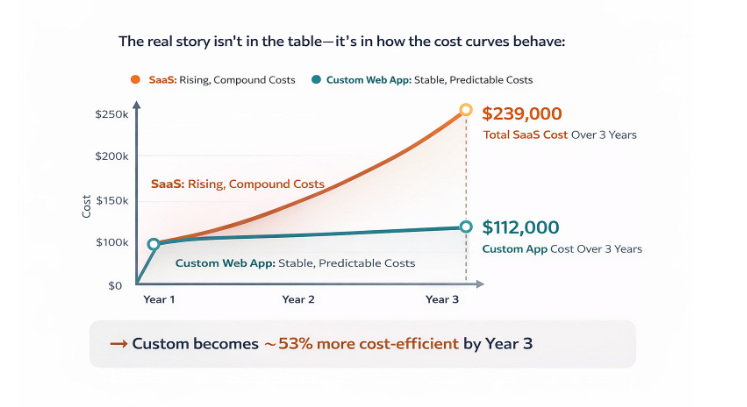
The table tells the essential story: each path has a different cost curve. SaaS starts cheap and gets expensive. Custom starts expensive and gets economical. Where those curves cross depends on your team size, operational complexity, and how long you’re planning to run.
Hidden SaaS Costs Founders Rarely See Coming
This is where the SaaS value proposition starts to quietly unravel — not dramatically, but through a slow accumulation of costs that were never on the original invoice.
Per-user pricing that compounds fast. The median SaaS entry-level price is now $29 per user per month — up 11% year over year. Zylo A team of 5 costs $145/month. A team of 50 costs $1,450/month. A team of 200 costs $5,800/month — for a single tool. Most growing companies are running 8–12 SaaS tools simultaneously.
Annual price hikes that outpace your budget. Average annual SaaS price increases now range from 8–12%, with aggressive vendors implementing hikes of 15–25%. Meetanshi, these aren’t optional. You absorb them, or you migrate — both options cost money.
Integration and middleware costs. Running multiple SaaS tools rarely means they talk to each other natively. You end up paying for Zapier, Make, or a developer to build custom API connectors — costs that rarely appear in the original business case.
Workflow inefficiency tax. When your operations are shaped around what a SaaS tool allows rather than what your business needs, you absorb friction every single day — in manual workarounds, in data exports, in features you’re paying for but don’t use.
Data migration when you eventually leave. Moving data between SaaS platforms requires middleware, integration work, and often developer involvement ResearchGate — none of which comes free. And the longer you’ve been on a platform, the more expensive the exit.
The vendor lock-in trap. The most dangerous hidden cost isn’t financial — it’s strategic. The deeper your operations are embedded into a SaaS platform, the harder it becomes to change direction. By the time the limitations become critical, migration is a multi-month project, not a weekend task.
SaaS vs Custom: 3-Year Cost Comparison Example
Here’s a grounded scenario to make the numbers real. Assume a growth-stage B2B startup with an operations team scaling from 10 to 40 people over three years, running a core stack of 5 premium SaaS tools (CRM, Project Management, Analytics, Communication, and HR).
Cost Category
Year 1 (10 Users)
Year 2 (25 Users)
Year 3 (40 Users)
3-Year Total
SaaS Stack (5 tools)
~$24,000
~$69,000
~$127,000
~$220,000
Integration/Middleware
~$3,000
~$6,000
~$10,000
~$19,000
SaaS Total (Realistic)
$27,000
$75,000
$137,000
$239,000
Custom Web App
$80,000 (Build)
$16,000 (Maint)
$16,000 (Maint)
$112,000
Note on SaaS Figures: Estimates use a 2026 benchmark of $40–$65/user/month across a 5-tool stack, with a 15% annual “effective” price increase factored in (inclusive of AI surcharges and tiered upgrades). Note on Custom Figures: Build cost reflects a mid-complexity B2B dashboard. Annual maintenance is budgeted at 20% of the initial build, covering hosting, security patches, and minor feature iterations.
The Strategic Takeaway
By year three, the custom solution costs roughly 53% less than the equivalent SaaS stack. While SaaS wins on speed in Month 1, the “SaaS Tax” compounds as your team grows.
The financial crossover typically happens between months 18 and 24. Beyond this point, the custom app stops being an “expense” and starts acting as a capital asset—offering full data ownership, unlimited flexibility, and zero vendor dependency.
This isn’t a case against SaaS. It’s a case for knowing when the math shifts from convenience to compromise
Why Building Custom Too Early Destroys Startup Capital
Here’s what separates informed advisors from software vendors: the willingness to say Don’t build yet.
For idea-stage and early-validation startups, premature custom development is one of the most reliable ways to burn capital without building value. The reasons are structural:
You don’t know what you’re building yet. Before you have users and feedback, every feature decision is a hypothesis. Early-stage startups often run at -10% to -50% profit margins. Mordor Intelligence — building the wrong architecture at that stage locks you into expensive pivots.
Overbuilding before validation is a silent burn. When SaaS tools vs custom web applications for startups is debated in investor rooms, the consensus is consistent: use the cheapest tool that proves the assumption, then invest in what the data confirms. Custom development before market validation doesn’t demonstrate ambition — it demonstrates premature confidence.
The opportunity cost is real. Every dollar spent building infrastructure before you have product-market fit is a dollar not spent on customer acquisition, iteration, or the hire that could have changed your trajectory.
The discipline isn’t choosing custom or SaaS. It’s knowing which stage you’re actually in — and being honest about it.
How to Decide: A Business-First Framework for Founders
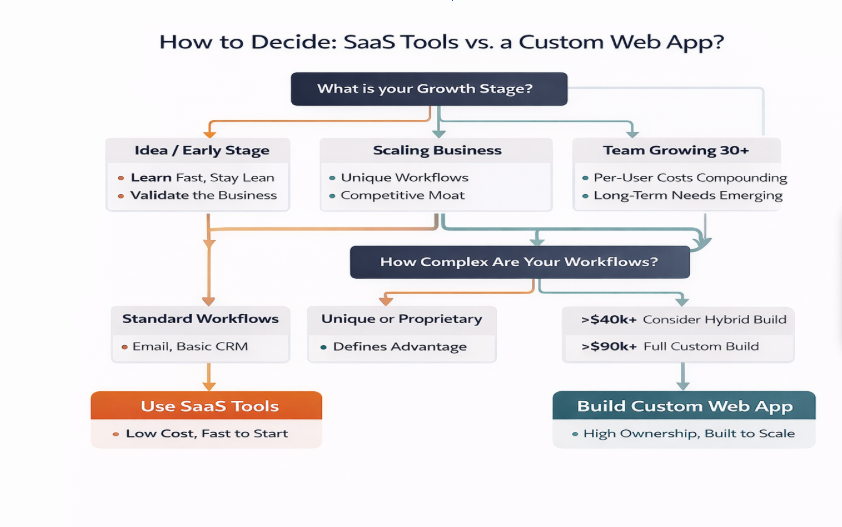
Knowing when to build a custom web app requires stepping back from the product and asking sharper business questions. Here is a practical decision framework based on 2026 market benchmarks:
1. Growth Stage
Idea / Pre-validation:Use SaaS. Always. Speed to market and low overhead are your only priorities here.
Post-validation / Early Traction: Evaluate based on workflow gaps and your per-user cost trajectory. This is the “observation” phase.
Growth-stage / Scaling Team: Audit SaaS spend and operational friction. At 30+ users, the “SaaS Tax” often makes a custom build a more viable financial asset.
2. Workflow Complexity
Standard Workflows (Email, basic CRM, Project Management): SaaS handles these best. Don’t reinvent the wheel for commodity tasks.
Proprietary Workflows: If your workflow defines your competitive advantage or involves unique data logic, Custom is the only path to avoid being “boxed in” by a vendor’s roadmap.
3. Budget Reality (2026 Benchmarks)
Under $40K for Tech Investment:SaaS only. Focus on maximizing existing tools.
$40K–$90K:Custom MVP or a “Phased Hybrid” approach (SaaS for basics, Custom for the “Secret Sauce”).
$90K+ with Clear Business Case:Full Custom Build. At this level, the 3-year ROI typically outperforms SaaS subscriptions by 40–60%.
The Differentiation Requirement
Ask this directly: Does my technology need to be different from my competitors’ to win? * If Yes: SaaS will eventually become a ceiling. You cannot out-innovate a competitor using the same restricted toolset.
If No: SaaS is sufficient, reliable infrastructure.
The Decisive Question
Are you building a business that uses software, or one where the software is the business? The answer tells you almost everything.
Real Founder Scenario: From SaaS Dependency to Custom Control
Consider a mid-sized logistics coordination startup — 30 staff, 3 years in, growing at 40% year on year.
Year 1: They launched on a smart SaaS stack — a CRM for client management, a third-party dispatch tool, a project tracker, and a billing platform. Fast, functional, sensible.
Year 2: As the team grew to 20, per-user costs started compounding. More critically, they hit a ceiling: their dispatch logic was unique enough that the SaaS tool required constant manual workarounds. The team was spending 12+ hours a week exporting data between systems that didn’t natively integrate.
Year 3: One of their key SaaS vendors raised prices by 18%, restructured the enterprise tier, and removed a feature their operations depended on — with 60 days notice. The combined SaaS spend had crossed $80,000 annually. The real cost — including staff time lost to inefficiency — was considerably higher.
The shift: They partnered with a development team to build a unified custom operations platform. Core features: integrated dispatch logic, client portal, billing, and live reporting — one system, one data layer.
The outcome: Within 18 months of launch, they reduced annual software spend by 55%, recovered approximately 600 staff hours annually in operational efficiency, and owned a platform that became central to their enterprise sales pitch — because no competitor running on the same SaaS tools could replicate what they’d built.
How to Move from SaaS Tools to a Custom Solution Without Business Disruption
The fear of migration is legitimate. The disruption of a poorly executed transition can cost more than staying put. But when to move from SaaS tools to a custom solution is rarely an overnight event — and the best migrations never are.
A phased approach removes most of the risk:
Phase 1 — Audit and map your SaaS stack. Identify which tools are core to operations vs. peripheral. Build a data flow map: where does data live, where does it move, and where does it break?
Phase 2 — Run parallel systems during build. Your custom app is being built while your SaaS tools continue running. Users aren’t disrupted — they continue operating normally until the new system is ready and tested.
Phase 3 — API-first integration. Build the custom app to connect with your existing SaaS tools via API during the transition. This creates continuity and reduces the hard cutover risk.
Phase 4 — Gradual replacement by module. Don’t replace everything at once. Move one workflow at a time — starting with your highest-friction, highest-cost SaaS dependency. Validate, stabilize, then continue.
Phase 5 — Full consolidation. Once the critical workflows are running on the custom platform and the team is trained, sunset the SaaS tools one by one.
Done well, this process takes 3–9 months depending on complexity — with zero business downtime and a clean, stable transition.
What to Look for in a Custom Web App Development Partner
The right Web app development partner isn’t just technically competent — they’re strategically aligned with how your business grows. When evaluating who to build with, these are the non-negotiables:
Business understanding, not just code fluency. A good partner asks about your operations, your users, and your three-year plan before they talk about tech stacks. If the discovery conversation goes straight to frameworks and timelines, walk away.
A clear, founder-friendly process. From scoping to sprint reviews to launch, you should understand exactly what’s being built, why, and what it costs. Opacity at this stage is a red flag, not a quirk.
Scalability thinking from day one. The architecture decisions made in month one will be felt in year three. Your partner should be designing for where you’re going, not just where you are.
Post-launch support that’s actually there. The build is not the end. Bugs appear, user needs evolve, and features need iteration. A partner who disappears after deployment is not a partner — they’re a vendor.
At Splitbit Innovative Solutions, this is exactly how we approach every engagement. We don’t start with technology — we start with your business model, your growth goals, and the operational gaps that are holding you back. Our process is transparent, our architecture is built to scale, and our teams stay engaged long after launch. If you’re evaluating whether to build or continue renting, we’ll give you an honest assessment — even if the answer is not yet.
Making the Final Call: Stage, Strategy, and Budget Aligned
After everything, the decision reduces to three honest questions:
What stage are you at? If you’re pre-validation, SaaS is your best tool. If you’re post-traction and scaling, your SaaS spend and operational limitations deserve a hard look.
What does your competitive advantage depend on? If your edge is execution on standard workflows, SaaS is sufficient. If your edge requires proprietary technology, SaaS is a ceiling.
What does your 3-year cost picture look like? Run the numbers with realistic team growth and SaaS price escalation. If the custom crossover happens within your planning horizon — and your business is stable enough to absorb the upfront investment — the case for building is almost always stronger than it appears.
When SaaS makes sense: Early stage. Standard workflows. Limited budget. Speed to market is the priority. Validation is still in progress.
When custom makes sense: Proven model. Unique workflows. Growing team with compounding per-user costs. Competitive advantage tied directly to how your technology works.
Neither path is a permanent commitment. The best founders move between them deliberately — using SaaS to learn fast, then building custom to scale smart.
Not sure which path fits where you are right now? Talk to the team at Splitbit Innovative Solutions. We’ll map your use case, audit your current SaaS spend, and give you a clear-eyed recommendation — with no agenda beyond finding what actually works for your business.
Frequently Asked Questions
You are ready when “SaaS Friction” starts costing more than the subscription itself. Look for three signals:
Engineering Waste: Your team spends 20%+ of their time building “bridges” or manual workarounds between rigid SaaS tools.
Data Fragmentation: You cannot get a “single source of truth” because your data is trapped in multiple vendor silos.
The Feature Ceiling: Your product’s growth is stalled because your SaaS provider’s roadmap doesn’t support your unique business logic.
Absolutely—this is the Hybrid Stack model used by most scaling startups. The goal isn’t to build everything from scratch.
Rent commodities (Email, Billing, HR tools)
Build proprietary workflows that generate revenue
For a professionally engineered, scalable application:
Note: Vague requirements—not technical complexity—are the #1 cause of budget overruns.
With modern AI-assisted development cycles:
Focused MVP: 2 – 4 months from discovery to launch
Full Operational Suite: 6 – 10 months to replace a multi-tool SaaS stack
Speed depends on Scope Discipline—clear “must-haves” = faster delivery.
Yes—especially for Data Privacy.
While SaaS platforms offer strong security, custom software gives you Data Sovereignty—full control over where and how your data is stored and processed.
This is critical if your product involves private data, AI models, or strict compliance requirements.
Still Weighing Your Options? That’s Exactly Where We Come In.
Splitbit Innovative Solutions works with founders who are past the guesswork stage and ready for a clear-eyed technology decision — one that’s aligned with their growth goals, operational reality, and budget.
We’ll tell you honestly whether to build, wait, or rethink. No agenda. Just a straight answer.