How Much Does It Cost to Build a SaaS Product in 2026?
Building a SaaS product in 2026 starts with one question that almost every founder underestimates. How much does SaaS development cost, and where does that number actually come from?
The honest answer is that the cost to build a SaaS product is not a single fixed number. It’s really the outcome of a series of decisions, most of which happen long before any code is written. What you choose to build, who you bring in to build it, and how much you actually need before testing with real users, these are the things that shape your true SaaS development cost, not some generic industry average you saw in a blog post.
Most founders trip up by treating development like a one-time purchase rather than a staged investment. The teams that get the most out of their early budgets do not build everything at once. They build the version that answers the most important question about their business, which is whether anyone will pay for it. That mindset is what separates a well-spent SaaS MVP development cost from an expensive lesson.
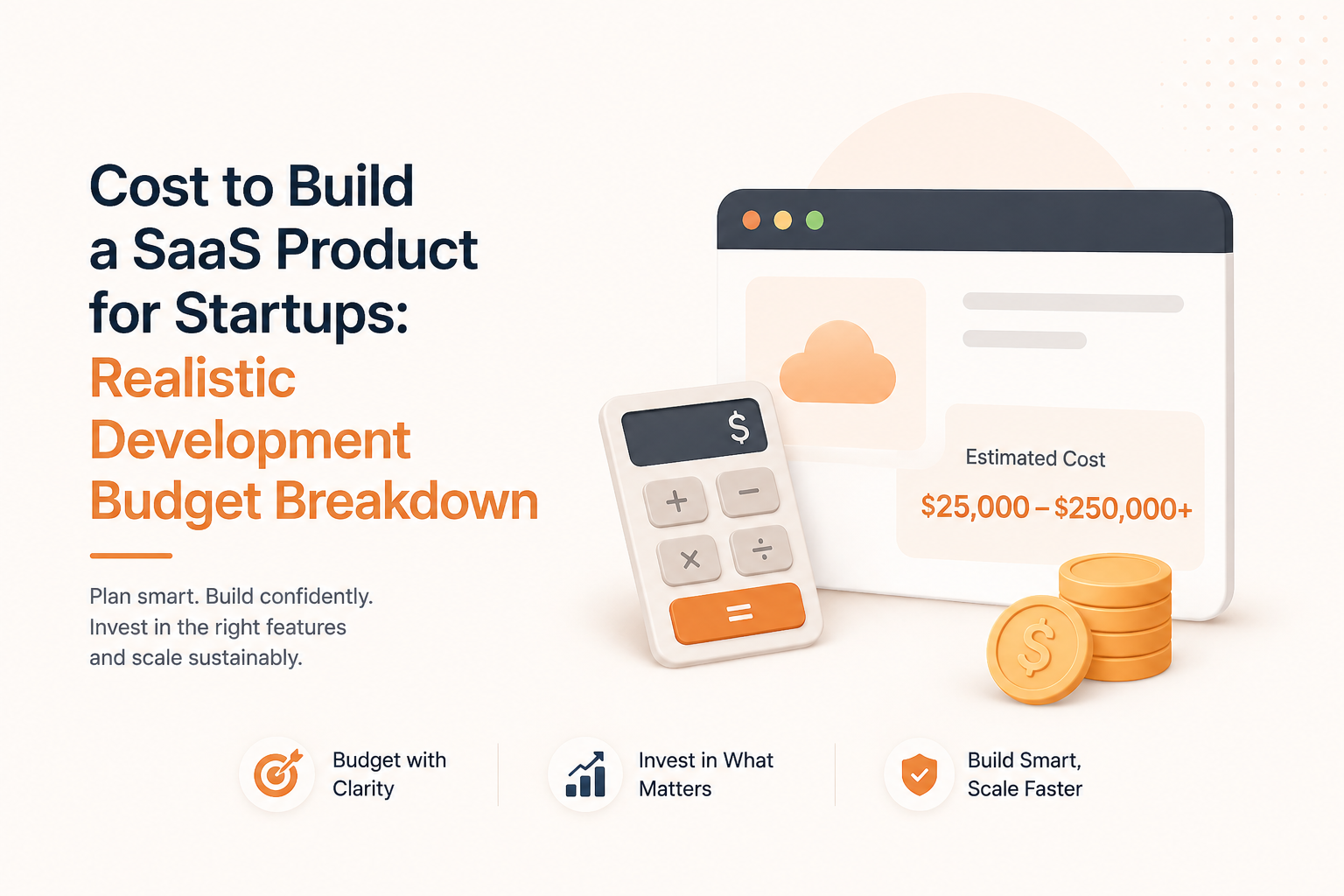
In 2026, a well-scoped SaaS MVP typically ranges from about $20,000 to $120,000, with most serious startup MVPs landing roughly in the $30,000–$75,000 band unless the product involves heavy compliance, AI, or real-time data. Once you move into full-scale SaaS platforms with mature infrastructure, enterprise features, and multi-tenant compliance, development costs often exceed $250,000 and can reach $300,000–$500,000 or more, especially for enterprise-grade systems.
This guide breaks down what drives those numbers, where founders commonly overspend, and how to build a budget that moves with your product instead of working against it.
The Core Cost Drivers of SaaS Development
Understanding where money actually goes is the first lever founders have for controlling it.
Team Composition
Your biggest cost is almost always people. A full in-house team — product manager, frontend developer, backend developer, DevOps engineer, and QA — can run $30,000–$80,000/month in North America or Western Europe. Nearshore and offshore teams can cut this by 40–70% without sacrificing quality if managed well.
Feature Scope
Every feature has a hidden tax: design time, testing time, edge cases, and future maintenance. A founder who ships 12 features in an MVP isn’t moving faster — they’re accumulating debt that costs more to unwind later.
Infrastructure & Architecture Decisions
Choosing a monolith vs. microservices, or a managed database vs. self-hosted, has cost implications that compound over time. Early-stage products almost always benefit from simpler, managed infrastructure. The “we’ll need to scale eventually” argument causes more waste than it prevents.
Compliance & Security
Regulated markets (healthcare, fintech, edtech) add real cost — not because security is expensive to do right, but because it’s expensive to retrofit. HIPAA (US healthcare data law), SOC 2 (data security certification) and GDPR (EU data privacy law) alignment should be scoped in from day one if your market demands it. Ignoring it early doesn’t save money; it defers a larger cost with interest.
Third-Party Integrations
Stripe, Twilio, Intercom, auth providers — these save build time but add monthly costs. The average early-stage SaaS product runs $800–$2,500/month in SaaS tooling before it earns a dollar.
Founder Insight: The two variables that have the most leverage over your total cost are scope discipline and team structure. Every other driver is downstream of decisions you make in the first two weeks of planning.
SaaS MVP Cost vs. Full Product Investment
The distinction between MVP and full product isn’t just about features — it’s about intent.
An MVP is a validation instrument. Its job is to answer one question: will people pay for this, consistently, and for this reason? A full product is a scalable business. These are not the same thing, and building the latter before proving the former is the most common — and most costly mistake in early-stage startups.
Typical SaaS MVP Development Cost in 2026
| MVP Type | Estimated Cost | Timeline |
|---|
| No-code / low-code MVP | $1,000 – $20,000 | 4–8 weeks |
| Custom-coded MVP (lean) | $15,000 – $60,000 | 6–16 weeks |
| MVP with auth, billing, dashboards | $35,000 – $120,000 | 8–20 weeks |
| MVP with compliance requirements | $80,000 – $250,000 | 16–28 weeks |
The jump from MVP to full product typically involves rebuilding architecture that wasn’t designed to scale, adding role-based access, hardening security posture, and building the operational layer (support tools, monitoring, billing management). For many teams, plan for a roughly 2x–3x budget increase, and in complex or enterprise-grade cases expect up to a 3x–5x multiplier when planning that transition.
Build vs Buy vs No-Code: Choosing the Right Starting Point
Before committing to custom development, founders should evaluate three approaches.
No-code platforms can be useful when validating simple workflows or testing demand with minimal engineering investment.
Off-the-shelf SaaS tools often make sense when the problem being solved is operational rather than product-driven — for example, CRM, analytics, or internal dashboards.
Custom development becomes necessary when the product itself is the competitive advantage and requires unique workflows, integrations, or proprietary logic.
Choosing the right path early can significantly influence the overall SaaS development cost for startups and reduce unnecessary engineering investment.
Founder Insight: A $40,000 MVP that validates your pricing model is worth more than a $200,000 product that doesn’t. Ship for learning, not for impressiveness.
SaaS Development Cost by Product Complexity
The SaaS development cost for startups increases primarily with product complexity. Rather than thinking in terms of features alone, it helps to view complexity through three product tiers:
Simple SaaS Products
Examples include lightweight productivity tools, internal dashboards, or niche automation software. These typically include authentication, basic dashboards, and limited integrations.
Estimated development cost: $25,000 – $80,000
Mid-Level SaaS Products
These products introduce deeper workflows, external integrations, team collaboration features, and analytics dashboards.
Estimated development cost: $80,000 – $150,000
Enterprise SaaS products include advanced permissions, high-scale infrastructure, AI capabilities, data processing pipelines, and deep integrations.
Estimated development cost: $200,000 – $500,000+
(Note: These ranges assume custom development in 2026; actual costs can vary by region, team model, and compliance requirements.)
How Development Timeline Impacts Total SaaS Cost
Time is cost. Every extra month of development burns runway — even if you’re paying offshore rates.
The relationship between timeline and cost isn’t linear. Compressing a 6-month build into 3 months often requires doubling the team, which can cost more than the time saved. Stretching a 3-month build to 8 months because of unclear requirements or slow decision-making is equally expensive, and far more common.
Three Timeline Failure Modes Founders Should Know
Scope creep mid-build is the most common. A new feature gets added, then another, and the original scope is unrecognizable by launch. Even at fixed-price contracts, scope changes trigger renegotiation.
Unclear specifications cause rebuild cycles. Development that starts without defined user flows, data models, and edge cases almost always requires rework — often at 30–50% of the original build cost.
Delayed feedback loops between founders and developers extend timelines invisibly. Weekly reviews, clear acceptance criteria, and fast decision-making from the founder side are not soft practices — they directly affect budget.
Here’s how each scenario plays out across team size, cost, and risk:
| Timeline | Team Size | Cost Impact | Risk Level |
|---|
| 3–4 months (tight, well-scoped) | 2–3 devs | Baseline — lowest total spend | Low |
| 3 months (compressed from 6-month scope) | 4–6 devs | +50–100% — team scaling | High |
| 6–8 months (scope creep) | 2–4 devs | +40–80% over baseline | High |
| 8–12 months (unclear specs + rework) | 3–5 devs | +70–150% — 30–50% rework | Very High |
| Extended (slow feedback loops) | 2–3 devs | +20–50% overhead | Medium |
Founder Insight: The cheapest thing you can do before development starts is spend two weeks on a detailed product spec. It will save you 4–8 weeks of paid development time.
Ongoing Costs of Running and Scaling a SaaS Product
Infrastructure costs for early-stage products typically run $200–$2,000/month depending on traffic, data storage, and usage patterns. Cloud costs scale with usage, but poor architecture can cause them to scale faster than revenue.
Engineering maintenance is often underestimated. Even without adding features, production systems require monitoring, dependency updates, bug fixes, and security patches. Budget at least 20–30% of your initial build cost annually for maintenance alone.
SaaS tooling and vendor costs compound quietly. Authentication, email, payments, monitoring, customer support, and analytics tools together can reach $3,000–$8,000/month for a growing team.
Customer success and support infrastructure — once you have paying users, you need processes to retain them. This isn’t a development cost per se, but it hits the same runway.
Where Startups Commonly Overspend on SaaS Development
Building admin panels too early. Founders want visibility into their product’s data. But a full-featured admin dashboard is weeks of engineering work. Use your database query tools or lightweight internal tools until you have revenue to justify it.
Over-engineering authentication. Single sign-on, multi-factor auth, and enterprise identity federation are table stakes for enterprise sales — not for 10 beta users. Start with battle-tested libraries and expand when the contract demands it.
Custom-building what platforms already solve. Payment infrastructure, email deliverability, file storage, and search functionality are solved problems. Building them from scratch to “maintain control” costs 10x more than integrating a managed solution — and delivers a worse result.
Hiring a full team before product-market fit. The SaaS development cost for startups that hire senior engineers, a product designer, and a DevOps lead before their first paying customer is often fatal. The lean model — two or three skilled generalists, or a focused agency — preserves runway for iteration.
Perfecting UX before validating the workflow. Design is important, but beautiful interfaces on top of a workflow nobody wants is a common trap. Validate the logic first, then invest in polish.
A Practical Framework for Budgeting SaaS Product Development
Founders need a decision framework, not just cost ranges. Here’s one that works across product types and team structures.
Step 1 — Define the validation question. What decision will the MVP help you make? Budget is allocated to answer that question, not to build a complete product.
Step 2 — List the minimum feature set. Write every feature you want. Then cut 50%. Then cut 30% more. What remains is your MVP scope.
Step 3 — Estimate in time blocks, not features. A feature isn’t a meaningful unit of estimation. A two-week sprint is. Convert your feature list into sprint estimates with your team or agency before committing to a budget.
Check out Things to Discuss with Your Development Team While Building an MVP here
Step 4 — Apply a 25% contingency buffer. Not as pessimism but as an operational math. Discovery always surfaces edge cases, integrations behave unexpectedly, and design takes longer than estimated. The 25% isn’t waste; it’s the cost of reality.
Step 5 — Model your post-launch cost stack. Before signing a development contract, model months 4–12 post-launch: infrastructure, tooling, maintenance engineering, and support. Many founders run out of runway not during development, but three months after launch.Step 6 — Align spend to validated milestones. Don’t fund the full build upfront. Structure payments and development phases around validation events — first user, first paying customer, first retention data point.
Founder Insight: The best SaaS budgets are built backward — from the validation milestone, not from the feature wishlist.
Real-World Scenario: Building a Lean SaaS MVP Before Scaling
A B2B workflow automation startup targeting mid-sized logistics companies had three pilot leads. They budgeted $280,000 for a full product build before talking to a single technical advisor. After a planning sprint, they redefined their MVP: a single automated workflow between their client’s dispatch system and their billing tool, with a basic dashboard and manual onboarding. Cost: $40K–$50K. Timeline: 10–12 weeks.
Within 90 days of launch, they had three paying customers at ($1K+/month), clear feature requests from real usage, and a fundraising narrative backed by revenue. Their Series A pitch included actual churn data, not projections.
The lesson isn’t that $280,000 was wrong in principle — it’s that spending it before validation would have eliminated any room to learn and pivot. Lesson: Validate first—$40K MVP de-risks larger spends.
Choosing the Right SaaS Development Partner for Cost Control
The agency or development partner you choose affects cost as much as scope does.
In-house vs. agency vs. freelance is often framed as a values decision, but in practice it is an operational one based on stage, speed, and budget. For early-stage startups with under $150,000 to invest, many teams find better ROI from a focused agency or a coordinated freelance setup—especially because these partners bring reusable SaaS patterns (authentication, billing, onboarding) that have already been battle-tested. In-house teams, by contrast, usually make sense later, once you have a clear product-market fit and the runway to justify full-time headcount overhead.
What to evaluate in a development partner:
- How much does SaaS development cost with this specific team? Ask for itemized estimates, not blended rates. Blended rates obscure where budget goes.
- Do they push back on scope? A partner who agrees to everything you ask for isn’t collaborative — they’re a risk. The right partner challenges unnecessary features before billing you to build them.
- Can they show maintenance and post-launch cost modeling? Partners who only plan to the launch date are leaving you with a cost surprise on month two.
- Do they have experience in your compliance tier? Building a healthcare SaaS with a team that has never navigated HIPAA is a risk multiplier that no hourly rate makes worth it.
The best development partners approach cost control before the first sprint — not after. Teams like Splitbit start engagements with a structured cost modeling exercise: mapping your validation question, scoping the minimum viable build, and phasing investment around milestones rather than a fixed feature list. Top partners (e.g., Splitbit-style) model costs upfront via validation scoping and milestones.
Budget discipline consistently outperforms budget size. The founders who build durable SaaS companies are those who sequence spend deliberately — validating before scaling, structuring investment around learning milestones, and treating the MVP as a research instrument rather than a product statement. Validation reduces risk more reliably than additional engineering. Sequencing matters more than scale. And spending to learn is always a better use of runway than spending to impress.Building a SaaS product is one of the highest-leverage investments a founder can make — if the spend is sequenced correctly. The founders who win aren’t those with the largest budgets; they’re those who treat every dollar as a question they’re trying to answer.