Education SEO in 2026: Why Digital Visibility Is No Longer Optional
For schools, colleges, and institutes today, digital visibility is no longer a marketing advantage—it is a prerequisite for enrollment viability. If prospective students and parents cannot find an institution at the right decision moment, everything else—campus infrastructure, faculty strength, academic outcomes—fails to enter the consideration set.
Poor visibility does not simply reduce website traffic. It quietly results in lost admissions, misaligned enquiries, and an unhealthy dependence on paid advertising to compensate for gaps that organic discovery should naturally address.
This shift has elevated SEO for education websites from a peripheral marketing activity to core enrollment infrastructure.
Modern student discovery journeys are fragmented and non-linear. Learners do not rely on a single search engine or channel. They search on Google, ask questions to AI tools, compare institutions through reviews and forums, watch videos, and expect immediate clarity—often before they ever visit a website or submit an enquiry.
Modern education SEO, therefore, is not about ranking pages alone. It is about:
- Being discoverable when critical questions are asked
- Appearing credible when options are evaluated
- Earning trust when final decisions are made
This guide is written for institutional leaders, admissions teams, and marketing decision-makers seeking to build sustainable, enrollment-focused visibility across search engines and AI-driven discovery systems.
The Real Visibility Crisis Education Institutions Encounter
Despite strong academic offerings, most educational institutions are invisible where it matters most i.e., during the early and mid-stage decision moments.
Thousands of institutions compete for the same attention, while search behavior is split across Google Search, Maps, YouTube, review platforms, and AI-driven answer engines. Visibility is no longer controlled by a single website.
In practice, this means:
- Institutions appear for broad queries but disappear for intent-driven ones
- Third-party platforms shape perception more than official websites
- AI summaries and reviews often replace direct website visits
Even established colleges struggle—not because they lack quality, but because their digital presence is fragmented, unclear, or unverifiable at scale.
Despite the expansion of digital channels, SEO remains central to how education institutions generate sustainable admissions impact. Its value lies not in reach alone, but in the quality, timing, and durability of discovery.
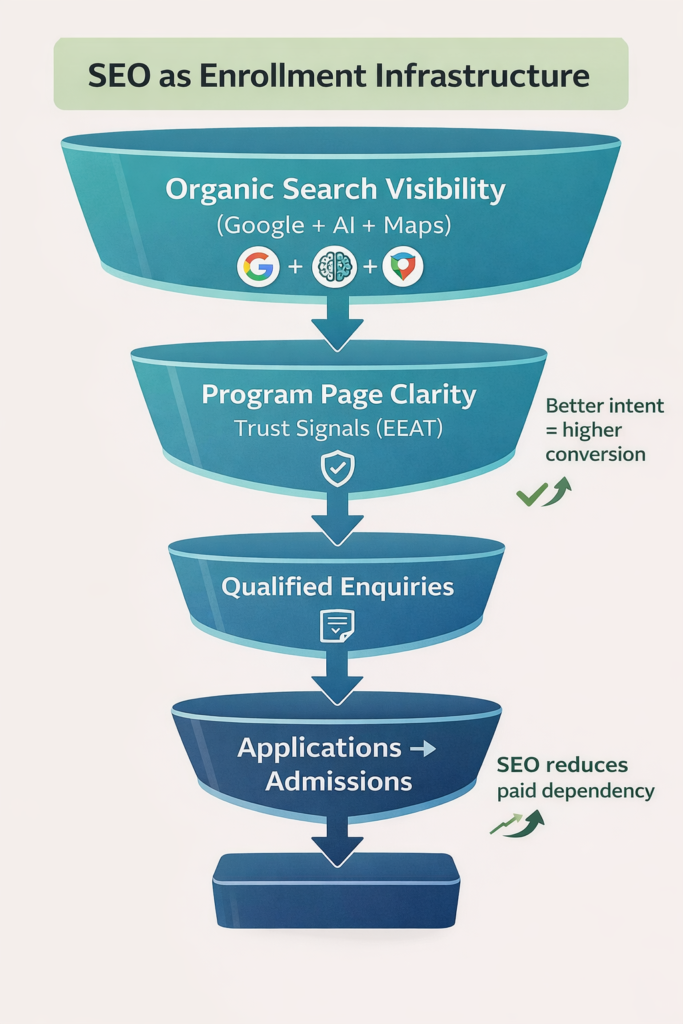
SEO directly influences admissions by ensuring programs are visible at the exact moments students actively search with intent. Unlike interruption-based channels, organic discovery attracts prospective applicants who are already evaluating options, resulting in better-fit enquiries and higher conversion potential.
From an institutional perspective, SEO is also a long-term growth lever. Strong organic visibility compounds across admission cycles, allowing institutions to build authority and demand year after year rather than resetting acquisition efforts each intake. As program pages mature and trust signals accumulate, dependency on high-cost paid campaigns reduces without sacrificing lead quality.
Paid advertising can generate short-term spikes in visibility. SEO builds enrollment infrastructure that continues to perform long after campaigns end.
How Today’s Students & Parents Actually Search for Institutions
Understanding search behavior in education is less about algorithms and more about human anxiety and risk assessment.
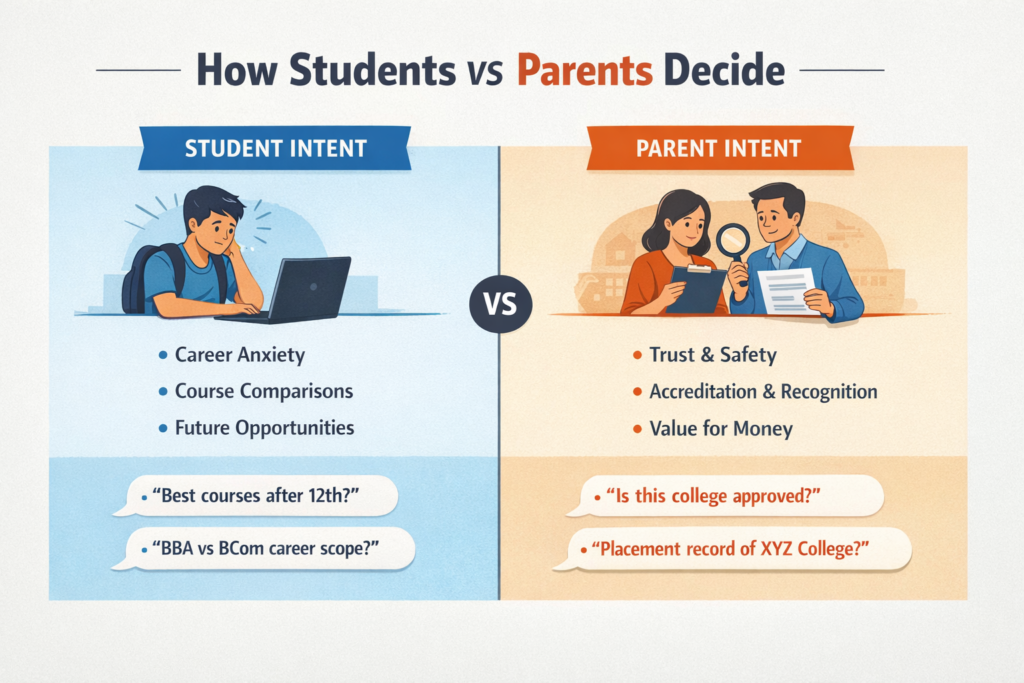
A typical student journey begins with uncertainty about the future. Students search around aspirations and outcomes, trying to reduce career anxiety and avoid irreversible choices:
- “Best courses after 12th science”
- “Data science colleges in Kerala”
- “Is BBA good for a career in marketing?”
These searches reflect fear of choosing a path that limits long-term options.
A parent’s journey, by contrast, is driven by legitimacy and safety. Parents search to verify whether an institution can be trusted with their child’s time, money, and future:
- “Is this college accredited?”
- “What are the placement records?”
- “Is the campus safe and officially recognized?”
Underlying these queries are concerns about regulatory approval, financial value, personal safety, and the risk of enrolling in an institution that overpromises and underdelivers.
Modern education SEO must therefore address dual intent simultaneously:
- Student intent: career outcomes, opportunity, and future relevance
- Parent intent: legitimacy, safety, value for money, and credibility
Institutions that design content for only one of these decision-makers may attract traffic, but they consistently lose conversions.
Why Institutions Struggle to Explain What They Truly Offer Online
Many education websites fail not from poor design but from poor clarity. Prospective students visiting a program page aren’t seeking to be impressed—they seek reassurance. Four questions drive their decision instantly:
- Who is this program for?
- What will I learn?
- What outcomes can I realistically expect?
- Why choose this institution over others?
When answers are hidden under abstract marketing language, both users and search systems struggle to determine relevance, leading to high bounce rates, weak visibility, and low-quality enquiries.
Key Principle: Clarity consistently outperforms creativity in education SEO.
Example: Program Page Clarity
Vague, Marketing-Heavy Description:
“Our industry-oriented program empowers future leaders with holistic knowledge and transformative learning experiences, guided by excellence and innovation.”
Why it fails:
- Target audience is unclear
- Curriculum and learning progression are vague
- Outcomes are implied, not explained
- Search engines cannot map content to real queries
Clear, User- and Search-Aligned Description:
“This BBA program is for students pursuing careers in marketing, business analytics, or entrepreneurship. The curriculum covers core management subjects in year one, followed by specialisations and internships in the final year. Graduates typically take roles in marketing operations, business development, or pursue postgraduate management programs.”
Why it works:
- Defines target students
- Explains learning progression
- Sets realistic outcomes
- Aligns with high-intent search queries
What Every Program Page Should Communicate
To support discovery and conversion, every program page must include:
- Course structure: What is taught and in what sequence
- Eligibility criteria: Who should apply
- Career paths or next steps: Jobs, higher studies, or professional outcomes
- Proof of outcomes: Internships, placements, alumni stories, or certifications
Structured, transparent, and scannable content improves organic visibility and ensures enquiries are better qualified by default.
SEO as the Foundation of Sustainable Enrollment Growth
Sustainable enrollment growth depends on whether an institution can be consistently discovered, clearly understood, and trusted across search platforms. SEO forms the structural base that enables this continuity. When foundational SEO is weak or uneven, visibility becomes unstable and inquiry quality fluctuates—regardless of later optimizations.
Website and Content Architecture
Why it matters:
Search and AI systems rely on structure to interpret academic relevance. Clear architecture ensures each program is surfaced for the right search intent and evaluated correctly.
Key foundations include:
- Logical, hierarchical site structure aligned with academic offerings
- One authoritative page per program or course
- Mobile-first performance and reliable load speeds
- Internal linking that reflects academic relationships
Program-Level Information Integrity
Why it matters:
Fragmented or inconsistent program information weakens both search visibility and user confidence. A single, consistent source of truth improves relevance, trust, and conversion.
Key foundations include:
- Centralized eligibility, curriculum, and outcome details
- Consistent program naming and descriptions across pages
- Content structured for clear interpretation and extraction
Local Presence and Institutional Signals
Why it matters:
For location-based and parent-led searches, institutions are assessed for legitimacy before academic depth. Strong local signals establish trust early in the decision journey.
Key foundations include:
- Verified and accurate Google Business Profiles
- Consistent Name, Address, and Phone (NAP) information
- Authentic reviews from students and parents
- Mentions from credible educational or regional sources
Without these foundations working together, SEO performance remains fragile and difficult to scale. Treating SEO as institutional infrastructure—not a tactical add-on—creates stability across platforms and supports predictable, long-term enrollment growth.
Ranking in AI Answers: SEO for Google SGE, ChatGPT & Generative Search
Search discovery in education is increasingly mediated by answer engines—systems designed to extract, synthesize, and present information directly, rather than route users through multiple pages. For institutions, visibility now depends on how clearly and reliably their information can be interpreted by these systems.
Simple example:
When a student asks an AI system, “Which colleges offer BCA with good placement support?”, the answer is typically assembled from program pages that clearly state the course name, eligibility, duration, outcomes, and supporting proof such as reviews or placement summaries. Institutions that present this information in structured, factual formats are referenced; those that rely on abstract descriptions are ignored.
Effective AEO (Answer Engine Optimization) and GEO (Generative Engine Optimization) do not require new content formats, but disciplined information design. Institutions that perform well share three characteristics:
- Question-aligned content that mirrors how students and parents phrase queries
- Structured formats such as clear headings, FAQs, and concise explanations
- Consistent, verifiable information across program pages, profiles, and external platforms
Answer engines favor content that can be confidently extracted, cross-checked, and summarized. When institutional data is clear and consistent, it becomes eligible for inclusion in AI-generated responses as well as traditional search features.
In this context, SEO for education websites must support both retrieval and interpretation—ensuring institutional information is not just discoverable, but usable by the systems shaping modern search experiences.
EEAT: The Trust Signals That Make Parents Choose You
In education, trust is not a supporting signal it is the deciding one. Search platforms increasingly mirror how parents evaluate institutions in real life, prioritising verifiable signals over persuasive language.
What parents actually check before shortlisting:
- Accreditation and approvals from recognised regulatory bodies
- Campus safety and governance clarity, especially for residential programs
- Student outcomes, such as placements, progression paths, or higher-study transitions
- Faculty legitimacy, not just names but qualifications and experience
Institutions that surface these signals clearly—through structured pages, transparent disclosures, and consistent third-party validation—are easier for both parents and search systems to trust. In high-stakes decisions like education, visibility without trust rarely converts.
How SEO Directly Influences Inquiries, Applications, and Admissions
SEO does more than boost overall traffic — it improves the quality and intent of prospects who discover your institution online. Research shows that a significant share of traffic to education websites comes from organic search, and a large portion of conversions — including inquiries and applications — originate from this traffic when it aligns with user intent and program relevance.
High-intent search visibility means your programs are found by students actively researching relevant degrees, requirements, career outcomes, and admissions information — not just casual browsers. This level of relevance improves outcomes across the recruitment pipeline.
A Student Journey Scenario
A student searching “BSc psychology career prospects and course details” lands on a program page that clearly outlines curriculum focus, eligibility criteria, career pathways, and outcomes. Meanwhile, a parent searching “psychology college accreditation and graduate success” finds accessible accreditation information and testimonials. Both arrive with aligned expectations, leading to an inquiry that reflects genuine interest and informed intent rather than uncertainty.
This kind of intent-matched SEO drives measurable improvements because it:
- Attracts applicants who understand the program scope and fit, not just volume.
- Reduces time spent on misaligned or low-intent inquiries, easing admissions counseling load.
- Improves conversion rates, because visitors who find clear, relevant content are far likelier to progress to application.
- Strengthens long-term pipeline health, with sustainable inquiry patterns that don’t rely on paid media alone.
In other words, well-implemented SEO doesn’t just generate more traffic — it attracts the right traffic. Over time, this compounds into a healthier admissions funnel built on clarity, trust, and relevance rather than persuasion alone.
The Most Common SEO Gaps Holding Education Institutions Back
Many institutions lose qualified applicants not due to academic shortcomings, but because of preventable execution gaps.
The most persistent visibility gaps include:
- Program pages that lack differentiation, making offerings indistinguishable in search results
- Inconsistent information across website, Maps, and third-party platforms
- Missing answers to real parent and student questions, forcing users to seek external validation
These gaps do not reduce rankings alone—they reduce confidence, which ultimately stalls enquiries.
Aligning SEO With Academic Calendars and Admission Cycles
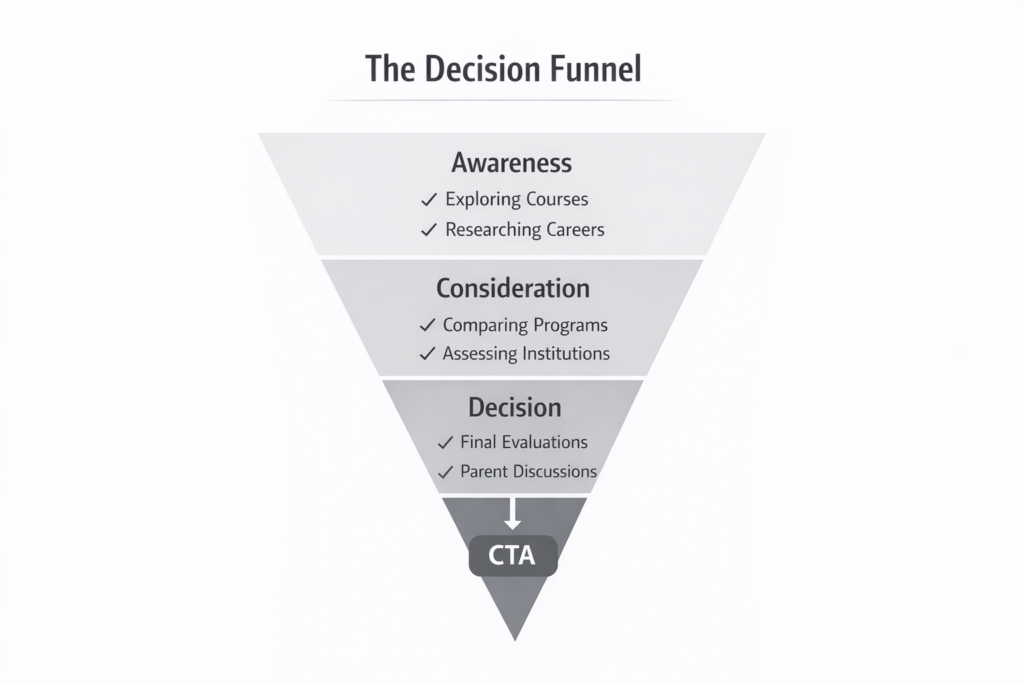
Effective education SEO operates on a simple timeline aligned to admissions activity.
Before Admissions
Focus: Discovery and evaluation
- Program and eligibility pages
- Career outcome and scholarship content
- Early indexing of “next intake” information
During Admissions
Focus: Decision support
- Application deadlines and FAQs
- Comparison-friendly content
- Clear enquiry and contact pathways
After Admissions
Focus: Authority and readiness
- Updated program information
- Reviews, testimonials, and outcomes
- Content preparation for the next intake
Institutions that treat SEO as a continuous cycle—not a campaign—maintain visibility across intakes without restarting effort each year.
Measuring What Matters: SEO Metrics That Impact Enrollment
The effectiveness of education SEO should be judged by the decisions it enables:
- Organic enquiries → Indicates relevance to real search intent
- Program page engagement → Signals clarity and comprehension
- Application conversions → Reflects applicant fit and readiness
- Organic cost per acquisition → Guides budget allocation between paid and organic channels
Traffic without downstream impact is a reporting metric, not a growth signal.
When In-House SEO Isn’t Enough: Knowing When to Seek Experts
Institutions typically benefit from external SEO support when internal efforts plateau or misalign.
Common failure signals include:
- No measurable organic growth across multiple admission cycles
- Rising enquiry volume but declining applicant quality
- Increasing dependence on paid advertising to meet intake targets
At this stage, SEO becomes a strategic issue requiring domain-specific expertise, not incremental optimisation.
Splitbit’s Proven SEO Framework for Education Institutions
Based on hands-on work with education websites across schools, colleges, and institutes, a few patterns recur:
- Program-level clarity consistently outperforms homepage branding for admissions-intent searches
- Institutions aligned to admission timelines generate better-fit enquiries even with modest traffic volumes
- Trust markers (accreditation, outcomes, faculty detail) often influence visibility as much as technical SEO, especially in parent-led searches
These patterns reinforce that education SEO succeeds when it prioritises interpretability over promotion.
Final Thoughts: Getting Found by the Right Students, Not Just More Traffic
Students do not choose institutions they cannot find—and parents do not trust institutions they cannot verify. In education, visibility is no longer about ranking higher; it is about resolving uncertainty at the moment decisions are formed.
Institutions that treat SEO as enrollment infrastructure—built on clarity, trust, and consistency—create sustainable advantage across search engines, AI systems, and human judgment alike.
If your institution is not clearly answering the questions that shape enrollment decisions today, it is quietly excluded from tomorrow’s choices.
Clear next step: Audit how your programs, trust signals, and admissions information appear across search and answer platforms—before investing further in campaigns or tools.