Introduction: MVP Communication Risks
Building an MVP is not a test of how quickly a team can ship features. It is a test of how clearly everyone understands what is being built, who it is for, and what uncertainty it is meant to reduce. Many MVPs fail not because the idea was weak or the developers lacked skill, but because critical conversations never happened early enough. Assumptions go unchallenged, priorities blur, and the product drifts away from the problem it was meant to validate.
For founders, the MVP phase is less about execution and more about alignment. Knowing the right things to discuss with your development team, from scope and technical trade-offs to security, timelines, and learning goals, can determine whether your product generates real insight or costly confusion. The difference between an MVP that sharpens product direction and one that stalls momentum often lies in these early, intentional discussions. This article breaks down the conversations every founder should lead so the MVP becomes a focused learning tool rather than just an early version of a product.
Align on the Product Vision (Before Code Exists)
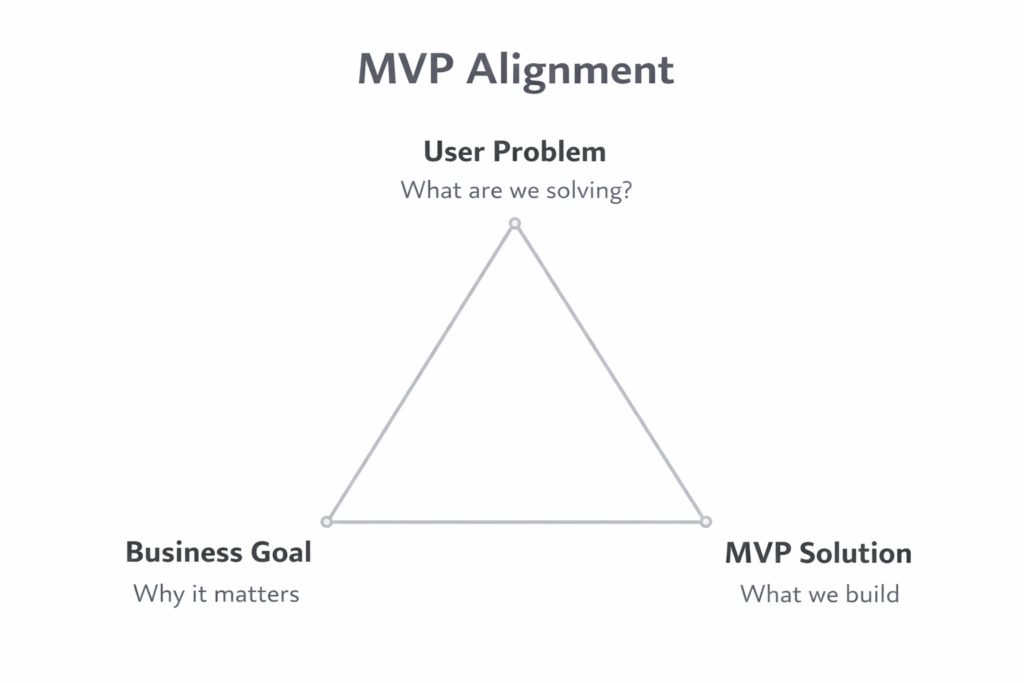
Before any code is written, founders and developers must align on a single, shared understanding of the problem. Start with a deceptively simple question:
What problem are we solving, for whom, and why does it matter right now?
This is not the pitch version or the investor slide narrative. It is the grounded, user-reality version. When this alignment is weak, it usually surfaces later as engineers building edge cases the founder never intended, or founders sensing that the product “doesn’t feel right” but struggling to explain why. This early alignment sets the foundation for what founders should discuss with developers during MVP execution, long before features and timelines dominate the conversation.
Founder Insight: If a developer cannot explain the user problem in their own words, alignment has not happened yet.
Equally important is clarity on the first believable user. Not the ideal future customer, but the narrowest user for whom the problem is real today. A fintech MVP built for “anyone with a bank account” collapses under ambiguity. One built for “freelancers invoicing international clients” gives developers the context they need to make smarter decisions.
Clarify MVP Scope Early (What You’re Not Building)
Every MVP requires ruthless prioritization. The most useful question to ask together is not “What should we build?” but:
What must exist for learning to begin?
If a feature does not directly enable onboarding, the core action, or feedback capture, it is likely not MVP-critical. Unclear exclusions cause more damage than missing features, because they create constant second-guessing during development.
Be explicit about what is out of scope for now, what is a known compromise, and what can be ugly but functional.
Founder Insight: A clearly defined MVP scope reduces developer stress more than a detailed specification ever will.
Discuss Assumptions and Risks Openly
Every MVP is a bundle of assumptions disguised as a product. These assumptions need to be surfaced early, not discovered accidentally after launch. Common examples include beliefs about user behavior, workflow intuitiveness, or pricing sensitivity.
When developers understand which assumptions matter most, they can design for learning instead of polish.
Technical risks also deserve explicit discussion. Non-technical founders may not see risks related to third-party dependencies, performance bottlenecks, or fragile integrations. A useful question to ask the team is:
What is the riskiest technical decision we are making, and how will we know if it is wrong?
This framing turns risk from something to avoid into something to test.
Define MVP Success Together
An MVP is successful if it reduces uncertainty—not if it looks impressive. Before development begins, founders and developers should agree on:
- The single question the MVP must answer
- The outcome that would clearly invalidate the idea
Without this alignment, teams often confuse early enthusiasm or positive comments with real validation.
Consider a B2B SaaS founder building an internal approval tool. The assumption might be that teams struggle primarily with speed. The MVP launches with a streamlined interface and early users say it “looks good.” However, if the real belief is that users can complete approvals faster without training, the meaningful signal is whether they complete the workflow on their own.
To evaluate that assumption, teams should look for specific behaviors:
- Users completing the core flow without guidance
- Minimal hesitation or drop-off at key steps
- Repeat usage within a short time window
If users still need walkthroughs, the MVP has succeeded by revealing a flawed assumption, even if the product receives positive comments.
Strong MVP success criteria are based on observable behavior, not opinions. Metrics such as user counts, vague positive feedback, or visual polish often hide unresolved risk. By agreeing upfront on which behaviors matter and what outcomes would trigger a rethink, teams ensure the MVP generates learning rather than false confidence.
Agree on the Measurement Approach
Measurement decisions should be made before launch, not after confusion sets in. Align early on:
- What events will be tracked
- Who implements tracking
- Who reviews and interprets the data
Equally important is alignment on interpretation. Metrics do not explain themselves. A drop‑off could indicate poor UX, the wrong audience, or unclear value. Agreement on interpretation frameworks prevents reactive, assumption‑driven decisions.
Decide the Tech Direction (Without Overengineering)
Founders should explicitly ask what the MVP is optimizing for: speed, cost, or flexibility. Every MVP carries technical debt, but it should be intentional.
An MVP built too cleanly often ships too late. One built too quickly may collapse before learning happens. Balance is a conscious decision.
Clarify:
- What will likely be refactored post‑MVP
- What components can be reused
- What is intentionally disposable
This avoids post‑launch shock around scalability and maintenance.
Align on Timelines and Milestones
Once success criteria and measurement are clear, timelines should be anchored to learning, not dates. Instead of committing to rigid delivery deadlines, align on milestones that reflect progress toward validation, such as the first internal test, the first real user interaction, or the first feedback loop completed. These markers keep the team focused on outcomes even when schedules shift.
Delays are normal in early-stage products. What causes real damage is uncertainty. Teams should agree in advance on how risks are surfaced, what signals trigger a scope adjustment, and when founder involvement is required. This clarity prevents last-minute surprises and reactive decision-making.
Founder Insight: Predictable communication creates more confidence than perfect timelines.
Set Clear Feedback and Iteration Rules
Iteration breaks down when feedback ownership is unclear. Decide:
- Who determines what feedback is valid
- What gets prioritized
- What is intentionally ignored
Useful filters include whether feedback supports a core assumption, represents a pattern, or can be safely deferred. Without filters, iteration becomes emotional rather than strategic.
Clarify Security, Access, and Ownership
Even at the MVP stage, clarity around ownership matters. Discuss who owns the codebase, where repositories live, and what happens if teams change. These conversations prevent painful disputes later.
Access control should also be defined. Decide who has production access, how credentials are managed, and how offboarding works. This is basic operational hygiene, not paranoia.
Discuss Scale and Post-MVP Next Steps
You do not need to build for scale now, but you do need awareness. Ask which decisions might block scaling later and which are easy to change versus hard to reverse.
Also clarify what happens if the MVP succeeds. Will the product be rebuilt, extended, or re-architected after funding? Ambiguity at this stage often creates friction right when momentum matters most.
Establish Communication Rules That Hold Under Pressure
When opinions clash, decision authority must be clear. Define who decides, on what basis, and with what input. Clear authority prevents slow paralysis.
Set expectations for updates, reviews, and escalations. This does not mean constant meetings, but predictable touchpoints. More than any tool or process, this determines whether an MVP feels collaborative or chaotic.
Splitbit’s Perspective: Industry Lessons from MVP Execution
Across early-stage products that make progress versus those that stall, a consistent pattern emerges. The differentiator is rarely engineering talent or tool choice. It is the quality of conversations that shape decisions long before code is written.
From an industry perspective, teams that build effective MVPs tend to share a few observable practices:
- They treat alignment as product work. Conversations about scope, assumptions, and trade-offs are handled with the same seriousness as technical decisions, not as pre-work to be rushed.
- They pressure-test assumptions before committing to architecture. Risky beliefs—about users, workflows, or constraints—are surfaced early so the MVP is designed to learn, not to impress.
- They optimize for learning velocity, not feature volume. Success is measured by how quickly uncertainty is reduced, not by how much functionality ships.
- They translate founder intent into developer-clear decisions. Scope boundaries, acceptable technical debt, security ownership, and post-MVP paths are explicitly agreed upon to avoid silent misalignment.
At Splitbit, these patterns guide how MVP work is approached. The focus is not on adding process, but on sharpening intent and decision clarity. When conversations are handled well, MVPs move faster, rework decreases, and momentum is sustained through validation.
Seen this way, the discussions outlined in this guide are not soft alignment exercises. They are leverage points that turn MVP development into a disciplined learning system.
Conclusion: Treat Conversations as Product Infrastructure
An MVP does not fail or succeed based on code quality alone. It succeeds or fails based on whether the right conversations happened at the right time. The discussions outlined in this guide—around vision, scope, assumptions, success criteria, measurement, and ownership—are not optional alignment rituals. They are mechanisms that shape how quickly a team learns, how confidently it decides, and how effectively it adapts when reality challenges the original plan.
Founders who approach these conversations deliberately reduce avoidable risk early. They make trade-offs explicit, prevent silent misalignment, and create shared clarity under uncertainty. Use this framework not as a one-time checklist, but as an operating discipline throughout the MVP lifecycle. In early-stage products, the quality of conversations determines whether your MVP becomes a source of momentum—or a costly detour disguised as progress.