Introduction: What This Article Will Actually Help You Decide
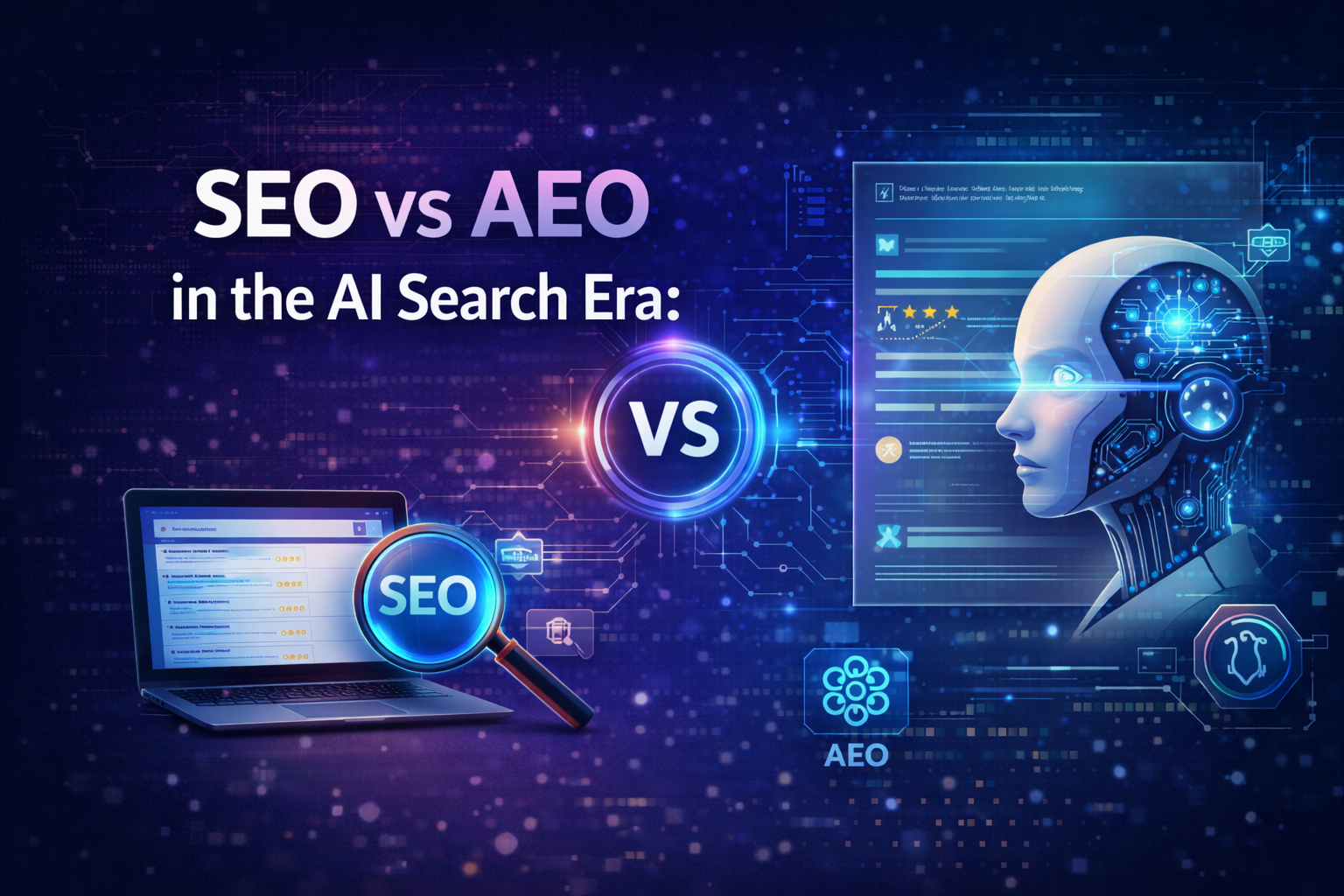
“SEO is dead. AEO is everything.” You’ve likely heard this framing more than once over the past year. It sounds decisive—even urgent—but for leaders accountable for long-term visibility, brand credibility, and revenue, it’s a misleading shortcut.
Search hasn’t disappeared in 2026. It has restructured. AI-driven interfaces like Google AI Overviews, Bing Copilot, and Perplexity now sit between intent and action, interpreting queries, synthesizing sources, and shaping decisions before a website is ever visited. In this environment, ranking no longer guarantees traffic, and traffic alone no longer reflects influence.
This is why many teams feel uneasy right now. Dashboards look fine, but leads are harder to explain, attribution feels fuzzy, and confidence in SEO quietly slips. That tension isn’t about poor execution—it’s the result of how modern search systems now surface, compress, and validate information.
Industry data reinforces this trend—Gartner projects a 25% decline in traditional search volume by 2026 as users increasingly rely on AI-powered interfaces, while SparkToro’s 2024 zero-click research shows nearly 60% of Google searches end without a click to external sites.
This article is not an SEO explainer or an AI hype piece. It is a decision guide for understanding:
- Why SEO and AEO are being misframed as competitors
- How AI-mediated search actually converts visibility into influence
- What changes in strategy, ownership, and measurement matter now
Why “SEO Is Dead, AEO Is Everything” Is the Wrong Debate
This debate exists because teams confuse visibility mechanics with business outcomes.
SEO has always governed eligibility. Content must be crawlable, indexable, structured, and evaluated for quality before it can appear anywhere in search—including AI-generated answers. AI systems do not operate independently of the web; they are constrained by it.
What has changed is how content is used after discovery.
Instead of consistently sending users to websites, modern search systems increasingly extract, synthesize, and present information directly within the interface. This makes Answer Engine Optimization (AEO) visible—but not substitutive.
Organizations that frame this shift as “SEO versus AEO” typically fall into one of two strategic errors:
- They continue optimizing for rankings and traffic, ignoring how AI now shapes perception upstream.
- Or they chase answer visibility without the technical quality, authority, and trust signals required for eligibility.
In reality, SEO and AEO serve different but inseparable roles.
SEO determines what can be surfaced.
AEO influences what is preferred and selected.
When this distinction is missed, teams optimize in opposite directions—and visibility erodes without anyone noticing why.
How Search Works Today: From Clicking Links to Getting Answers
Search has crossed a structural threshold.
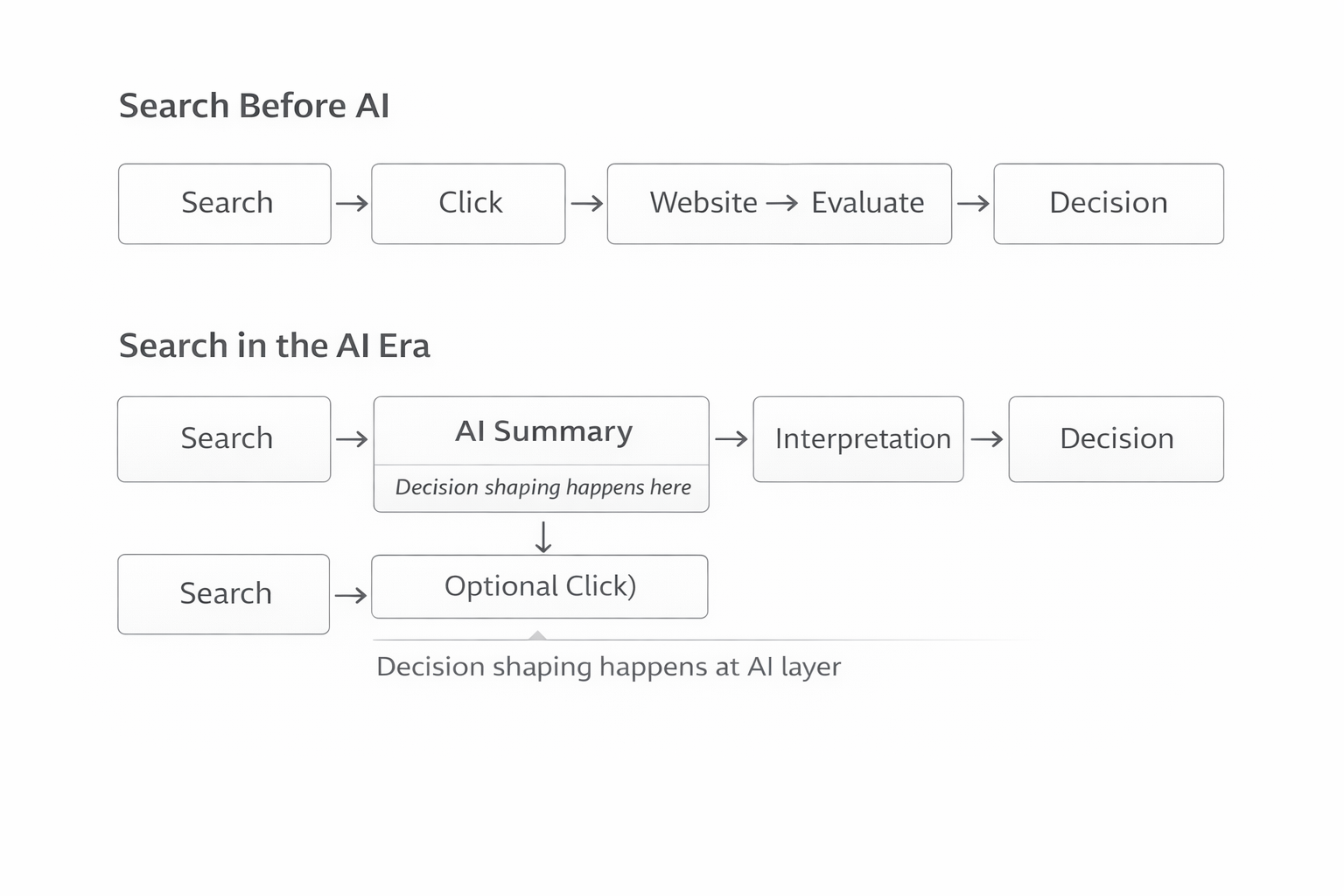
Traditional search asked users to retrieve documents and evaluate them independently. AI-mediated search increasingly interprets intent, assembles context, and presents synthesized conclusions directly within the interface.
Websites are no longer just destinations. They are inputs into decision systems.
Influence now occurs even when clicks do not. Losing traffic does not automatically mean losing impact—but losing authority does. This is why traffic-centric reporting increasingly fails to explain real performance.
Modern search is no longer about winning clicks.
It is about shaping decisions earlier in the journey.
How AI Changed Search and What “AI SEO” Means for Modern Websites
AI did not replace search engines.
It changed how search systems reason.
Large language models interpret intent, compare sources, and generate responses designed to minimize uncertainty. This has led to the rise of “AI SEO,” often misunderstood as a new discipline or shortcut.
In practice, AI SEO is not optimization for a black box.
It is optimization for machine interpretability at scale.
Crawling, indexing, ranking, and quality evaluation still apply. What AI adds is a stricter requirement for clarity, explicit intent, consistent semantics, and content that can be extracted without inference.
AI SEO feels new because it exposes weaknesses traditional SEO could previously mask.
Key takeaway: AI SEO is strong SEO executed with precision, where clarity determines whether eligibility translates into influence.
AEO Explained: What Answer Engine Optimization Really Is
Answer Engine Optimization focuses on one question:
Can an AI system confidently use your content as an answer without misrepresenting it?
While SEO ensures your content can be found, AEO ensures it can be selected. This requires resolving intent quickly, defining concepts clearly, and removing ambiguity.
AEO is not about formatting content for snippets.
It is about making your content safe to rely on.
Key takeaway: AEO earns interpretability and trust, not exposure alone.
Where SEO or AEO Breaks Down in Real-World Scenarios
These failures are easier to see when viewed diagnostically.
Strong SEO, weak AEO: Rankings exist, but AI answers cite competitors because explanations are shallow or inconsistent. The site is eligible, but not preferred.
AEO-style content on weak SEO foundations: Clear answers exist, but poor technical SEO or thin authority prevents inclusion entirely.
Inconsistent content ecosystems: Blogs, service pages, and positioning conflict. AI systems avoid citing the site to reduce risk.
Across cases, the pattern is consistent:Visibility failures stem from misalignment—not missing tactics.
Is AEO Better Than SEO? Understanding Where the Myth Comes From
The belief that AEO is “better” than SEO often emerges when click-through rates decline despite stable rankings. To many teams, this feels like SEO stopped working.
What actually changed is how value manifests. AI-driven interfaces increasingly satisfy intent without a click. Selection becomes visible, while infrastructure fades into the background. But visibility without eligibility is fragile.
The deeper risk is dashboard blindness—trusting metrics that no longer capture where influence is created.
How People Search in 2026: Conversational, Voice, and Intent-Driven Queries
Search behavior is no longer keyword-led.
It is intent-led.
Users ask full questions, follow up conversationally, and expect systems to retain context. Voice assistants reinforce this shift. Content that anticipates follow-up questions and resolves uncertainty holistically now outperforms fragmented, keyword-optimized pages. Pages optimized for isolated queries increasingly fail because they cannot support decision paths.
What Content Ranks in AI Search and How AI Evaluates It
AI systems prioritize content that reduces ambiguity. This includes:
- Clear definitions and explanations
- Consistent topical depth
- Demonstrated expertise and real-world relevance
- Alignment with established consensus and credible sources
AI favors coherence and credibility over volume or keyword density.
Website Quality and Trust Signals That Influence AI Visibility
Trust has become a technical signal.
As AI systems increasingly generate and cite answers directly, the tolerance for uncertainty has decreased. Unlike traditional ranking systems, modern AI-driven search prioritizes sources that appear reliable, accountable, and low-risk to reference. This shifts quality evaluation from individual pages to the overall site and brand. AI systems assess whether a website is safe to cite, not just relevant to rank.
Signals such as clear authorship, demonstrable expertise, domain history, and factual consistency across pages influence whether content is used in AI-generated answers. Frameworks like Google’s E-E-A-T and Search Quality Rater Guidelines formalize these criteria, and their importance intensifies when content is summarized without human mediation.
User experience now functions as a credibility proxy. Unstable layouts, aggressive monetization, broken navigation, or inconsistent publishing standards introduce ambiguity. AI systems designed to minimize hallucination and risk tend to avoid sources that appear operationally unreliable, even when technical SEO is strong.
The absence of trust signals rarely results in overt penalties. Instead, sites are silently excluded from AI summaries and citations while remaining indexed and ranked in traditional search. This creates a reporting blind spot for teams measuring success only through rankings and traffic.
In AI-mediated search, trust is not a branding concept. It is an eligibility constraint. Websites that treat credibility as optional risk losing influence at the decision layer even when users never click through.
Common SEO Mistakes Businesses Make in the AI Search Era
Common failures include:
- Chasing AI tools without fixing SEO foundations
- Publishing shallow content for snippets
- Ignoring authorship and governance
- Treating AI visibility as a hack
The most damaging mistake is assuming fewer clicks mean less value.
What Actually Changes in SEO Strategy (And What Doesn’t)
The shift toward AI-mediated search does not invalidate SEO strategy. It changes the conditions under which that strategy succeeds. The distinction that matters is not old versus new, but foundational requirements versus decision-layer optimization. Businesses that separate these correctly avoid overreacting to surface-level changes.
What Does Not Change
Crawlability
Search systems, including AI answer layers, still rely on consistent access to content. If pages cannot be reliably discovered, parsed, and refreshed, they are excluded from consideration before quality or relevance is evaluated. Crawlability remains a hard eligibility constraint.
Technical hygiene
Site performance, structured architecture, internal linking, and indexation control continue to determine whether content is processed accurately. AI systems do not compensate for broken infrastructure; they amplify its weaknesses by avoiding unstable sources.
Authority
Domain-level credibility, demonstrated expertise, and historical reliability still govern trust. AI systems favor sources with established authority because they reduce the risk of misinformation. Authority is cumulative and cannot be replaced by format or presentation.
Topical depth
Isolated answers do not perform without contextual grounding. Search systems continue to evaluate whether a site understands a topic comprehensively, not just whether it can respond to individual questions. Depth signals reduce ambiguity and improve confidence in citation.
What Does Change
Content structure
Content must now be organized for interpretability, not just discovery. Clear hierarchies, explicit definitions, and logically sequenced sections make it easier for AI systems to extract meaning without inference.
Answer clarity
Ambiguity becomes a liability. Pages that resolve intent directly, address assumptions, and minimize interpretive gaps are more likely to be selected for summaries and citations. Precision outweighs breadth.
Measurement approach
Traditional metrics such as rankings and traffic no longer capture influence accurately. Visibility in AI answers, brand citations, assisted conversions, and downstream recall increasingly reflect real impact.
Page intent design
Pages must be designed around decision stages, not keywords alone. Content that anticipates comparison, validation, and risk assessment aligns more closely with how AI systems mediate choices.
In modern search, SEO strategy does not split into “traditional” and “AI-ready.” It matures. The fundamentals continue to govern eligibility, while structure, clarity, and intent alignment determine whether that eligibility translates into influence.
The Business Risk of Treating SEO as a Traffic-Only Channel
AI-mediated search increasingly shapes perception before a website visit occurs. For many decisions, the first—and sometimes only—exposure to a brand now happens inside AI-generated answers, summaries, and comparisons. This shifts where influence is created and where it can be lost.
When SEO is evaluated solely through traffic and rankings, this influence becomes invisible. Competitors that articulate categories, definitions, and positioning more clearly can be surfaced repeatedly in AI answers, effectively framing the market on behalf of the user. In these environments, brand meaning is formed through summarization rather than exploration, often without any direct engagement.
This creates a structural risk for businesses that rely on traditional SEO reporting. Performance dashboards may continue to show stable rankings and impressions while decision-layer visibility erodes. Revenue impact does not disappear immediately; it disconnects. Over time, demand shifts toward brands that are consistently cited, compared, and trusted by AI systems, even if those brands attract fewer direct visits.
The most significant risk is not traffic loss. It is category displacement. Businesses that fail to account for AI-shaped perception can lose authority over how their offering is defined, evaluated, and remembered—without a clear signal in standard SEO metrics. Adapting SEO strategy to account for this shift is not optional; it is necessary to protect long-term market position.
Splitbit’s Field Learnings on SEO, AEO, and AI Visibility
This isn’t theoretical. These patterns come from live SEO engagements adapting to AI-driven search. Across industries, the sites appearing consistently in AI answers share common behaviors:
- They treat content as infrastructure, not campaigns
- They reduce ambiguity aggressively
- They align technical SEO and content early
- They optimize for decision moments, not keywords
- They measure influence, not just traffic
A Practical Checklist for Using SEO and AEO Together
Eligibility
- Crawlability and indexation
- Clean architecture
- Strong internal linking
Interpretability
- Clear headings and definitions
- Explicit intent alignment
- Consistent entity usage
Trust
- Authorship transparency
- Factual consistency
- Demonstrated expertise
The Real Takeaway: SEO Gets You Found. AEO Gets You Chosen.
SEO earns eligibility.
AEO earns preference.
At Splitbit, this is how we approach modern SEO: protect fundamentals, remove ambiguity, and design content for how decisions are actually made in AI-driven search.