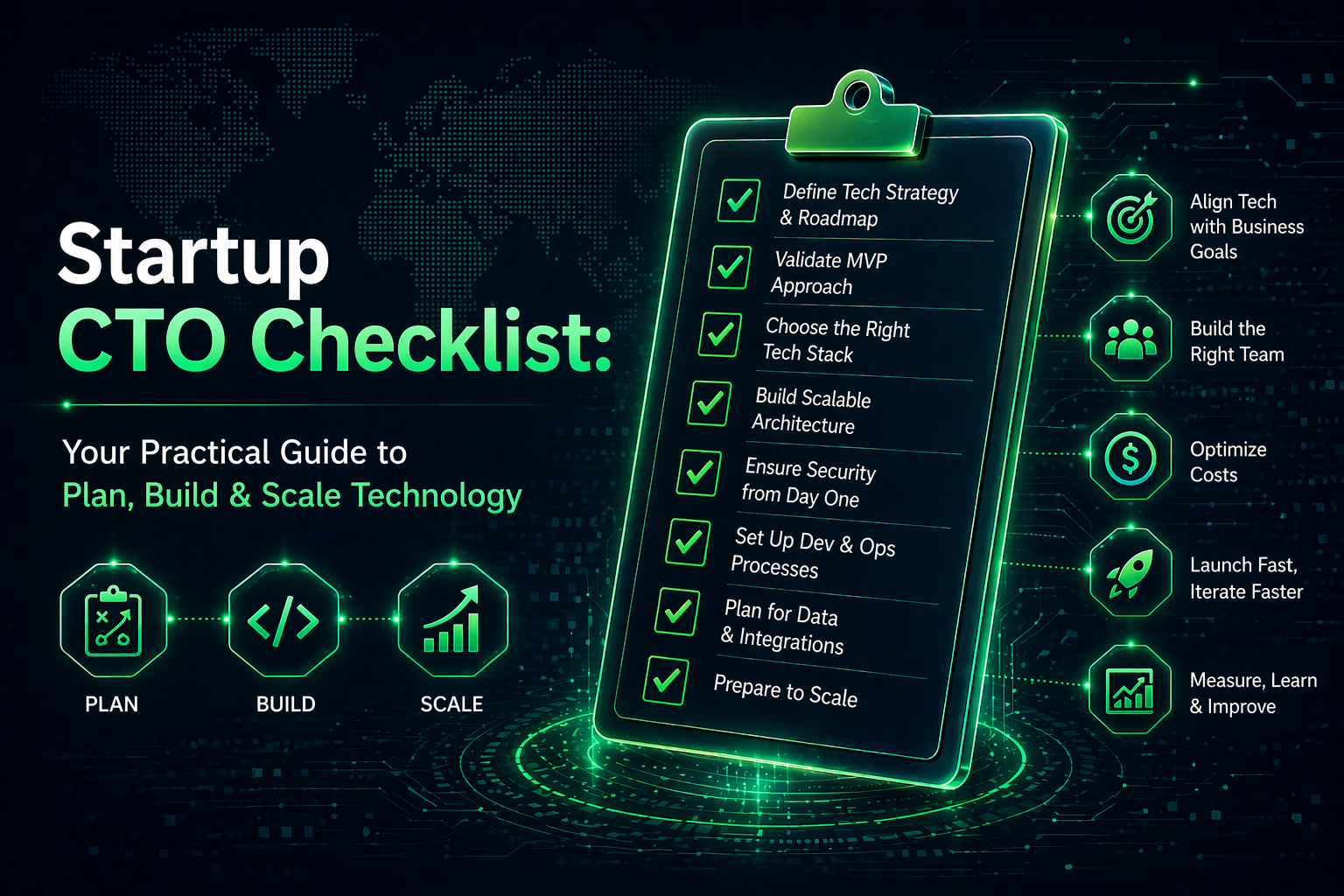
Introduction — Why Founders Must Think Like CTOs in 2026
By 2026, investors evaluate startups as much on technical foundations as on growth or vision. McKinsey estimates technical debt consumes 20–40% of a company’s technology value—making engineering quality a direct driver of risk, valuation, and scalability.
Yet many founders still make high-impact technical decisions without CTO-level judgment, increasing execution risk and embedding hidden fragility. This CTO checklist offers a practical framework to assess readiness, reduce technical exposure, and build systems that support sustainable scale before constraints become costly to reverse.
CTO Mindset & Strategic Vision
Thinking Like a CTO: Key Mental Models for Founders
A CTO mindset prioritizes decision leverage over short-term speed. The goal is not to ship faster at all costs, but to make decisions that preserve flexibility, control long-term cost, and reduce avoidable rework as the company scales.
Every technical decision creates future leverage or future debt. Founders stepping into CTO responsibilities must recognize which decisions are reversible — and which ones lock the company into long-term constraints.
Decision Leverage Frameworks (Non-Negotiable)
Principles:
- Build for adaptability, not theoretical perfection
- Move fast on reversible decisions; slow down on irreversible ones
- Optimize for learning speed early, then system stability as scale increases
- Assume every technical decision compounds leverage or compounds debt
Irreversibility filter: If reversing a decision would take more than three months, materially block growth, or disrupt users, data integrity, security, or infrastructure, it qualifies as a CTO-level decision and requires board-level rigor.
TL;DR — CTO Mental Models
Treat irreversible technical decisions with the same rigor as capital allocation. Every engineering choice either compounds leverage or creates long-term debt.
Aligning Product, Business, and Technology Strategy
Startups rarely fail because the product is wrong; they fail when systems can’t support traction. When product ambition outpaces infrastructure readiness, misalignment becomes a structural growth ceiling.
An aligned technology roadmap connects:
- Product milestones
- Revenue targets
- Infrastructure capacity
- Hiring plans
- Risk mitigation timelines
If these move independently, scale fractures.
Typical failure pattern: Product ambition → infrastructure mismatch → reliability decline → customer churn → stalled growth.
Prevention requires explicit mapping:
- Revenue targets → Product roadmap → Infrastructure capacity → Hiring priorities
- Customer growth → Performance requirements → Cloud and data scaling
- Market differentiation → Build vs. buy → Long-term maintenance cost
Aligned decision-making looks like:
- Architecture planned for projected revenue, not current load
- Roadmaps optimized for customer value and resilience
- Hiring driven by upcoming complexity, not reactive gaps
When product, business, and technology strategy advance together, capital efficiency improves and technical ceilings surface later—if at all.
Prioritizing Features and Initiatives from a CTO Lens
From a CTO perspective, feature prioritization is capital allocation, not backlog management. Every feature consumes engineering capacity, operational overhead, and long-term maintenance cost. The goal is not to build what is loudest or most requested; it is to invest in initiatives that measurably improve revenue, retention, and risk posture.
How CTOs Prioritize Initiatives
CTO-level prioritization evaluates each initiative against four decision-critical dimensions:
- Business impact — revenue growth, churn reduction, and competitive positioning
- Risk reduction — security posture, reliability, and operational resilience
- Engineering effort — time investment, complexity, and opportunity cost
- Long-term system health — maintainability, scalability, and technical debt impact
This approach aligns with established product and engineering prioritization frameworks such as Weighted Shortest Job First (WSJF) and RICE, which emphasize value delivery relative to cost and effort.
A Practical Prioritization Scoring Model
Priority Score = (Business Impact × Risk Reduction × Learning Value) ÷ Engineering Effort
This model reflects a value-over-cost principle used in modern product and engineering planning, balancing outcome potential, uncertainty reduction, and delivery effort.
Ranking guidance:
- High impact + high learning + low effort → Fast-track
- High impact + high effort → Plan, stage, and resource deliberately
- Low impact + high effort → Reject
Negative Example: When a Feature Actively Destroys Value
Feature built → support burden increases → roadmap velocity slows → maintenance cost rises → margins compress
This pattern commonly emerges when teams approve narrowly scoped customer requests without evaluating long-term cost, scalability impact, or opportunity trade-offs. The feature ships, but engineering effort shifts from compounding product value to ongoing support and exception handling.
Real Decision Scenario: Rejecting Feature X
A major customer requests a custom integration that benefits only their internal workflow. While it offers short-term revenue, it introduces recurring maintenance overhead, fragments the codebase, and slows delivery of roadmap initiatives that serve the broader customer base.
A CTO-led decision deprioritizes or declines the request in favor of initiatives that compound value across the market, protecting engineering focus and long-term platform scalability.
Decisive Prioritization Filter
If a feature will not increase revenue, improve retention, reduce meaningful risk, or accelerate validated learning within 90 days, it does not qualify for investment and should be deprioritized.
Founders who adopt CTO-level prioritization protect engineering leverage, prevent roadmap bloat, and ensure every build decision produces measurable business return.
TL;DR — CTO Decision Takeaway
Feature prioritization is a capital allocation decision — fund only initiatives that maximize business impact per unit of engineering effort. If a build does not compound revenue, learning, or risk reduction quickly, it should not receive engineering capacity.
Architecture, Systems & Technology Decisions
Building Scalable, Maintainable Startup Architecture
Early-stage architecture should optimize for iteration speed, clarity, and maintainability—not hypothetical scale. The goal is rapid learning today without embedding constraints that force emergency rewrites later.
Effective early architecture is:
- Simple: minimal moving parts, easy to debug
- Modular: components evolve without cascading failures
- Refactor-friendly: built to change as product–market fit shifts
- Cloud-native: flexible and cost-aware by default
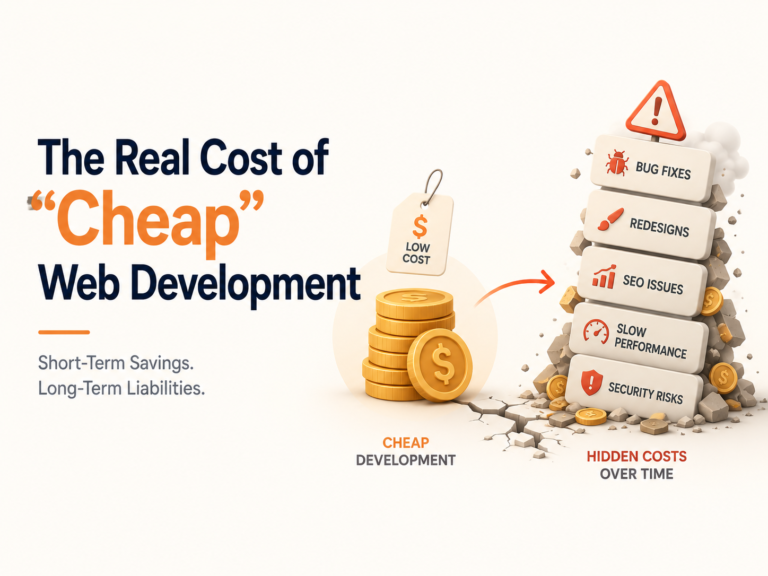
Most rewrites are not strategic upgrades—they are emergency recoveries. Poor early architecture can consume months of runway just as growth accelerates, diverting engineering effort from customer value to reconstruction.
Architecture Strategy That Works in Practice
- Start with a monolith — fastest to build, easiest to change, simplest to operate
- Introduce modular services only when product and team complexity justify separation
- Adopt microservices only when scale is proven through sustained traffic, team size, and operational maturity
Non-negotiable principle: Microservices before scale impose a tax on speed, focus, and burn rate without delivering meaningful upside.
Architecture Anti-Patterns to Avoid
- Over-engineering — designing for imagined future scale
- Premature microservices — adding operational complexity without necessity
- Infrastructure vanity — selecting complex stacks to appear “enterprise-ready”
- Ignoring maintainability — building systems only the original developer can operate
Best practice (2025–2026): Prioritize maintainability, debuggability, and developer velocity before extreme scalability. Startups that commit to clean, adaptable architectures ship faster, avoid forced rewrites, and preserve runway as they scale.
Cloud strategy is financial governance, not infrastructure optimization. Cloud decisions directly affect burn, margins, and runway. Without discipline, cloud spend compounds quietly and erodes operating capital.
Founder blind spot: Cloud bills scale faster than revenue due to idle resources, auto-scaling misconfigurations, and outdated architectural assumptions.
Effective Cloud Governance
- Auto-scale only where it reduces waste
- Monitor compute, storage, and transfer costs continuously
- Separate production and non-production environments
- Track cloud cost per active user or transaction
Financial Benchmark
Cloud spend should generally stay within ~5–15% of SaaS revenue. When costs grow faster than usage or revenue, it signals inefficiency—not progress.
TL;DR — Cloud Cost
Cloud spend is a runway decision, not a technical one. Infrastructure must scale revenue, not burn.
Security, Compliance, and Regulatory Readiness
Security is growth infrastructure. In 2026, security posture directly affects enterprise sales velocity, diligence outcomes, and investor confidence. Weak security slows revenue and caps valuation.
Enterprise buyers increasingly delay contracts when startups lack SOC 2 readiness, documented controls, or clear data-handling practices.
Security Expectations by 2026
- Data privacy compliance (GDPR, India DPDP Act, CCPA equivalents)
- SOC 2 readiness for B2B SaaS
- Strong authentication and encryption
- Role-based access control (RBAC)
Non-Negotiable Security Baseline
- Encryption at rest and in transit
- Secure APIs with access controls
- Regular vulnerability assessments
- Documented incident response plan
TL;DR — Security
Security maturity directly affects revenue velocity and investor trust. Treat security as a revenue enabler, not a cost center.
Data Strategy and Analytics: Guiding Decisions from Day One
Data exists to drive decisions—not to signal activity. From the MVP stage onward, analytics must directly inform where to invest, what to fix, and what to stop building. Startups that collect data without decision intent accumulate noise, not insight.
What Founders Must Lock In Early
- Event and behavior tracking from day one to capture how users actually engage—not how teams assume they do
- Business-critical KPIs tied to revenue, activation, retention, and churn
- Reliable, auditable data pipelines so decisions are based on trusted inputs, not debated numbers
Decision Failure in Practice: When the Wrong Metric Drives the Wrong Investment
A startup optimizes aggressively for sign-ups, assuming growth momentum is strong. Activation and retention metrics are ignored. Leadership increases acquisition spend and accelerates feature development—only to discover months later that most users never reach meaningful usage. Revenue stalls, churn rises, and capital is misallocated. The failure wasn’t execution. It was optimizing the wrong metric.
Non-Negotiable Data Rule
Track only metrics that change a decision—pricing adjustments, roadmap prioritization, retention interventions, or go-to-market shifts. If a metric does not influence action, it does not belong in your core analytics.
Connecting Data to Business Outcomes
Use analytics to:
- Prioritize features that increase revenue or reduce churn
- Identify drop-off points that suppress conversion and lifetime value
- Detect customer behavior that signals expansion potential or retention risk
Bottom line: Analytics is a decision system, not a reporting layer. Startups that use data to guide capital allocation and product direction move faster, waste less, and build more profitable growth paths.
Technical debt is a velocity tax. As it compounds, release speed falls, defects rise, and the cost of change escalates. What starts as a shortcut eventually restricts growth, hiring, and revenue momentum.
Hidden business costs include:
- Slower release cycles
- Rising support and bug workload
- Missed delivery timelines
- Longer onboarding for new engineers
Every quarter of deferred cleanup increases operational friction and erodes competitive advantage.
How High-Performing Teams Prevent Debt
- Track technical debt alongside product backlog
- Reserve sprint capacity for refactoring and performance
- Eliminate repeated quick fixes that create fragile systems
Founder Warning Signals
- Engineers flag deployments as risky
- Simple changes require workarounds
- Release frequency declines despite stable headcount
At this stage, technical debt becomes a business bottleneck, not an engineering issue.
TL;DR — Technical Debt
Unchecked technical debt becomes a revenue and delivery constraint. System health must be managed like financial burn.
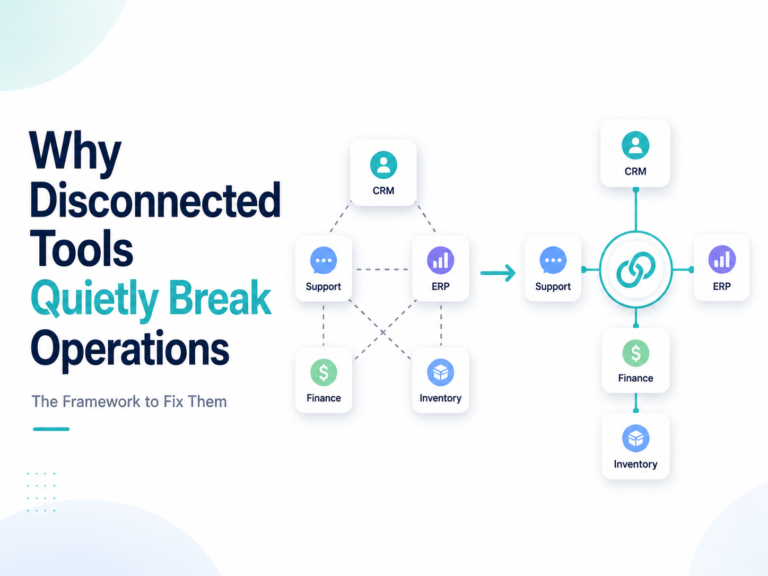
Tooling decisions directly shape cost structure, security exposure, and operational velocity. Without strict governance, startups accumulate overlapping platforms, uncontrolled SaaS spend, fragmented workflows, and growing integration debt—creating risk that compounds as the company scales.
Tool Sprawl Is a Security and Cost Risk
Unchecked tool proliferation weakens access control, fragments data ownership, and reduces visibility into who can access sensitive systems. Each unmanaged tool expands the attack surface, increases operational overhead, and introduces silent compliance risk.
Without centralized governance, these risks often remain invisible until surfaced by a breach, enterprise customer review, or investor technical diligence.
Non-Negotiable Criteria for Evaluating Tools and Vendors
Every tool decision must pass these filters:
- Long-term viability: vendor stability, credible roadmap, and proven maturity
- Security and compliance: data handling standards, access controls, audit readiness
- Integration fit: compatibility with the existing stack and automation workflows
- Cost predictability: transparent pricing, scalable tiers, and spend controls
If a tool fails any one of these, it should not be adopted.
Founder-Ready Tool Approval Policy
Before approving a new platform, require:
- A clear business justification tied to revenue impact, efficiency gains, or risk reduction
- A named owner accountable for usage, access, cost, and renewal decisions
- An integration plan to prevent data silos and redundant workflows
- A quarterly review checkpoint to validate ROI, security posture, and continued relevance
Governance Rule
Every tool must reduce friction—not introduce operational drag. If a platform does not lower cost, strengthen security, simplify workflows, or improve revenue impact, it does not belong in the stack.
Bottom line: Disciplined vendor governance is mandatory. Startups that enforce it control SaaS spend, limit security exposure, reduce integration debt, and scale without accumulating hidden operational risk.
People, Teams & Technical Leadership
Structuring Your Early Tech Team: In-House, Hybrid, or Outsourced
Your early team structure directly impacts product velocity, IP ownership, execution continuity, and valuation. This is not a staffing choice—it is a capital and risk decision that investors scrutinize closely.
The Valuation Lens Founders Miss
Investors routinely discount startups where core product IP is outsourced. Externalized knowledge increases execution risk, weakens defensibility, and raises concerns about continuity post-funding. Even strong traction can be devalued if the product cannot be confidently built, maintained, and evolved in-house.
Team Models — Decision-Focused Comparison
In-House Team
Best when the product represents core IP and long-term differentiation.
Trade-off: Higher fixed burn early, slower initial hiring.
Investor signal: Strong ownership, higher confidence in scalability.
Hybrid Model (In-House Core + Vendors)
Best when speed is required without surrendering control.
Trade-off: Requires tight coordination and clear ownership boundaries.
Investor signal: Acceptable if core logic and roadmap control remain internal.
Outsourced Model
Best for MVP validation or non-core experimentation.
Trade-off: Knowledge dependency, IP ambiguity, and slower iteration over time.
Investor signal: Tolerated early; penalized if extended into core systems.
When Outsourcing Becomes a Growth Constraint
Outsourcing starts to hurt velocity and valuation when:
- Product knowledge lives outside the company
- Internal engineers cannot safely modify vendor-built systems
- Vendors prioritize other clients over your roadmap
At this point, speed gains reverse into refactoring costs, slower innovation, and execution risk.
Non-Negotiables for Ownership and Continuity
- Keep core product logic and architecture in-house whenever possible
- Enforce clear IP ownership clauses in all vendor contracts
- Plan knowledge transfer milestones before fundraising or scaling
- Ensure internal teams can operate independently of vendors
How Founders Should Decide
Anchor the decision to:
- Burn rate and runway constraints
- Product complexity and defensibility
- Need for speed versus long-term maintainability
- IP ownership, continuity, and hiring scalability
- Future fundraising and valuation expectations
Bottom line: Your team structure signals how investable and defensible your startup is. Founders who retain core engineering ownership move faster post-funding, face fewer diligence objections, and protect long-term valuation.
Hiring for Scale: Skills, Seniority, and Culture
Early hiring decisions compound faster than almost any other technical choice. The wrong mix of seniority and skills inflates burn, slows execution, and weakens your ability to scale the product roadmap. Hiring is not a capacity problem—it is a leverage problem.
The Failure Pattern Founders Repeat
Headcount increases. Output doesn’t.
Teams grow, but delivery slows due to rework, unclear ownership, and fragile systems. More engineers create more coordination overhead, not more progress. This failure almost always traces back to missing senior technical leadership early.
What Strong Early Hires Actually Deliver
High-leverage early engineers:
- Adapt quickly as product direction changes
- Communicate clearly across engineering, product, and leadership
- Own outcomes end-to-end, not just assigned tasks
- Design systems and standards, not temporary fixes
- Raise the bar for future hires through mentorship and code quality
The Non-Negotiable: A Senior Technical Anchor
Over-hiring junior engineers without an experienced technical anchor is a structural mistake. Without senior guidance:
- Architectural debt accumulates early and silently
- Rework becomes constant, slowing every release
- Leadership bandwidth is consumed by reviews, debugging, and decision arbitration
Velocity drops even as headcount rises. No amount of junior hiring compensates for the absence of senior technical judgment.
First Five Engineering Hires — Execution-Focused Blueprint
A proven early sequence that maximizes leverage:
- Senior Backend or Full-Stack Engineer — sets architecture, standards, and decision quality
- Product-Oriented Engineer — translates user needs into scalable execution
- Frontend or Mobile Engineer — owns performance, UX, and delivery quality
- QA or Automation Engineer — prevents quality bottlenecks as speed increases
- Junior or Mid-Level Engineer — scales execution under senior mentorship
This structure protects velocity, controls technical debt, and preserves runway while the product matures.
Why This Matters to Scale and Valuation
Hiring for scale is a strategic decision with long-term consequences. The right early team multiplies execution speed, reduces rework, and builds investor confidence. The wrong mix increases burn, slows progress, and raises future operating costs.
Bottom line: Scale comes from execution leverage, not team size. Founders who hire senior judgment early move faster, ship cleaner systems, and scale with control—not chaos.
Technical Culture, Knowledge Sharing, and Mentorship
In early-stage startups, technical culture is not a soft value—it’s a delivery system. The way engineers collaborate, share knowledge, and support each other directly impacts speed, execution quality, and retention. For founders and CTOs, building the right technical culture is a core lever for scaling technology effectively.
High-Performing Teams Prioritize:
- Code reviews — Ensure quality, consistency, and shared ownership.
- Documentation — Reduce reliance on individuals and protect institutional knowledge.
- Mentorship — Accelerate skill development and leadership readiness.
- Psychological safety — Enable faster problem-solving, honest feedback, and innovation.
Retention Costs: Attrition Resets Velocity
Culture directly influences retention. When engineers disengage or leave:
- Knowledge exits with them.
- Hiring and onboarding costs increase.
- Delivery momentum slows across the technology roadmap.
Real Pattern: Culture Failure → Attrition → Velocity Collapse
A common failure mode in scaling startups:
- Weak feedback loops and unclear ownership.
- Senior engineers disengage or exit.
- Knowledge silos form.
- Delivery speed drops and technical debt grows.
This is not a morale issue—it is a direct threat to product velocity and execution.
Founder Rule
Culture compounds faster than code quality. The habits your team forms early—how they review, document, teach, and support—shape engineering performance long after tools and architectures change. Treat culture as a scalable system, not a side concern.
Documentation and Knowledge Systems That Enable Growth
Strong documentation is not overhead—it’s a risk management and scalability system. In high-growth startups, disciplined knowledge management accelerates onboarding, reduces operational fragility, and strengthens business continuity. For CTOs, maintaining effective documentation is a core lever for sustaining velocity and minimizing delivery risk.
Key Benefits of Good Documentation
- Faster onboarding — New engineers ramp up quickly with fewer blockers.
- Reduced dependency on individuals — Knowledge is shared, not siloed.
- Lower operational risk — Fewer single points of failure threaten delivery.
- Smoother execution — Teams move efficiently without waiting on tribal knowledge.
Example: Teams with structured onboarding docs often reduce ramp-up time from 8–10 weeks to 3–5 weeks, improving both delivery velocity and hiring ROI.
Minimum Documentation Coverage
- Architecture overview — System design, dependencies, and data flows.
- Deployment processes — CI/CD, release workflows, rollback steps.
- Security practices — Access controls, secrets management, and threat handling.
- Incident procedures — Monitoring, escalation paths, and postmortems.
Fundraising & Diligence Scenario
Poor documentation raises red flags during fundraising, M&A, or audits:
- Increases operational risk and reliance on founders or key engineers.
- Signals unpreparedness for scale or acquisition.
Conversely, well-maintained documentation demonstrates discipline, reduces diligence friction, and strengthens investor confidence in the startup’s technology roadmap.
Why This Matters: Documentation is risk insurance. It connects engineering discipline to business continuity, ensuring teams maintain velocity while safeguarding knowledge. For founders using a tech checklist, knowledge systems are core infrastructure, not an afterthought.
CTO Decision Frameworks Without a Full-Time CTO
High-Stakes Tech Decision-Making for Non-CTO Founders
When founders make technical decisions without a CTO, intuition alone isn’t enough. What works is a repeatable, battle-tested decision operating system that preserves velocity, reduces risk, and protects the startup technology roadmap.
4-Step Decision Framework
- Define the decision impact — Assess effects on revenue, reliability, security, hiring, and scalability.
- Identify long-term risks — Evaluate lock-in, technical debt, cost creep, and hiring constraints.
- Seek independent technical review — Engage external advisors, senior engineers, or fractional CTOs.
- Document rationale and revisit later — Track assumptions, outcomes, and lessons learned.
This system creates accountability, auditability, and learning loops—a core operational lever in startup tech.
Decision Failure Example: Choosing a new database platform without review led to severe vendor lock-in and migration delays. The team had to rebuild services under tight deadlines, slowing delivery by 40% and increasing costs. A structured framework could have flagged these risks before execution.
Real Decision Walkthrough: Vendor vs. In-House Infrastructure
- Scenario: Decide between managed cloud vendor or building in-house infrastructure.
- Impact: Platform cost, uptime, and future scalability.
- Long-term risks: Vendor lock-in, rising cloud spend, limited customization.
- Independent review: External infra architect evaluates cost and scaling thresholds.
- Decision: Start with managed infra; set migration trigger at 10× traffic growth.
- Outcome: Faster launch today, controlled technical debt tomorrow.
Principle: Speed now, flexibility later—a core founder CTO operating principle.
Decision Postmortem Format (Lightweight)
After major technical calls, document:
- Decision made and why
- Assumptions at the time
- What worked / what failed
- Unexpected risks or costs
- Lessons for next time
Over time, this builds a founder-level technical memory system, improving judgment and reducing repeated mistakes.
Founder CTO Readiness Checklist: Assessing Capabilities and Gaps
This tech checklist for founders is designed to help non-CTO leaders stress-test their ability to make high-impact technical decisions without exposing the company to avoidable execution, security, or scalability risk. It clarifies whether you can safely manage early technical responsibilities—or whether the business requires experienced technical leadership to prevent compounding mistakes.
Use this as a decision tool, not a confidence test. The goal is to identify blind spots early, before they become costly constraints on growth, hiring, or fundraising.
Founder CTO Readiness Checklist — Core Capability Assessment
Assess Core Areas:
- Technical understanding — Evaluate trade-offs and feasibility
- Hiring readiness — Assess engineering talent and seniority
- Architecture oversight — Review system design and scalability risks
- Security awareness — Understand data protection, access control, and exposure
- Vendor evaluation skills — Compare build vs buy and manage external partners
| Area | Score (1–5) |
|---|
| Technical understanding | |
| Hiring readiness | |
| Architecture oversight | |
| Security awareness | |
| Vendor evaluation skills | |
| Total (out of 25) | |
Outcome Mapping
- 20–25 (Strong Readiness): Manage early technical decisions with light advisory support
- 13–19 (Moderate Readiness): Engage a technical advisor or fractional CTO to reduce risk
- Below 13 (High Risk): Prioritize hiring senior technical leadership or long-term CTO support
⚠ Warning: Unchecked gaps increase execution risk, slow delivery, and compound long-term technical and financial exposure.
Using a Fractional CTO or Tech Agency
Fractional CTOs provide senior technical leadership without the commitment of a full-time hire—a strategic option for high-impact guidance while scaling a startup.
Key Contributions:
- Architecture validation — System design, scalability, and tech debt
- Hiring strategy — Role definitions, evaluating senior talent, org design
- Risk assessment — Security, reliability, and vendor risks
- Long-term planning — Aligning technology with business goals
Best Used For:
- Direction-setting — Establishing technical vision and priorities
- Governance — Defining standards, review processes, and accountability
- Decision audits — Evaluating major choices (infra, vendors, architecture, hiring)
When Fractional CTO Beats Full-Time Hire:
- Early-stage team; decisions carry high long-term impact
- Senior judgment needed without daily operational overhead
- Budget constraints make a full-time CTO premature
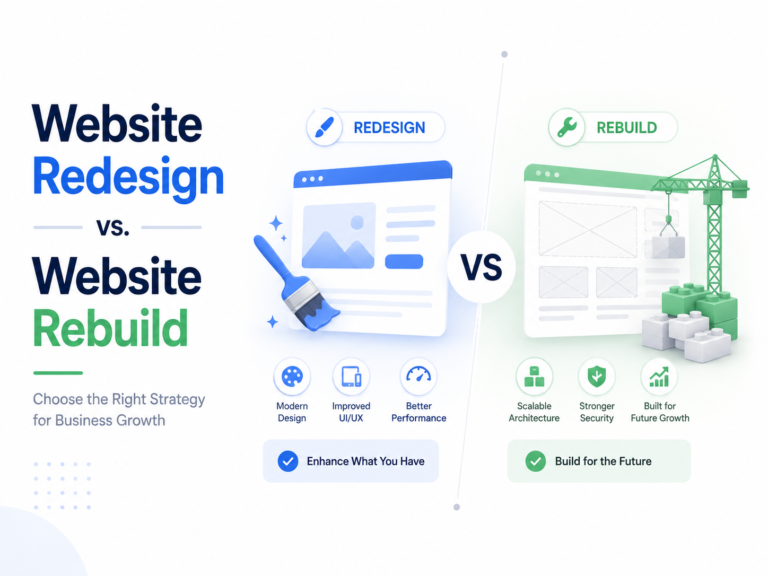
| Model | Strengths | Limitations |
|---|
| Fractional CTO | Lower cost, high leverage for strategy and reviews | Limited day-to-day execution |
| Full-Time CTO | Deep execution ownership, leadership of large teams | Higher cost, upfront commitment |
| Tech Agency | Execution speed | Limited long-term ownership, knowledge retention |
Principle: Maximize decision quality per dollar spent.
Why This Matters: A repeatable decision operating system protects capital efficiency, execution speed, and long-term technical health. Fractional leadership, structured frameworks, and postmortems allow founders to maintain velocity while minimizing risk—without prematurely hiring a full-time CTO.
Scaling, Monitoring & Long-Term Strategy
Portfolio-Level Technology Planning for Multi-Product Growth
Portfolio-level technology planning ensures shared systems, aligned tooling, and scalable foundations—protecting margins and delivery speed as startups expand into multiple products. Without it, small inefficiencies compound quickly, inflating costs and slowing execution.
Scaling Companies Should:
- Share infrastructure where possible — Reduce hosting, DevOps, and observability overhead while protecting margins.
- Avoid duplicated tooling — Standardize CI/CD, analytics, and internal platforms across products.
- Plan for cross-product data integration — Enable unified customer insights and smarter decision-making.
Example: Multi-Product Scaling Complexity
Launching a second product with a separate tech stack, analytics pipeline, and auth system can quickly lead to:
- Higher maintenance and cloud spend
- Fragmented customer data and reporting
- Slower feature delivery due to duplicated engineering effort
Cost Savings Scenario
Shared infrastructure across products (auth, data warehouse, monitoring, deployment pipelines) can:
- Cut cloud and tooling costs by 20–40%
- Reduce duplicated engineering effort
- Accelerate cross-product experimentation and launches
Principle: Shared systems are margin protection; portfolio-level planning turns technology into a scalable asset rather than a cost center.
Monitoring Metrics, KPIs, and ROI from a CTO Perspective
From a CTO lens, metrics must reflect business impact—not activity. If a metric doesn’t influence revenue, cost, risk, or retention, it is vanity and should be removed.
Track metrics that move financial outcomes:
- Engineering velocity: release cadence tied to market responsiveness
- System uptime & reliability: direct effect on churn and trust
- Cost per user: infrastructure efficiency and margin health
- Incident frequency: operational risk and support cost
- Feature delivery speed: time-to-value and competitive edge
Connect technology metrics to outcomes:
- Profitability: align infrastructure and engineering spend with revenue
- Churn reduction: faster fixes and stable systems improve retention
- Investor confidence: predictable velocity and controlled burn signal maturity
Principle: Outcome-driven KPIs turn technology into a growth engine, not a reporting layer.
Preparing for Future Rounds, Scaling Teams, and Infrastructure
Technology maturity becomes a valuation signal in later funding rounds. Investors expect proof that your systems can scale reliably, support team expansion, and sustain execution under increasing complexity.
Founders should treat infrastructure and engineering readiness as strategic assets, not operational details. Demonstrated scalability, system resilience, and disciplined technical execution strengthen credibility, reduce diligence friction, and improve leverage in capital discussions.
Investor Expectations:
- Security readiness: Data protection, access controls, compliance hygiene
- Scalable architecture: Systems that handle growth without major rewrites
- Clean technical documentation: Transparent, auditable, transferable knowledge
- Clear technology vision: Roadmap aligned with revenue, growth, and defensibility
VC Red Flag Example: A startup relying entirely on the founder’s knowledge for critical services often triggers concerns about single points of failure, delaying term sheets or reducing valuation multiples.
Outcome: Startups with modular architecture, disciplined documentation, and strong uptime metrics can:
- Demonstrate lower operational risk
- Reduce diligence friction and accelerate funding
- Justify higher valuation multiples due to scale readiness
Principle: Funding readiness isn’t just traction—it’s technical credibility. Proactive investment in architecture, security, and documentation strengthens CTO responsibilities while positioning the startup for smoother future rounds.
Conclusion
In 2026, technology leadership is a strategic advantage, not optional. Founders who treat technology as a core business strategy make smarter decisions, scale faster, and avoid costly technical resets. Systems, documentation, and disciplined decision-making allow your company to compound knowledge and execution capability over time.
Executive Insight: Founders who embed CTO-level thinking early consistently outperform peers in execution speed, investor confidence, and long-term valuation.
Take Action: Evaluate Your Readiness
Get actionable insights to strengthen your startup technology roadmap and CTO responsibilities:
- Free CTO Readiness Score — Measure your ability to lead early-stage technical strategy
- Strategy Audit — Identify gaps in architecture, hiring, and risk management
- Fractional CTO Consultation — Gain expert guidance without full-time commitment
- Investor-Ready Tech Checklist Download — Prepare documentation, architecture, and KPIs for due diligence
Aligning technology with business strategy is no longer optional—it’s a lever for growth, valuation, and competitive advantage.