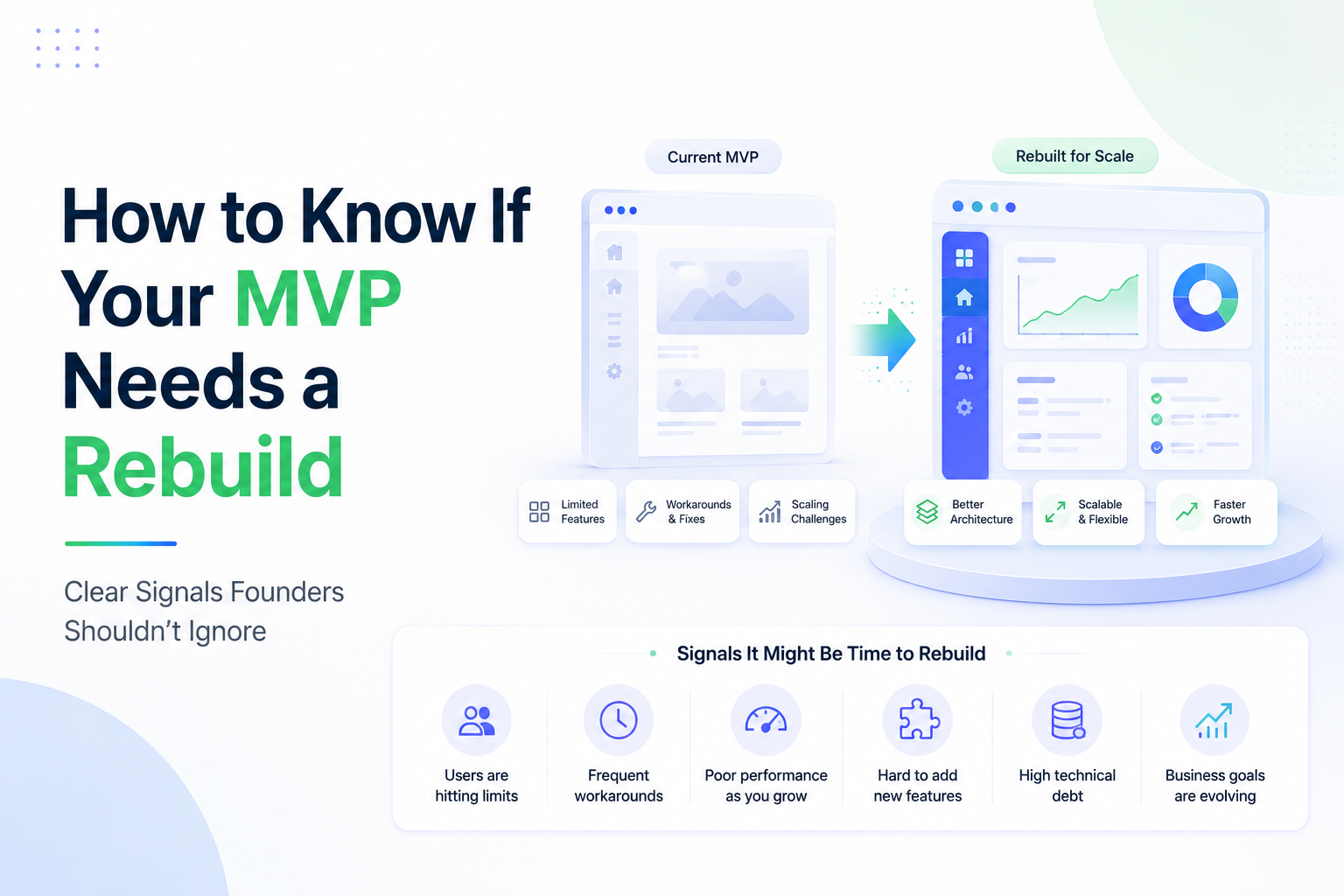
How To Know If Your MVP Needs a Rebuild: Clear Signals Founders Shoudn’t Ignore
Growth was supposed to be the reward. Instead, it became the problem. That's the moment founders don't see coming. The MVP worked. Users came. Revenue followed. And then, almost as punishment for succeeding, the system started cracking — slow performance, failing deployments, engineers spending more time on fires than features. The product that validated your …
Growth was supposed to be the reward. Instead, it became the problem.
That’s the moment founders don’t see coming. The MVP worked. Users came. Revenue followed. And then, almost as punishment for succeeding, the system started cracking — slow performance, failing deployments, engineers spending more time on fires than features. The product that validated your business is now quietly limiting it.
This isn’t bad engineering. It’s a structural inevitability. And knowing when to act on it — before it forces the decision — is one of the highest-leverage calls a founder can make.
Why MVP Growth Exposes a Hidden Technical Ceiling
MVPs are built for validation, not durability. The shortcuts that got you to market—a monolithic codebase, single-server infrastructure, hardcoded configurations—accumulate as technical debt: the compounding cost of decisions made under speed and resource pressure.
In 2026, that cost is no longer abstract. Gartner predicts that 80% of all technical debt will be architectural by 2026. This is a critical distinction for founders. Most assume their problems are “code-level” (like messy syntax) and fixable with a quick cleanup. The data says otherwise: 80% of the debt is now baked into the very structure of your system. It cannot be resolved through a simple refactoring sprint; it requires a deliberate system redesign.
The Consortium for Information & Software Quality (CISQ) estimates this debt costs US businesses $2.41 trillion per year. At the engineering level, McKinsey found that technical debt accounts for 40% of IT balance sheets, effectively siphoning off engineering capacity. Today, over half of businesses spend a quarter or more of their IT budgets just managing this debt—often at the direct expense of innovation.
Your MVP didn’t suddenly become bad. It reached its limit. The question is whether you’ve already hit it.
What an MVP Is Built For- And What It Is Not
An MVP, as Eric Ries defined it, is “the version of a new product which allows a team to collect the maximum amount of validated learning about customers with the least effort.” That definition is important. It says nothing about scale. It says nothing about long-term architecture. It says least effort — deliberately.
This is worth internalising, not as a criticism but as a boundary condition. An MVP is an experiment, not an infrastructure investment. It is designed to answer one question: does this product serve a real need? Once that question is answered, you’re operating under a fundamentally different set of requirements — reliability, performance, flexibility, security — that the original MVP was never built to meet.
The mismatch between what founders expect of their MVP later, and what the MVP was actually designed to do, is where scaling problems in MVPs are born..
MVP Rebuild vs Refactor: What Founders Must Understand First
Before acting, you need to understand what you’re actually dealing with — because choosing the wrong path is expensive in both directions.
Refactoring improves specific parts of your existing codebase without touching the core architecture. It’s right for localised problems: a slow query, a bloated module, an inefficient API call.
Rebuilding replaces the architectural foundation itself. It’s necessary when the structure is the constraint — when issues aren’t isolated bugs but system-wide limitations that refactoring can only mask, not resolve.
The distinction matters because founders frequently invest months and significant engineering budget in refactoring an architecture that was never going to scale — and end up in the same place, later and with less runway.
What’s Happening
What You Need
Isolated performance bottlenecks
Refactor
A specific feature is slow to build
Refactor
Every change breaks something unrelated
Rebuild
New features require rewriting old ones
Rebuild
Architecture blocks your business roadmap
Rebuild
Security and compliance can’t be retrofitted
Rebuild
Signs Your MVP Needs a Rebuild
These are operational signals, not hypothetical warnings. If you’re seeing more than two or three together, you’re almost certainly past the point where refactoring alone is viable.
Sign 1: Your MVP Cannot Handle User Growth Without Breaking
This is the most visible sign that your MVP is not scalable — and often the last one founders act on, because the symptoms arrive one at a time.
What’s happening: Page loads collapse under peak traffic. Server errors spike after a launch or press feature. Infrastructure costs scale faster than revenue. Engineering goes on call every weekend.
Why it’s happening: The MVP was almost certainly built on a monolithic architecture with no autoscaling, no load balancing, no caching layer. It wasn’t built for concurrent high-volume requests — because at the time, there weren’t any.
What it means: Organizations with high technical debt spend 40% more on maintenance and deliver new features 25 to 50% slower than their competitors. Every user you add is working against your architecture. Patching individual bottlenecks buys weeks, not months.
Sign 2: Every New Feature Destabilises What Already Works
You ship a feature. Something else breaks. You fix it. Another thing breaks.
What’s happening: Engineers are afraid to deploy. A change in one module creates unexpected failures in three others. Testing takes longer and longer because the codebase is too tightly coupled to isolate changes safely.
What it means: This isn’t a code quality problem — it’s an architecture problem. Tightly coupled, monolithic systems have no safe surface to modify. The appropriate response isn’t better test coverage or more careful code reviews. It’s a structural redesign.
Sign 3: Manual Workarounds Have Become Part of Normal Operations
Scaling problems in MVPs don’t always show up as crashes. Sometimes they’re quieter: a team member manually exporting data every morning, an engineer running a nightly script to sync records that should sync automatically, a support rep fixing user accounts by editing the database directly.
What it means: Manual operations are not an operational inconvenience. They are fake scalability — the appearance of a functioning product maintained by invisible human effort. Research shows developers spend an average of 33% of their time solving problems resulting from technical debt, and in poorly managed codebases, that figure can reach 50–80%. When a meaningful portion of that is absorbed by manual workarounds rather than product development, you’re subsidising your architecture with people. It doesn’t compound. It collapses.
Sign 4: The Architecture Is Blocking Your Business Strategy
This is the most strategically dangerous sign — and the least visible on a technical dashboard.
What’s happening: You want to add pricing tiers, but billing is hardcoded for a single plan. An enterprise prospect asks for SSO, and your team goes quiet. A potential partner wants API access and there isn’t one. A market expansion requires configuring your current stack doesn’t support.
What it means: Your technology has become a strategy tax. Accenture’s research found that companies with lower-than-average technical debt outperformed their peers in revenue growth — 5.3% versus 4.4% projected over 2024–2026. The inverse is the reality for most scaling MVPs: every new revenue stream, every enterprise requirement, every pivot runs into the same architectural wall. When your infrastructure is dictating your product roadmap instead of enabling it, the constraint isn’t competitive — it’s structural.
Sign 5: Security Gaps and Compliance Risks Are Surfacing
Security vulnerabilities in an MVP are rarely the result of negligence. They’re the result of building before security requirements were understood — before GDPR, SOC 2, or enterprise-grade data handling was on the roadmap.
What’s happening: A security audit surfaces hardcoded credentials. User data isn’t encrypted at rest. Access control is inconsistent. An enterprise prospect’s security team fails your product on a questionnaire.
What it means: The 2025 Verizon Data Breach Investigations Report found that 68% of breaches exploited known vulnerabilities where patches had been delayed due to technical debt. The average cost of a breach now exceeds $4.5 million. Security gaps in a legacy MVP are usually structural, not cosmetic. They reflect architectural decisions made when security wasn’t the constraint — and they cannot be patched without rearchitecting the affected systems.
Sign 6: Investors and Enterprise Clients Are Questioning Your Scalability
When external scrutiny starts generating questions your team can’t confidently answer, that’s a mirror worth looking into.
What’s happening: A Series A investor asks about your infrastructure’s ability to support 10x growth and gets a hesitant answer. An enterprise prospect requests a technical architecture document and your team buys time. A customer asks about uptime SLAs and you quietly redirect the conversation.
What it means: Developers frustrated by convoluted codebases are 2.5x more likely to leave, according to a 2026 Stack Overflow survey — and investors and enterprise buyers are increasingly fluent in what that kind of friction signals. External confidence in your infrastructure is no longer a nice-to-have at fundraising conversations or enterprise sales cycles. It is table stakes.
The Hidden Business Cost of Delaying an MVP Rebuild
The instinct to delay is understandable. A rebuild feels like stopping. But what actually happens while you wait?
Feature velocity continues to decline. Stripe’s Developer Coefficient report found that 33% of every developer’s working week is consumed by technical debt and bad code—roughly 13.5 hours per person, per week. The roadmap slips month after month, not because the team isn’t capable, but because the architecture is consuming the capacity.
Deals start dying quietly. Enterprise clients walk away when technical due diligence raises concerns. Integrations you promised take three months to deliver. Features your competitors shipped in a sprint take you a quarter.
Infrastructure costs rise disproportionately. Instead of cost-efficient cloud scaling, you’re adding servers to compensate for architectural inefficiency. Industry data suggests that nearly one-third of cloud spend is wasted on unoptimized environments; for a mid-sized company, this can easily add $500,000 or more annually in unnecessary infrastructure costs.
Engineers leave. A 2025 study by Pegasystems found that the average global enterprise wastes more than $370 million per year due to its inability to efficiently modernize outdated legacy systems. Engineers who spend their working weeks maintaining fragile systems instead of building products they’re proud of don’t stay.
The rebuild isn’t the cost. Not rebuilding is.
Rebuild Now vs Rebuild Later: A Cost Comparison
Factor
Rebuild at 10K Users
Rebuild at 100K Users
Engineering time required
3–5 months
9–18 months
Risk of customer disruption
Moderate
High
Data migration complexity
Low–Medium
High
Cost (relative)
1x
5–10x
Team size needed
3–5 engineers
8–15 engineers
Competitive window impact
Manageable
Significant
The table above is illustrative, not prescriptive — every product context differs. But the directional truth holds: architectural debt compounds. A rebuild that takes four months at scale-entry can take four times longer at scale-maturity, with far higher operational risk.
When Rebuilding Your MVP Is the Wrong Decision
There are situations where rebuilding would be premature, wasteful, or simply the wrong call — and being clear about this is what separates a diagnostic framework from a sales pitch.
You haven’t found product-market fit. If users aren’t staying and you’re still fundamentally iterating on what the product should be, architecture isn’t your constraint. Rebuilding won’t save a product whose core value proposition isn’t resonating.
Usage is too low to justify the investment. A few hundred active users with no clear traction signal means the business questions still take precedence over the engineering ones.
The problems are genuinely isolated. Not every performance issue is an architectural crisis. A proper technical audit may reveal that the constraint is a slow query, an unoptimised pipeline, or a single overloaded service — that’s a refactor, not a rebuild.
You don’t have the runway or team to execute it safely. A poorly executed rebuild is worse than no rebuild at all. If you can’t do it properly, a phased refactor is a more responsible path than a rebuild that stalls your product for six months under uncertain execution.
How to Plan a Safe and Structured MVP Rebuild
A rebuild done well is not a pause. It is a transition — from a system that constrains you to one that enables the next phase.
Start with a technical audit. Before a single line of new code is written, map the existing system: what’s load-bearing for current users, where the architectural constraints actually live, and how your business roadmap runs into those constraints over the next 18–24 months.
Adopt a phased approach, not a big-bang rewrite. The single most common and costly mistake in software engineering is tearing everything down at once. Build new architecture in parallel, migrate components progressively, and keep the existing product live for current users throughout.
Design for your 3-year roadmap, not your current feature set. What markets will you be in? What compliance standards must you meet? What integrations will enterprise clients require? The rebuild is your opportunity to encode the right business assumptions into the architecture — not just the ones you have today.
Define success metrics before you start. Faster deployment cycles, reduced incidents per sprint, lower infrastructure cost-per-user, improved time-to-feature delivery. These are the metrics that tell you the rebuild worked.
Real Startup Scenario: From Scaling Crisis to Stable Growth
A B2B SaaS company in the HR automation space hit a wall after scaling to its first 50 enterprise accounts. Every new client required manual backend overrides to accommodate unique data structures. Deployments became high-stress “all-hands” events. Two major enterprise deals were lost when technical due diligence revealed a lack of automated audit logging and—critically—a shared staging and production database environment.
The team initially resisted a rebuild because they were in an active fundraise. However, their investors—recognizing a systemic pattern of “leaky bucket” churn and lost deals—pushed for a structural shift.
They adopted the Strangler Fig approach, systematically replacing their legacy data model and API layer over six months while keeping the core product live. By month four, the technical onboarding time for new enterprise clients dropped from three weeks of manual engineering work to just four days of automated configuration. By month six, they successfully re-engaged and closed both of the previously lost enterprise deals.
The rebuild cost them roughly four months of net-new feature development. The alternative—continuing to patch a failing foundation—would have cost them the business.
Why Rebuilding Your MVP Is a Strategic Growth Decision
There’s a narrative in startup culture that frames rebuilding as failure — evidence that you built it wrong the first time. That narrative is worth discarding.
Building an MVP fast is a strategy. It’s the right strategy. Rebuilding when you’ve outgrown it is the natural continuation of that strategy, not a rejection of it.
The companies that scale sustainably treat infrastructure as a product: something to be deliberately invested in at the right moment. Accenture’s 2025 survey of 1,500 companies found that executives now rank AI as the top contributor to new technical debt, on par with enterprise applications — which means the architecture decisions being made today are more consequential than ever. The difference between a throwaway MVP and a growth-ready product is not the features it ships. It’s the foundation those features are built on.
Every sprint you redirect toward a rebuild stops paying for the debt of the past and starts paying for the potential of the future.
Frequently Asked Questions About MVP Rebuilds
You should consider a rebuild when you’re seeing multiple signals together:
Performance Failures: Consistent issues under load.
Increasing Fragility: New features break existing functionality.
Manual Workarounds: ежеднев operations rely on patches or fixes.
Architectural Limits: System prevents business strategy execution.
Security/Compliance Gaps: Cannot be fixed without structural changes.
Refactoring improves specific parts of your code without changing the core architecture—best for localized issues.
Rebuilding replaces the architectural foundation—needed when the structure itself is limiting growth.
The key question: are your problems code-level or architecture-level?
After achieving product-market fit, but before a crisis forces the decision.
The ideal window is when you have enough engineering capacity and runway to execute a planned, phased rebuild.
The better question is: compared to what?
Technical debt can cost hundreds of thousands annually in engineering time and inefficiency.
Over time, the cost of not rebuilding—lost deals, slow development, and system instability—often exceeds the investment in a well-planned rebuild.
Yes, with proper planning.
A phased rebuild allows you to build new architecture in parallel and migrate components gradually.
This ensures continuous service without disrupting users.
A full “big-bang” rewrite carries higher risk and is generally not recommended.
If You Recognised More Than Two of Those Signs, Your Next Move Isn’t a Rebuild.
It’s an Audit.
A rebuild without a prior audit is a guess made at scale. Before any architectural decision, you need an objective read on what your current system can and cannot support — where the real constraints live, what your 18-month roadmap runs into, and whether you’re looking at a targeted refactor or a phased rebuild.
That’s what Splitbit Innovative Solutions does first. We give founders a clear, written technical assessment — no engagement required, no architecture sold in advance. Just an honest picture of where your MVP stands and what comes next.