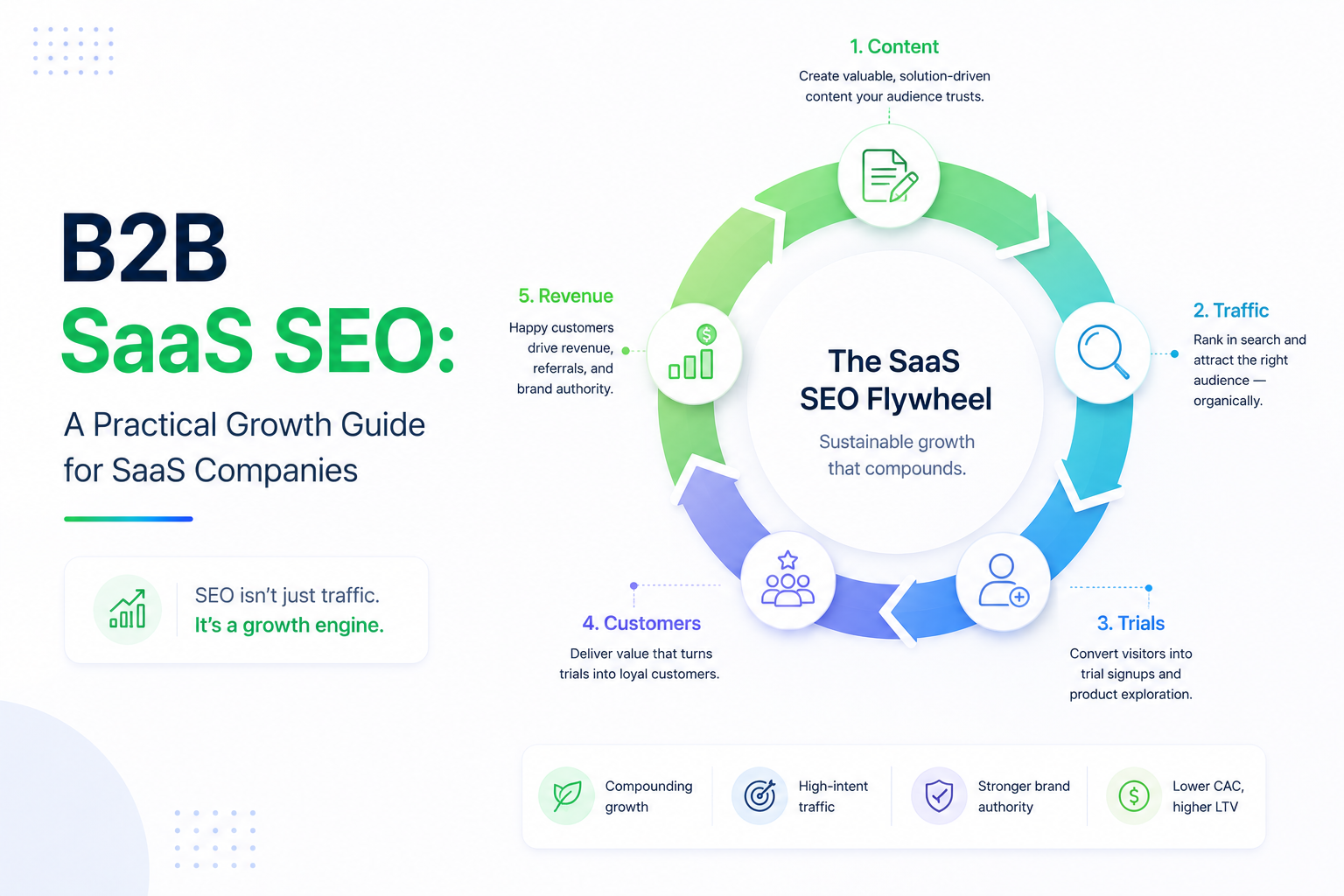
B2B SaaS SEO: A Practical Growth Guide for SaaS Companies
Why Most B2B SaaS SEO Fails (And What Actually Works) Every year, B2B SaaS companies invest in SEO and get almost nothing back in the pipeline. The content gets published. The keywords are researched. The traffic numbers climb. And yet demo requests do not move, trial sign-ups stay flat, and organic search remains invisible in …
Why Most B2B SaaS SEO Fails (And What Actually Works)
Every year, B2B SaaS companies invest in SEO and get almost nothing back in the pipeline. The content gets published. The keywords are researched. The traffic numbers climb. And yet demo requests do not move, trial sign-ups stay flat, and organic search remains invisible in the CRM. The activity is real. The return is not.
The failure is not random — it follows the same three patterns across companies at every stage. The first is building for volume rather than intent: producing content that attracts the wrong audience at scale and earns sessions from people who will never buy. The second is measuring the wrong thing: equating traffic with demand, and discovering the mistake only when the revenue attribution is audited. The third is skipping the technical foundation: crawlability failures, architectural mistakes, and JavaScript rendering issues that silently prevent ranking regardless of how strong the content is.
This guide is built for the founders, technical leads, and growth teams who want SaaS SEO to function as a revenue channel, not a reporting line item. It covers every layer of the system — technical infrastructure, content strategy, authority building, and the conversion architecture that connects organic traffic to closed ARR. Over 90% of B2B content earns zero external backlinks (Backlinko / SeoProfy). The companies that beat that number do not produce more content. They build a better system.
TL;DR for FoundersIf you read nothing else, this is the strategy: • SEO is not traffic. It’s pipeline. Most SaaS SEO fails because it targets volume, not intent. • The highest ROI comes from: comparison pages, integration pages, and product-led content. • Technical SEO is not optional in SaaS — it is the foundation everything else depends on. • AI search is changing visibility, not replacing SEO. The companies cited by AI systems are the ones already ranking on page one. • The companies winning SEO treat it as infrastructure, not content.Build SEO like a system, not a blog.
What B2B SaaS SEO Actually Means
B2B SaaS SEO is the practice of engineering organic search visibility specifically for software-as-a-service products sold to businesses, where the measurable objective is not traffic volume but qualified pipeline — demo requests, trial sign-ups, and closed ARR attributable to organic discovery. It is a distinct discipline from general SEO, and conflating the two is one of the most expensive mistakes a SaaS company can make.
The discipline operates across three interdependent layers, and weakness in any one limits the ceiling of the other two.
The technical layer is the foundation. It encompasses site architecture, crawlability, Core Web Vitals performance, canonical tag management, structured data implementation, and JavaScript rendering behaviour. SaaS sites introduce architectural complexity — the separation of the marketing domain from the application subdomain, multi-product URL structures, and JavaScript-heavy front-ends — that creates failure modes traditional SEO does not face. These must be resolved before content investment produces reliable returns.
The content layer is the engine. Topical authority — the depth and coherence of a site’s coverage of a specific subject domain — has become the primary content-quality signal in Google’s 2025–2026 algorithm. For B2B SaaS, this means building content that comprehensively covers the problem space your product solves, at every stage of the buyer’s journey, in the exact language your ICP uses when they search. This is not a content blog. It is a structured, intent-mapped asset library.
The authority layer is the amplifier. Backlink profiles, brand signals, entity recognition by LLMs, and the broader digital footprint of the company and its people all influence whether search engines and AI systems treat a source as credible and citable. Currently, this extends beyond Google — it includes whether your brand appears accurately and favourably in LLM-generated responses when a buyer asks about your product category.
Why SEO for SaaS Drives Compounding Growth
The business case for SEO in B2B SaaS is not qualitative. SEO delivers a 702% average ROI for B2B SaaS companies over three years, with a break-even point at approximately seven months. No other acquisition channel produces that return at that payback period for companies that execute it correctly. The organic cost per lead for B2B SaaS sits at $164, compared to $310 for paid channels — a structural cost advantage that widens as ad auction prices continue to rise (FirstPageSage).
The proof is in deployment. SPOTIO, a B2B SaaS company, generated over 1,700 demo requests and $2.8 million in new ARR from organic search alone using a product-led content strategy aligned to their ICP’s search behaviour. The mechanism was not publishing volume — it was intent alignment at every stage of the funnel. That is the distinction between a traffic programme and a growth asset.
Every well-executed SEO asset — a ranking article, an earned backlink, a structured data implementation — continues to generate return without additional spend. Every month you delay, that compounding advantage accumulates on a competitor’s balance sheet.
SEO is not a marketing expense. At scale, it is the most capital-efficient growth asset a SaaS company can build.
If your SEO is not generating pipeline, it is not working — no matter what your traffic dashboard says.
How SaaS SEO Is Fundamentally Different from Traditional SEO
The frameworks that govern traditional SEO are necessary but insufficient for B2B SaaS. The differences are structural, and misunderstanding them is where most SaaS SEO programmes make their costliest early mistakes. B2B SaaS purchases move over weeks and months, with multiple decision-makers and a buyer who may consume four to five pieces of content before ever speaking to a sales representative (Isoline). The SEO strategy must map to that entire journey, not just to the point of first discovery. Traffic alone is not a meaningful success metric — the relevant question is always what kind of buyer the traffic represents and where they are in their evaluation cycle.
The keyword intent landscape is materially different. A B2B SaaS buyer does not arrive at a single “buy now” query. They move through problem-awareness searches (“why is my team missing quota”), to solution-awareness searches (“workflow automation software comparison”), to vendor-awareness searches (“[your brand] vs [competitor]”). Each stage requires different content types, different conversion architectures, and different SEO optimisation strategies. Treating all three as a single “target keywords” brief is a category error.
Technically, SaaS sites introduce complexity that most traditional SEO frameworks do not address. The separation between the marketing site and the application subdomain creates crawl budget considerations and canonical structure challenges unique to this architecture. Integration pages built around ecosystem partnerships capture high-specificity searches from buyers who have already decided on a workflow and are evaluating fit — a buyer context that simply does not exist in most non-SaaS categories.
The measurement framework is the most important distinction. In B2B SaaS SEO, the metric hierarchy begins with organic-attributed demos and trials, moves through organic MQLs, then to traffic from ICP segments — not total sessions. A SaaS company receiving 100,000 monthly organic visitors with zero MQL attribution has built expensive brand awareness, not a growth channel. The entire execution system must be built backwards from revenue, not forwards from traffic.
In B2B SaaS, every ranking position is a sales asset. The SEO strategy must be designed to reflect that reality.
Understanding the B2B SaaS Buyer Journey
The B2B buyer journey has three stages — and your content strategy must serve all three. 40% of software buyers spend several weeks or months in research before purchasing, consuming around 4.5 pieces of content before reaching sales (Isoline). 94% now use LLMs at some point during their buying process. Organic search sits at the centre of that pre-sales layer, and content that does not map to a specific stage of it will not convert.
Stage 1: Problem-Aware (Top of Funnel)
The buyer knows something is broken but cannot yet name the solution category. Their searches reflect symptoms, not product categories.
• They search for: “why is my sales team missing quota,” “how to reduce customer churn,” “enterprise workflow automation problems”
• Serve them with: diagnostic frameworks and educational guides structured for AEO citation — clear semantic headings, definition-first paragraphs, internal links into MOFU assets
Stage 2: Solution-Aware (Middle of Funnel)
The buyer knows the category they need and is actively evaluating options. This is the highest-value and most consistently underfunded content type in SaaS SEO.
• They search for: “best CRM for enterprise,” “Salesforce alternatives,” “workflow automation software comparison”
• Serve them with: comparison pages, integration pages, use-case landing pages, ROI calculators — least affected by AI Overviews, highest conversion rate of any content type
Stage 3: Vendor-Aware (Bottom of Funnel)
The buyer is comparing specific vendors and seeking validation. These are the highest-converting queries in your entire programme.
• They search for: “[Your Brand] pricing,” “[Your Brand] vs [Competitor],” “[Your Brand] reviews”
• Serve them with: pricing pages, competitor comparison pages, testimonial-embedded case studies — defend these before investing further in TOFU content
The practical implication: a complete B2B SaaS content strategy requires content at every stage, with clear internal linking pathways that guide buyers from problem awareness through to vendor evaluation without leaving the site.
Modern Search: AI, Zero-Click, and the New Rules of Visibility
Understanding the 2026 search landscape is not optional context — it is a competitive requirement. The companies that understand these structural shifts have a material advantage over those still optimising for how search worked in 2022.
Shift 1: AI Overviews Are Reshaping TOFU Economics
AI Overviews now appear for approximately 15–20% of B2B queries, a significant rise from early 2025 (Semrush / Conductor, 2026). The important nuance: 76% of AIO citations are pulled from pages already in the organic top ten (Ahrefs). The path to AI Overview citation runs directly through traditional ranking. Furthermore, organic listings remain essential for credibility even when an AIO occupies the top of the page, because buyers click through to verify sources.
Shift 2: Zero-Click Is the New Default for SaaS Search Visibility
60% of Google searches now end without a click (SparkToro / Semrush,). Optimising for brand recall within the SERP itself — through schema-rich snippets, FAQ structured data, and well-crafted meta descriptions — is as strategically important as click-through optimisation. Impressions carry brand value even when they do not generate a visit.
Shift 3: LLMs Are a New Discovery Surface
94% of B2B buyers already use AI tools to research products and services. ChatGPT, Perplexity, Gemini, and Claude are active in the pre-purchase research phase. GEO — Generative Engine Optimisation — is the practice of structuring content so it is retrievable, accurately citable, and well-represented by LLMs.
Shift 4: Topical Authority Beats Domain Authority
Google’s 2025–2026 algorithm updates have systematically penalised broad content sprawl in favour of deep, coherent topical coverage — HubSpot’s 77% blog traffic loss being the defining industry example (Ahrefs / ABM Agency). Authority compounds through depth, not breadth.
SaaS SEO by Business Stage
SEO strategy is not one-size-fits-all across a company’s growth trajectory. Capital constraints, team capacity, ICP clarity, and risk tolerance all change significantly between Seed and Series C. Misapplying a growth-stage playbook to an earlier-stage business is a reliable way to waste budget and damage domain equity simultaneously.
Pre-Product-Market Fit / Seed Stage: What SaaS SEO Looks Like Before Product-Market Fit
Do not invest heavily in SEO before PMF. The ICP is still being validated, and content built around the wrong buyer persona is a liability, not an asset. The exception is foundational: secure your branded keywords, establish your primary domain, and implement basic technical hygiene covering crawlability, site speed, and canonical structure. Consider one or two high-intent, long-tail content pieces to test messaging resonance — not as an SEO programme, but as ICP validation with a search-data feedback loop.
Budget signal: approximately 5% of marketing spend, maximum.
Post-PMF / Series A–B: Building Your SaaS Organic Search Foundation
ICP is defined. Now the work begins. Map it to keyword clusters across all three stages of the buyer journey. Build the foundational content architecture: pillar pages anchored to category-level terms, cluster content addressing long-tail subtopics, and integration and comparison pages that capture high-commercial-intent searches. Begin systematic link acquisition through digital PR and original research. MOFU content — comparison pages, use-case pages, ROI calculators — should be the first content priority, as it is both the highest-converting and the least affected by AI Overviews.
Budget signal: 15–25% of marketing spend.
Growth / Series C+: Scaling SaaS SEO as a System
At this stage, SEO becomes a system, not a campaign. Programmatic SEO — across use-case pages, integration pages, and industry-specific landing pages — becomes a viable production lever. The focus shifts from content creation to content architecture: data-driven refresh cycles, original research commissioned as a link and authority engine, and BOFU expansion into competitor comparison pages and pricing transparency content. Sites publishing original research see 67% higher growth rates on average versus those without.
Budget signal: VC-backed growth companies often direct 10–20%+ of ARR to marketing, with organic as the anchor channel.
Keyword Strategy for B2B SaaS
Keyword strategy begins where most practitioners never look: inside the ICP’s vocabulary. Before opening Ahrefs or Semrush, audit your customer’s language. Mine sales call transcripts, CRM win/loss notes, and reviews on G2, Capterra, and Trustpilot. The language your ICP uses in unfiltered professional contexts is the most reliable proxy for how they search.
Intent Distribution: The Right Content Mix for SaaS Organic Growth
The optimal content distribution for B2B SaaS, based on SeoProfy’s 2026 analysis, is 60% informational (problem-aware, educational content), 30% comparative (solution-aware, evaluation content), and 10% commercial or transactional (vendor-aware, decision-stage content). This ratio ensures full-funnel coverage without over-indexing on BOFU content that requires domain authority the site may not yet hold. Most SaaS content teams fail this balance by over-indexing on broad TOFU topics or thin BOFU landing pages, leaving the critical MOFU layer entirely unmapped.
Keyword Categories to Build
A complete B2B SaaS keyword architecture covers six distinct categories:
• Problem-based keywords — describe the pain the product solves: “how to prevent customer churn,” “reduce manual reporting time”
• Job-to-be-done keywords — describe the task a buyer needs to complete: “automate sales reporting,” “track SaaS metrics”
• Category keywords — name the product category: “revenue intelligence software,” “B2B data enrichment tool”
• Comparison keywords — serve buyers who are actively shortlisting: “[Competitor] alternative,” “[Product A] vs [Product B]”
• Branded and near-branded keywords — defend your own brand in search; these represent late-stage buyers and should be captured from day one
Long-Tail SEO Strategy for Early-Stage SaaS Sites
Sites with low domain authority should resist targeting high-difficulty head terms early. Target long-tail keywords of three to five words with a difficulty score of 20–40 in Ahrefs, build a base of ranking pages, and use that authority to compete progressively for broader terms. Lower-competition content compounds more reliably and remains stable longer — giving new sites a structural durability advantage that over-ambitious targeting destroys.
Topical Cluster Architecture
Build pillar pages anchored to category-level terms — for example, “Revenue Operations Software Guide” — and cluster supporting articles around long-tail subtopics that link back to the pillar. Every piece of cluster content reinforces the pillar’s topical authority signal, and every pillar page benefits from the combined link equity of the cluster. This architecture, consistently maintained, is the primary mechanism through which new SaaS sites build the topical authority to compete against established players.
Tools for execution: Ahrefs (keyword research, competitor gap analysis), Semrush (SERP analysis, intent classification), Google Search Console (query performance, CTR optimisation), AlsoAsked (question-intent keyword expansion for AEO structure), AnswerThePublic (ICP language discovery). Keyword strategy is not a one-time deliverable — it is a living map of how your ICP’s language evolves and should be revisited every quarter.
SaaS Content Strategy That Drives Pipeline
The distinction between content that generates traffic and content that generates revenue is not subtle — it is the difference between an expense and an investment. The correct metric hierarchy is: organic-attributed demo or trial requests first, organic-attributed MQLs second, organic traffic from ICP segments third, keyword rankings for commercial-intent terms fourth. Total traffic without ICP qualification is vanity.
The Four Content Types That Drive Pipeline
1. Problem-Aware Guides (Top of Funnel)
These are not “what is [category]” definitions designed to capture generic search volume — they are diagnostic frameworks that help buyers understand their problem with enough precision to begin evaluating solutions. The goal is credibility, not conversion. Presently, TOFU content must be structured for AEO citation: concise answers near the top of sections, FAQ schema at the article level, and named frameworks that LLMs can attribute clearly.
2. Comparison and Alternative Pages (MOFU)
“[Competitor] vs [Your Product]” and “[Competitor] Alternatives” pages are the highest-converting content types available to a B2B SaaS company. They capture buyers who have already decided on a product category and are actively shortlisting vendors. These pages are minimally affected by AI Overviews because the intent is explicitly commercial and vendor-specific. Ahrefs has executed this playbook with documented success — comparison articles consistently ranking on page one and driving direct trial sign-ups. Every B2B SaaS company should have comparison pages for their top three to five competitors built and optimised before investing further in TOFU content.
3. Use-Case and Integration Pages (MOFU)
Pages built around specific use cases, industries, or integrations capture high-specificity searches that indicate purchase readiness. B2B SaaS sites that segment content by industry see 28.7% organic traffic growth on average, compared to 4.1% for those without industry-specific content. Integration pages carry the additional function of signalling ecosystem credibility — a buyer evaluating whether a tool fits their existing tech stack is significantly closer to purchase than one at early problem-awareness.
4. Product-Led SEO Content
This is content that embeds the product directly — interactive demos, guided walkthroughs, embedded calculators, template libraries. Notion’s organic growth engine is built on this principle: every major feature has dedicated, SEO-optimised content with embedded use cases that let users experience the product before committing to a conversation with sales. Websites offering free tools see 35.6% year-on-year organic traffic growth. A buyer who has experienced the product through a content-embedded demo arrives at a demo request with significantly higher intent.
Pipeline content is the only kind of SaaS content that functions simultaneously as an SEO asset and a sales asset.
Content that doesn’t move a buyer forward is not content. It’s noise.
Content That Ranks and Converts
Publishing is the easy part. The quality standard that earns ranking in 2026 is materially higher than it was three years ago, and the gap between content that ranks and content that merely exists has widened with each successive Google algorithm update.
The 2026 Quality Standard: E-E-A-T Applied to B2B SaaS
Google’s E-E-A-T framework — Experience, Expertise, Authoritativeness, and Trustworthiness — has become the governing quality signal for ranking decisions, and it translates into specific, verifiable content characteristics.
• Experience and Expertise: Content must reflect genuine practitioner knowledge — specific tool names, real workflow details, named authors with demonstrable credentials. B2B buyers check bylines. Involving subject matter experts in content creation is a structural requirement, and SaaS sites using original research see 42.2% more backlinks on average.
• Authoritativeness: Being cited by others — linked to by relevant sites, referenced in industry coverage, and increasingly cited by LLMs in response to category-level queries.
• Trustworthiness: Accuracy, currency, and attribution. No unnamed statistics. No outdated benchmarks presented as current.
Structural Elements Every High-Intent SaaS Article Needs
Semantic heading structure should mirror the search query logic — H2 and H3 headings should function as standalone answers to the questions a buyer at that funnel stage would ask. Lead with a clear definition before elaborating — a pattern that LLMs reliably extract and cite. Write concise summary statements at the end of major sections as quotable, self-contained insights. Internal links to related cluster content and conversion pages — demo, pricing, case study — should be contextual and editorial, not appended as afterthoughts. Named source citations with year build E-E-A-T credibility and signal factual accountability to both readers and search engines.
Content Refreshes as a Managed Asset
In 2026, refreshing a ranking page that has slipped from position three to position eight frequently delivers better ROI than publishing a new article. Title tag optimisation, updated data citations, strengthened internal linking, and improved conversion elements can restore ranking velocity in a fraction of the time new content requires. Content inventory is a managed asset — not a publish-and-forget library.
Technical SEO Foundations for SaaS Sites
Technical SEO is not a checklist item — it is the infrastructure that determines whether content investment compounds or leaks. For SaaS specifically, the architectural complexity of the product creates failure modes that traditional SEO frameworks do not account for.
Pillar 1: Site Architecture
Keep the marketing site on the root domain (company.com) and house the application on a subdomain (app.company.com). This preserves all organic equity — backlinks, authority signals, crawl priority — on the root domain. URL structure should be logical, flat, and category-organised: /blog/, /product/, /integrations/, /customers/. For the blog, a subdirectory placement (company.com/blog/) is consistently preferred over a subdomain for SEO purposes — it passes link equity to the root domain, compounding authority with each piece of content published.
Pillar 2: Core Web Vitals — A Ranking and Conversion Signal for SaaS
Google’s Core Web Vitals are ranking signals, and in B2B SaaS they carry conversion implications that extend beyond search. A buyer comparing three to five products will not wait for a six-second page load when a competitor loads in two. Practical benchmarks: Largest Contentful Paint below 2.5 seconds, Interaction to Next Paint below 150 milliseconds, Cumulative Layout Shift below 0.1. These are not aspirational targets — they are the floor for competitive performance.
Pillar 3: Crawlability and Indexation for SaaS Sites
The XML sitemap should include only canonical, indexable URLs — exclude application pages, thank-you pages, filtered parameter pages, and any URL that should not appear in search results. Canonical tags are particularly critical for SaaS sites that generate near-duplicate content through product filters, pricing tier variations, or geographic location variants. For sites with more than 500 pages, log file analysis reveals crawl budget allocation in practice and surfaces pages consuming crawl budget without delivering ranking value.
Pillar 4: Structured Data
Implement Article, FAQPage, HowTo, Product, BreadcrumbList, and Organisation schema as appropriate to page type. Schema markup increases eligibility for rich results and carries increasing weight as a source-quality signal for LLMs, which use schema to assess whether a page is credibly authored, accurately categorised, and reliably maintained.
Pillar 5: JavaScript SEO — The Hidden Risk in SaaS Front-End Frameworks
SaaS marketing sites frequently use React, Next.js, or Vue. The critical requirement is that key marketing content — headings, body text, meta tags, internal links — is server-side rendered (SSR) or statically generated at build time. Client-side-only rendering means Googlebot sees an empty shell on first crawl and cannot index the content. Use Google’s URL Inspection Tool in Search Console to verify that rendered HTML matches the visible page content. This is a common and often invisible failure mode in SaaS sites built primarily by product engineering teams.
Tools for technical SEO execution: Screaming Frog or Sitebulb (site crawl and audit), Google Search Console (indexation monitoring, query performance), Ahrefs Site Audit (automated issue detection), Google PageSpeed Insights (Core Web Vitals measurement), Chrome DevTools (JavaScript rendering inspection).
Technical SEO is not a fix. It’s the foundation everything else stands on.
Building Authority and Links
Link building in 2026 is not a volume exercise — it is a reputation exercise. AI search systems evaluate content based not just on relevance but on demonstrable authority: the breadth and credibility of a brand’s presence across the professional internet. This extends well beyond backlink counts into brand mentions, founder thought leadership, and the digital PR footprint that signals to both Google and LLMs that a source is credible and worth citing.
Original Research as a Link Engine
Proprietary data is the most reliable and durable link acquisition mechanism available to a B2B SaaS company. Surveys of your customer base, benchmark reports built from product usage data, and annual industry trend reports all create assets that other publishers need to cite in order to make specific claims. Original research drives 42.2% more backlinks on average compared to standard content and creates a compounding authority asset that continues earning citations years after publication. Ahrefs’ annual link-building studies and G2’s State of Software reports each earn thousands of industry citations annually — from trade publications, analyst reports, and course creators who embed findings as primary references. The investment is meaningful; the return is structural.
Product-Embedded Link Acquisition
Free tools, calculators, and utility pages earn links because they provide durable, shareable value. Ahrefs’ suite of free SEO tools — Backlink Checker, SERP Checker, Keyword Generator — collectively earns tens of thousands of backlinks from SEO tutorials, course creators, and industry publishers who embed them as go-to resources. This is a content architecture decision with link acquisition as a built-in consequence. Every free tool a SaaS company publishes has the potential to become a permanent link-earning asset.
Strategic Digital PR
The goal is not generic guest post placement — it is coverage in industry publications that your ICP actually reads: trade media, category-specific newsletters, analyst blogs, and professional community platforms where your target persona is active. Coverage in credible category-specific publications signals relevance to both Google and the LLMs that use web citations to build their understanding of a brand’s authority within a domain.
Founder and Expert Brand Building
Now, the professional visibility of a company’s founders and senior practitioners is a legitimate component of its SEO strategy. Founder LinkedIn authority, podcast appearances, conference presentations, and co-authored research all contribute to the entity recognition that LLMs use to assess brand credibility and category authority. A company whose founders are publicly recognised as genuine practitioners in their category is structurally easier for AI systems to cite accurately and favourably.
What Does Not Work
Generic guest post exchanges on low-relevance sites produce no meaningful authority signal and expose the site to Google’s SpamBrain classifier. Volume-over-quality outreach is an investment that damages authority rather than building it. Authority is built through genuine value creation — research worth citing, tools worth recommending, and practitioners worth listening to. The link profile follows as a consequence.
Conversion-Focused SEO for SaaS
Organic traffic that does not convert is expensive brand awareness. The work of SEO does not end when a buyer lands on a page — it extends through the conversion architecture of that page and the journey the buyer can navigate from it. Every high-intent organic landing page must have a conversion design aligned to where the buyer sits in their evaluation cycle.
Conversion Architecture by Funnel Stage
• TOFU pages: Low-friction offers only. A buyer in problem awareness is not ready to request a demo. The appropriate conversions are newsletter subscription, access to a free tool or diagnostic, or download of a research report. The goal is to capture the buyer in a nurture sequence before they leave.
• MOFU pages: Mid-friction offers are appropriate here: access to an ROI calculator, a request for a comparison guide, or a 15-minute discovery call. Buyers at the solution-awareness stage are actively evaluating — they will invest time if the value proposition is specific enough to justify it. Generic “Book a Demo” CTAs without context are the lowest-converting option at this stage.
• BOFU pages: Present the full commercial ask: demo request, free trial, or a direct sales conversation. The buyer has self-qualified; the page’s job is to make the next step frictionless and confidence-building, not to re-educate.
The Product-Led SEO Conversion Model
Embedding product experiences within content pages consistently outperforms static content with a trailing CTA. A guide on “how to automate invoice processing” that includes an interactive demo of your product’s invoice automation feature converts at dramatically higher rates than the same guide ending with a generic button. Buyers who have already experienced product value before a sales interaction are more qualified, faster to close, and less likely to churn after onboarding.
Contextualised social proof converts better than generic testimonials. A customer quote about invoice automation on the invoice automation guide outperforms a generic CEO endorsement in the footer. Internal links should guide the buyer’s next logical step — not every possible destination, but the single most relevant next page. In-content CTAs should reference the specific pain addressed in the article, not generic product language.
The B2B SaaS average SEO conversion rate is 2.1%. TOFU content will sit below this benchmark; BOFU landing pages should target 5–8%+. The channel advantage is real — capturing it requires deliberate conversion architecture at every stage.
Budgeting and Scaling SaaS SEO
Three data points matter for budget decisions in B2B SaaS SEO. Typical SaaS companies allocate 20–30% of overall marketing budget to SEO , with VC-backed companies often directing more as organic becomes the anchor channel. At the content investment level, companies spending $4,000 or more per content asset are 2.6 times more likely to report a “very successful” content strategy than those spending less than $500 per piece — this is the clearest signal that quality of investment matters more than volume. And the return timeline is fixed: meaningful ranking signals appear in months three to six, break-even at approximately seven months, full compounding effects at 12–18 months.
Set stakeholder expectations accurately from the outset. SEO is not a 90-day sprint with a measurable return by quarter-end. Companies that treat it as one consistently underdeliver and underinvest; companies that treat it as the long-term infrastructure decision it is consistently outperform.
Common B2B SaaS SEO Mistakes
These are not theoretical mistakes. They are patterns observed consistently across SaaS companies at every stage, and each one is more expensive in hindsight than it appears in real time.
Mistake 1: Optimising for Traffic, Not ICP
Pursuing high-volume keywords that the ICP would never search in the context of their problem generates impressive traffic dashboards and negligible pipeline — and ultimately risks the topical authority reclassification that cost notable legacy B2B blogs approximately 77% of blog traffic. Every keyword must pass one test: “Would our ICP type this query when they have the problem our product solves?” If the answer is no, the keyword does not belong in the programme.
Mistake 2: Neglecting Technical SEO
Content investment without technical foundation is architecturally equivalent to advertising a restaurant with a permanently locked door. Crawlability failures, page speed deficits, and canonical tag errors silently prevent ranking gains regardless of content quality. SaaS sites are technically complex — the app-versus-marketing-site architecture, JavaScript-heavy rendering, and multi-product URL structures create failure modes that only surface through systematic technical auditing and are often invisible to the content team.
Mistake 3: Treating SEO as a Campaign, Not a System
Publishing twenty articles in Q1 and going quiet for six months destroys whatever compound momentum was built. Content momentum is the mechanism through which topical authority develops — consistent signals that a site is actively maintained, continuously updated, and reliably relevant. Campaigns can launch a programme. They cannot sustain one.
Mistake 4: Ignoring the MOFU
Most SaaS content teams produce TOFU awareness content — high search volume, easy to brief — and BOFU landing pages, which have an obvious commercial rationale. The MOFU layer — comparison pages, integration pages, use-case landing pages — is consistently underfunded despite delivering the highest conversion rates from organic traffic and being the content type least affected by AI Overviews.
Mistake 5: Not Measuring Organic Pipeline
Reporting organic sessions to a CFO achieves nothing strategically. 56% of B2B marketers say they struggle to attribute ROI to content (Content Marketing Institute). The companies that solve this problem — building multi-touch attribution models in GA4 or their CRM that connect organic touchpoints to MQLs, demos, and closed revenue — have more budget, stronger internal buy-in, and more accurate decision data than those still reporting page views as a proxy for success.
Mistake 6: Ignoring LLM Discoverability
LLM discoverability is not a future concern — it is a present competitive gap with measurable consequences. A brand invisible to ChatGPT, Perplexity, or Gemini when a buyer asks about your product category is absent from a growing pre-purchase touchpoint. In practice, this means:
• Your brand does not appear in AI-generated comparison lists for your category
• Perplexity and similar tools return competitor names when buyers research your solution space
• Buyers shortlist vendors they’ve “heard of” from AI research before they ever reach your website
The SaaS SEO Execution Framework
What follows is the Splitbit Organic Growth Framework — a phased execution model built around the mechanics covered throughout this guide. It is designed to be applied sequentially, with each phase building the foundation for the next.
Phase 1: Foundation (Months 0–3)
Begin with ICP definition and buyer journey mapping — every subsequent decision depends on this clarity. Conduct a full technical SEO audit covering crawlability, Core Web Vitals, site architecture, canonical structure, and schema implementation gaps. Run a competitor keyword gap analysis to identify the terms your market is already ranking for. Establish baseline metrics: keyword positions, organic sessions, organic MQLs, and Core Web Vitals scores. Produce three to five foundational pillar or cluster content assets aligned to MOFU intent — these are the conversion infrastructure of the programme and should be live before TOFU content is prioritised.
Phase 2: Authority Building (Months 3–9)
Maintain systematic content production at six to eight pieces per month, aligned to the intent map developed in Phase 1. Begin link acquisition through digital PR, original research, and strategic partnerships — the authority built here accelerates ranking velocity for all subsequent content. Implement the full content cluster architecture: pillar pages interlinked with cluster content, with internal links functioning as a guided buyer journey through the site. Conduct monthly performance reviews tracking keyword velocity alongside absolute rankings. Optimise existing content continuously: title tags, conversion CTAs, internal linking, and data currency.
Phase 3: Compounding (Months 9–18+)
Scale content production based on performance data — invest proportionally more in content types and topic clusters that are demonstrably producing ranking and pipeline results. Launch programmatic SEO where applicable: integration pages, use-case templates, industry or location variants. Commission original research for authority building and link acquisition simultaneously. Expand BOFU content: competitor comparison pages, pricing transparency content, and customer proof pages. Build the LLM entity footprint — ensure the product, founders, and category are accurately and favourably represented by major LLMs through structured data, consistent brand mentions across authoritative external sources, and a coherent digital presence.
Phase 4: Optimise and Defend (Ongoing)
Conduct quarterly content audits — refresh declining pages before they fall off the first page, not after. Maintain continuous Core Web Vitals and technical health monitoring. Track branded query volume as a brand health indicator; growth in branded search is the leading indicator of organic authority building. Expand into adjacent topic clusters systematically, building category dominance through deliberate architecture rather than opportunistic content decisions.
The framework is not a straight line — it is a compounding loop. Every asset built in Phase 1 earns more from the authority built in Phase 2. Every Phase 3 investment in scale compounds the foundation laid in Phases 1 and 2. The system builds on itself, which is precisely why it must be maintained as a system.
How Splitbit Approaches SaaS SEO
Splitbit is a web development and digital growth agency whose technical foundation distinguishes it from content-first SEO providers. Most SEO agencies bolt technical recommendations onto a content programme and rely on client development teams to implement them — often partially, often slowly, and always with translation loss between SEO requirement and engineering execution. Splitbit’s founding model integrates technical SEO into the development process from day one, because the people who build the site are the same people who understand how it must be structured for search.
Most SEO agencies produce content. We build systems that generate pipeline.
This matters practically. Splitbit’s SEO work begins at the architecture phase — rendering strategy, URL structure, Core Web Vitals targets — before a single piece of content is commissioned. The architectural decisions that have the most significant SEO impact — subdirectory versus subdomain structure, server-side versus client-side rendering, schema implementation within component libraries — are development decisions, not content decisions. They are set during the build phase and expensive to correct retroactively. Splitbit’s integrated approach means these decisions are made correctly at the point of lowest cost to change them.
On content, Splitbit’s approach begins with ICP definition and buyer journey mapping before a single keyword is identified. The keyword strategy that follows is intent-mapped across all three buyer journey stages, LLM-optimised in structure, and measured against pipeline attribution rather than traffic volume. Every content asset is built to serve the buyer’s decision process and to be citable by AI systems — not to satisfy a publishing schedule.
Splitbit works with B2B SaaS companies across growth stages — from Series A businesses building their first systematic organic programme to growth-stage companies scaling content architecture and technical infrastructure in parallel. The common thread is that SEO is treated as an engineering discipline integrated into product and marketing decisions from the beginning, not a campaign retrofitted onto an existing site.
If your SEO isn’t generating pipeline, the issue isn’t effort — it’s structure.
Where to start. Before adding more content, you need to understand:
• What your current SEO is actually doing • Where your pipeline gaps are • What’s blocking growth? At Splitbit, we start with a structured SaaS SEO audit — covering technical foundation, content gaps, and revenue alignment — so you know exactly what to fix and in what order.SEO doesn’t fail slowly. It fails silently — until the traffic report arrives and the pipeline hasn’t moved in six months.
SEO as a Long-Term SaaS Growth Asset
The delay cost of not starting SEO is real and quantifiable. Every month a competitor is building organic authority while you are renting paid traffic, their content is compounding and your acquisition cost is rising. The gap narrows only through the same compounding process, which requires 12–18 months to reach full velocity.
In the current environment, this case is more compelling, not less. AI is reshaping search economics: zero-click is the new default, LLMs are an active buyer research surface, and topical authority has displaced domain authority as the primary ranking signal. The companies building for this landscape now — structuring content for LLM citation, building entity-rich authority signals, and integrating technical SEO into every development decision — will be structurally harder to displace in 2027 and beyond. The companies running 2022 playbooks will find the competitive gap widening against them, not closing.
The SaaS companies that will win the organic channel over the next five years are not necessarily those with the largest budgets. They are the ones that treat SEO as an engineering discipline — systematic, compounding, and integrated into product and marketing from the earliest possible stage. That is the approach that earns the returns no other acquisition channel can match at scale.
FAQs on B2B SaaS SEO
B2B SaaS SEO is the practice of engineering organic search visibility for software products sold to businesses, with the goal of generating qualified pipeline — demo requests, trial sign-ups, and revenue from organic discovery.
It operates across three layers:
Technical SEO: Site architecture, Core Web Vitals, and structured data.
Content SEO: Topical authority and intent-based content strategy.
Authority Signals: Backlinks, brand mentions, and search engine trust.
SaaS SEO differs from traditional SEO because the sales cycle is longer and the conversion goals are more complex.
Longer Sales Cycles: Buyers research for weeks or months before converting.
Multi-Stage Intent: Users search across awareness, comparison, and evaluation stages.
Technical Complexity: JavaScript frameworks, app subdomains, and multi-product structures create unique SEO challenges.
Pipeline-Focused Metrics: Success is measured in demos, trials, MQLs, and ARR — not traffic volume alone.
The average break-even point for B2B SaaS SEO is approximately 7 months.
Months 3–6: Initial ranking movement and visibility growth.
Months 12–18: Consistent organic pipeline and compounding results.
SEO is a long-term growth channel that compounds through authority, backlinks, and content depth over time.
SEO delivers an estimated 702% average ROI for B2B SaaS companies over three years.
Average Break-Even: Around 7 months.
Lower CPL: Organic leads average around $206 compared to $463 from PPC.
Strong ROI depends on consistent execution, proper attribution, and long-term investment.
A strong SaaS keyword strategy covers six keyword categories:
Problem-Based Keywords
Job-to-be-Done Keywords
Category Keywords
Comparison Keywords
Integration Keywords
Branded Keywords
The ideal content mix is 60% informational, 30% comparative, and 10% transactional.
AI search is changing how buyers discover SaaS products. Many B2B buyers now use AI tools before traditional search engines.
LLM Visibility Matters: Brands cited in AI responses gain early-stage trust.
GEO (Generative Engine Optimisation): Content should be structured for AI retrieval and citation.
Entity-Based SEO: Clear semantic structure and structured data improve AI understanding.
Most SaaS companies allocate 8–10% of ARR toward marketing, with SEO acting as a long-term acquisition channel.
Growth-Stage Companies: Often invest 10–20% of ARR in marketing.
Efficient-Growth Teams: Lean heavily on SEO to reduce paid acquisition costs.
Content Investment: High-performing SaaS brands typically invest heavily in premium content assets.
The five most critical technical SEO areas for SaaS are:
Site Architecture: Keep marketing pages on the root domain.
Core Web Vitals: Fast loading speeds and stable user experience.
Canonical Tags: Prevent duplicate content issues.
JavaScript Rendering: Ensure important content is crawlable and indexable.
Structured Data: Use FAQ, Article, HowTo, and Organisation schema.