Introduction: Why Your MVP Team Choice Matters
For early-stage founders, deciding how to choose an MVP development agency is one of the highest-stakes calls you’ll make before reaching product-market fit—not because code is expensive, but because flawed execution compounds quietly over time. With 90% of startups failing overall and 42% of those failures attributed to no market need—often due to inadequate validation, an MVP must be more than a technical build. It is a learning engine, a risk-reduction tool, and a signal to investors, users, and future hires. The development team or agency you partner with directly influences how quickly you learn from real users, the kind of product debt you accumulate, and whether iteration feels manageable or painful months down the line.
This blog breaks down what founders should evaluate before signing a contract—beyond portfolios and pricing. You’ll learn how to assess a team’s ability to drive learning, manage early technical and security decisions, support iteration, and align execution with real business signals. The goal is simple: help you avoid building the wrong version of the right idea and choose a development partner who accelerates insight, not just output.
Define Your MVP Needs Before You Start Talking to Teams
Before evaluating agencies or developers, founders must do a harder—but essential—job: clarify what success looks like for this MVP.
This step is often skipped in the rush of selecting the right MVP development agency—yet it determines the quality of every conversation that follows.
Start with the Problem, Not the Product
Strong MVP teams will ask uncomfortable questions early. Weak ones will jump straight into features.
Be clear on:
- What problem are you testing
- Who the early user is
- What uncertainty must this MVP reduce
If you can’t articulate this, you’re outsourcing thinking—not just execution.
Set Scope Boundaries (Explicitly)
Ambiguity is the #1 cause of MVP bloat.
Define:
- What’s in scope for V1
- What is intentionally excluded
- What can be simulated, manual, or mocked
This clarity makes any MVP development agency selection guide—formal or informal—actually useful, because teams are evaluated against the same baseline.
Types of MVP Development Agencies (and How to Choose Based on Your Needs)
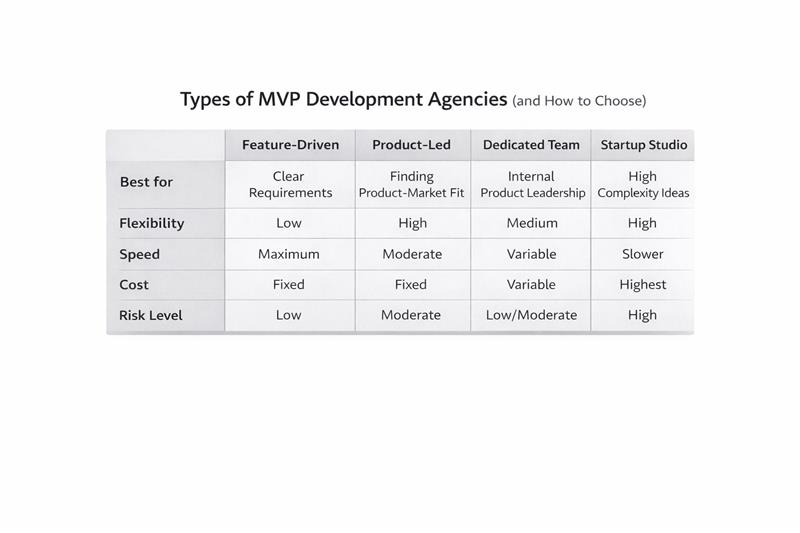
Before comparing portfolios or pricing, founders need to answer a more fundamental question: what type of development partner fits the stage and uncertainty of my MVP? Many poor outcomes stem not from weak execution but from selecting an agency model that doesn’t match the problem being solved.
Feature-Driven Agencies
Feature-driven development agencies focus on delivering clearly defined requirements within a fixed scope. They work best when the product vision is stable, decisions are already made, and the primary goal is execution speed. For founders who have strong internal product leadership and minimal ambiguity, this model can be efficient. However, it often struggles when assumptions change or when the MVP requires ongoing discovery and adjustment.
Product-Led MVP Agencies
Product-led MVP agencies emphasize validation alongside development. These teams typically help challenge assumptions, refine scope, and iterate based on early user feedback. They are better suited for founders still searching for product-market fit, where learning speed matters more than feature completeness. The trade-off is usually higher collaboration requirements and fewer guarantees around fixed scope.
Dedicated Development Teams
Dedicated development teams (staff augmentation or managed teams) provide access to engineers who work as an extension of the founder’s internal team. This model works well when founders have strong product direction but need execution capacity. Its success depends heavily on internal leadership; without clear ownership, momentum and decision-making can slow down.
Startup Studios and Venture Builders
Startup studios and venture builders offer deeper involvement across product, design, and sometimes go-to-market. They can be valuable for non-technical founders or highly complex ideas, but they often come with higher costs and longer timelines—making them less suitable for lean MVPs focused purely on market learning.
The right choice depends on your level of uncertainty, internal capabilities, and how much discovery your MVP still requires. Founders who skip this step often evaluate teams using the wrong criteria—and end up frustrated even when the agency delivers exactly what it promised.
Evaluating Technical and Process Fit (Without Being Technical)
You don’t need to know frameworks or cloud jargon to assess whether a team is technically capable. You need to evaluate how they think and execute, which is central to how to choose an MVP development agency wisely.
Look for MVP-Relevant Experience (Not Enterprise Flash)
Ask:
- Have they built products from zero to first users?
- Can they explain trade-offs (intentional compromises) they made in past MVPs?
- Do they understand speed vs stability decisions?
Teams optimized for large enterprises often struggle with MVP constraints—they overbuild, over-secure, and over-architect.
Evaluate Their Execution Approach
Strong MVP teams typically:
- Break work into short milestones
- Release partial functionality early
- Tie development decisions to learning goals
Be cautious if you hear:
- “We’ll deliver everything at the end”
- “We follow a fixed process regardless”
- “We’ll figure product decisions during development.”
Founder Insight: The right team doesn’t just ask what to build, but why this now.
Assessing Collaboration and Cultural Fit
An MVP is built through constant feedback, not perfect plans. This is often the most underestimated factor when deciding what to look for in an MVP development team or agency.
Feedback Readiness Matters More Than Politeness
Ask:
- How do they handle scope changes?
- What happens when assumptions break?
- Can they challenge your ideas respectfully?
You’re not hiring order-takers. You’re hiring thinking partners.
Look for a Shared Product Mindset
Signals of strong cultural fit:
- They talk about users, not just features
- They reference outcomes, not tickets
- They proactively flag risks early
If a team avoids hard conversations early, they’ll avoid accountability later.
Budget and Value Alignment: Beyond Hourly Rates
Cost discussions derail MVP decisions when founders treat budget as a pricing exercise instead of a learning strategy. Comparing teams purely on hourly rates often hides the real question: what are you paying to learn, and how quickly does that learning reduce uncertainty?
Demand Cost Transparency That Explains Decisions
Strong MVP teams don’t just present estimates. They can explain why those numbers move. At a minimum, they should be able to articulate:
- What drives scope-based cost changes
- Where technical or functional flexibility exists
- Which trade-offs meaningfully reduce spend without weakening validation
Be cautious of vague ranges or rigid fixed bids early on. When requirements are uncertain — as they should be in an MVP — inflexible pricing often reflects inflexible decision-making.
Optimize for Learning Value, Not Raw Velocity
Speed only matters when it accelerates learning. Instead of asking how fast features can be built, founders should focus on how deliberately they’re chosen:
- Which features surface real user behavior earliest?
- Where can architectural or workflow complexity be deferred?
- Which assumptions are the most expensive to validate incorrectly?
Example: A B2B SaaS MVP initially scoped role-based access, configurable dashboards, and detailed analytics. After mapping features against cost and learning impact, the team deferred permissions and analytics entirely. They shipped a single, opinionated workflow to test one core assumption: whether users would return weekly without prompts.
The MVP cost less, shipped sooner, and validated retention risk before investing in scale-oriented complexity.
The Ideal MVP Team Composition
Great MVPs are rarely built by large teams. They’re built by small, senior, cross-functional groups.
Skill Balance Matters More Than Team Size
An effective MVP team usually includes:
- A senior engineer or tech lead
- A product-aware designer (even part-time)
- Someone accountable for delivery and decisions
Avoid teams that stack juniors without clear leadership.
Leadership Involvement Is Non-Negotiable
Ask:
- Who reviews architecture decisions?
- Who is accountable for quality?
- How involved is the senior talent, really?
If senior leaders disappear after sales calls, that’s a warning sign.
Post-Launch Support: What Happens After “Version 1”?
Many MVP failures happen after launch, not before. This phase is often overlooked when founders focus only on selecting the right MVP development agency for delivery rather than iteration.
Clarify Iteration Capability
Your MVP will surface:
- Performance issues
- Security gaps
- Usability flaws
Ask:
- How do they support rapid iteration?
- What does a post-launch sprint look like?
- How do they handle user feedback loops?
Growth Readiness (Without Overengineering)
Good teams plan for:
- Clean handovers
- Scalable foundations
- Clear documentation
But they don’t push premature scaling or heavy infrastructure before it’s needed.
Founder Insight: A strong MVP team helps you delay irreversible decisions until data earns them.
Red Flags When Choosing a Development Team
Not all warning signs are obvious. Many surface quietly in early conversations and only reveal their cost once development is underway. Founders without a clear evaluation framework often mistake confidence for competence — and clarity for alignment.
Strategic Red Flags
These signals reflect how a team approaches product risk, not just delivery.
- Little curiosity about users, assumptions, or how success will be measured
- Immediate agreement with ideas, without pressure-testing priorities or trade-offs
- Generic proposals that could apply to almost any product, regardless of context
Teams that don’t challenge early decisions often push uncertainty downstream, where it becomes more expensive to correct.
Process Red Flags
These affect predictability, accountability, and your ability to adapt.
- No milestone-based delivery tied to outcomes or learning goals
- Ambiguity around who owns decisions, quality, and timelines
- No proactive discussion of data handling, access controls, or basic safeguards
A weak process doesn’t just slow execution — it limits visibility and control when changes are inevitable.
Communication Red Flags
These determine whether collaboration improves or degrades over time.
- Heavy reliance on jargon instead of clear explanations
- Defensive responses to questions or feedback
- Inconsistent points of contact as conversations progress
Communication gaps compound quickly in MVP environments, where decisions are frequent and context shifts fast.
If something feels unclear, rushed, or overly confident in the early stages, it rarely improves once real constraints appear.
Conclusion: Choosing a Partner, Not a Vendor
Strong MVP outcomes rarely hinge on who builds the fastest or charges the least. They emerge when teams share a clear understanding of what must be validated first, how decisions evolve as evidence changes, and where accountability sits when assumptions fail. Whether you follow a formal evaluation framework or rely on instinct shaped by experience, the objective remains unchanged: make progress by learning, not by accumulating features. A capable development partner contributes judgment, not just execution — helping founders avoid premature certainty while moving forward with intent.
A closing note for founders: early product decisions compound quickly. The people you build with shape not only what gets shipped, but how confidently you navigate what comes next. For founders who value thoughtful iteration and principled decision-making, working with teams like Splitbit Innovative Solutions often feels less like delegation and more like collaboration. The right partnership doesn’t just deliver an MVP — it sharpens the founder’s ability to decide well, long after the first version is live.