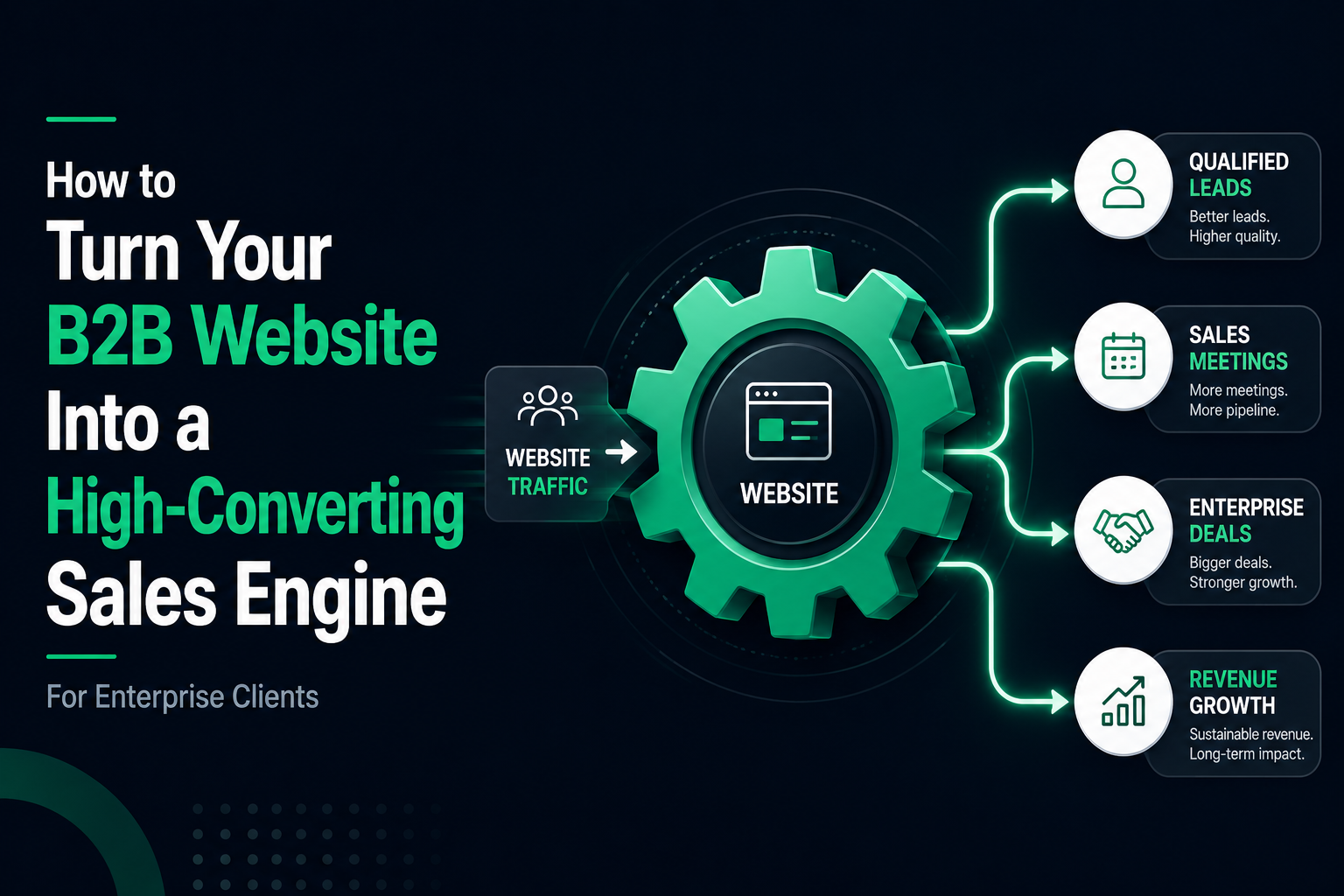
How to Turn Your B2B Website Into a High-Converting Sales Engine for Enterprise Clients
Introduction — Your Website Is Not a Marketing Brochure Enterprise deals involve 6 to 10 stakeholders, play out across 9 to 18 months, and hinge on decisions made in rooms you will never be invited to — yet most B2B websites are still built to impress, not to sell. That disconnect is expensive. Your website …
Introduction — Your Website Is Not a Marketing Brochure
Enterprise deals involve 6 to 10 stakeholders, play out across 9 to 18 months, and hinge on decisions made in rooms you will never be invited to — yet most B2B websites are still built to impress, not to sell.
That disconnect is expensive. Your website is the one asset that shows up to every meeting, answers every question, and represents your company to every member of a buying committee — including the ones you have never spoken to. If it is built like a brochure, it will perform like one.
This article makes the case that ahigh-converting B2B website for enterprise clients is not a design challenge — it is a strategy and architecture challenge. What follows is a section-by-section guide to building a website that earns enterprise trust, equips the people selling on your behalf, and converts serious buyers into pipeline. Not by repeating the standard advice, but by addressing the specific way enterprise decisions are actually made.
TL;DR
You’re being disqualified before sales gets involved. Most enterprise buyers complete their evaluation privately, on your website. By the time they reach out, the decision is largely made.
Your site speaks to one person. The deal involves a committee. Each stakeholder — champion, economic buyer, technical evaluator, procurement — needs different evidence. Most B2B websites serve only one of them.
Vague case studies do more harm than good. Enterprise buyers are building an internal business case, not reading for inspiration. Named outcomes beat anonymised metrics every time.
Pricing silence is friction, not strategy. Buyers want to qualify you before they talk to you. Give them enough commercial context to do that — or lose them to a competitor who did.
One CTA cannot convert a committee. Different buyers are at different stages. A tiered approach — conversations for active evaluators, value assets for researchers, intent signals for early visitors — is what actually moves a complex deal forward.
Measure impact using pipeline and revenue metrics—not traffic—while continuously improving the site using sales feedback and deal data.
Why Enterprise Buyers Walk Away from Most B2B Websites
An enterprise buyer arriving after a peer referral has roughly 8 minutes and is trying to answer three questions: can you handle our scale, have you done this at this level before, and how much risk am I taking on? Most B2B websites answer none of these. That is not a design problem — it is a strategic one.
Messaging built for one persona. Enterprise deals are committee decisions. A homepage that speaks exclusively to the champion — the person who found you and believes in you — ignores the economic buyer, the technical evaluator, and procurement entirely. Each of these people arrives with a different question. A site optimised for one of them alienates the rest.
Value propositions framed around features, not commercial outcomes. Enterprise buyers are not acquiring software. They are building a business case to present to a CFO. Features do not appear in a CFO’s approval criteria — cost reduction, risk mitigation, and implementation certainty do. A site that leads with product capabilities and buries the business case forces the buyer to translate themselves. Most will not bother.
Social proof calibrated to the wrong audience. A logo bar of 200 SMB customers is not neutral — it is negative evidence for an enterprise buyer. It signals that your product may not operate at their scale. One enterprise case study with deal size, implementation complexity, and a measurable business outcome outperforms a hundred generic testimonials. Proof must be peer-relevant to work.
No content for buyers already in evaluation. Most B2B websites are built for strangers at the top of the funnel — people who have never heard of you and need to understand what you do. Late-stage buyers are different. They have already decided to evaluate you. They arrive needing procurement-ready documentation, security compliance details, and implementation specifics — and find nothing.
Fixing these is not a design problem. It is a strategy and architecture problem, which is exactly what the rest of this article addresses.
Inside the Enterprise Buying Committee: How Decisions Are Made
Your website is not being evaluated by one person. It is being evaluated by a committee — serially, asynchronously — and your website content is the only thing in the room when you are not. Understanding who is in that room is the prerequisite for everything that follows.
The champion wants ammunition. They found you, they believe in you, and they are now selling you internally. The website needs to give them assets they can forward without embarrassment: executive summaries, ROI evidence, and peer-company case studies that make the internal case for them. If your site cannot equip the champion, they will lose the deal before you ever get a chance to lose it externally.
The economic buyer wants risk reduction, not product depth. They will spend four minutes on your website and look for two things: evidence that you have delivered at their scale, and a signal that the commercial relationship is manageable. They are not reading your feature matrix. They are answering the question: is this a career-safe decision?
The technical evaluator will go deep. They will find your integration documentation, your security page, and your API reference — or they will mentally disqualify you before the conversation moves forward. This stakeholder often makes a unilateral no-go decision based on what they cannot find.
Procurement is not trying to understand your product. They are reducing legal and financial exposure. They need contract terms, compliance certifications, and a transparent commercial model. If this content does not exist on your site, procurement will slow the deal while they wait for you to produce it manually.
These four people visit your website at different times, from different entry points, and none of them will read the same pages. The website architecture must work as a coherent whole even when encountered in fragments — because it will be.
The champion’s burden is the thread that runs through the rest of this article. The internal person advocating for you needs your website to do their job. Build for them first.
Enterprise Positioning and Ideal Client Clarity
Positioning for enterprise clients requires more precision than most B2B companies apply. A well-defined Ideal Customer Profile for enterprise does not stop at industry and headcount — it includes buying-trigger scenarios and deal-disqualification criteria.
Buying triggers matter because enterprise organisations do not buy on a schedule. They buy when something changes: a compliance requirement, a merger, a leadership change that opens budget, or a competitor event that creates urgency. A website that speaks to these triggers — not just to general pain points — signals to a buyer that you understand their context, not just their category.
Disqualification criteria, stated clearly on the site, are counterintuitive but powerful. Negative positioning — naming the client profiles or deal scenarios you are not built for — builds credibility with enterprise buyers. It communicates that you have enough client experience to know where you succeed and where you do not. For a buyer who has been burned by an undersized vendor before, that specificity is reassuring.
On the homepage or solutions pages, this translates directly. Name the tier, the organisational complexity, or the type of company you serve in the hero — not in the fine print. Generic positioning (“for growing businesses of all sizes”) is a disqualification signal to enterprise buyers. Specificity is the magnet.
Mapping Your Website to the Enterprise Sales Funnel
Funnel Stage
Page Type
Content Job-to-Be-Done
Awareness
Homepage, Thought Leadership
Signal relevance and credibility at enterprise scale
Consideration
Solutions Pages, Case Studies
Mirror the buyer’s specific context; build the business case
Remove risk from the decision; equip procurement and technical teams
Decision
ROI Frameworks, Executive Summaries, Reference Customers
Arm the champion for internal approval
Post-Decision
Onboarding Timeline, Implementation Guides
Reduce the perceived risk of commitment
The table above is useful, but it conceals the most important insight in this section: enterprise buyers do not move linearly through the funnel.
A technical evaluator enters at the evaluation stage with no prior awareness journey on your site. An economic buyer dips in at the decision stage after the champion has already briefed them. Procurement arrives last, at a stage most marketing teams have never built content for. Each of these visitors re-enters at a different point, revisits the same pages multiple times across different weeks, and arrives through different channels.
The website architecture must accommodate non-linear journeys without losing narrative coherence. That means ensuring that every key page — not just the homepage — can orient a new visitor, make the value proposition clear, and offer a relevant next step, regardless of which page they land on first.
Transforming Key Pages Into Enterprise Sales Assets
Most B2B website audits cover everything from page speed to button colour. This section covers only the four pages where enterprise deals are won or lost.
Homepage. The enterprise buyer’s first question is not “what do you do?” — it is “are you for someone like me?” The homepage must signal relevance to enterprise scale within the first scroll. Name the tier, the complexity, or the type of organisation you serve in the hero statement — not in a sub-heading three screens down. Generic positioning (“helping businesses grow faster”) is a disqualification signal to a buyer who has been burned by vendors who overpromised and underdelivered at scale.
Solutions and Use-Case Pages. Most B2B companies build one solutions page. Enterprise buyers need their specific context reflected — by industry, by company size, by organisational trigger. A manufacturing company navigating a compliance deadline has a different problem than a financial services firm integrating after an acquisition, even if your product solves both. One undifferentiated solutions page is a page written for no particular buyer.
Case Studies. The enterprise buyer reads case studies as mirrors, not testimonials. They are looking for a company that looks like them, facing a problem that looks like theirs, with a measurable outcome they could use in an internal business case. Anonymised results and vague “significant improvements” are worse than no case study at all — they suggest the vendor has something to hide. Include deal complexity, implementation timeline, and a specific, quantified outcome.
Pricing Page. The default instinct is silence — withhold pricing and force a sales conversation. For enterprise buyers, this creates unnecessary friction at exactly the moment when they are trying to assess whether evaluation is worth their time. A pricing philosophy page (“enterprise contracts are structured around seat count and integration scope — typical engagements range from X to Y”) qualifies buyers and pre-warms conversations far more effectively than a blank page with a “contact us” form.
Designing for the Multi-Stakeholder Buyer Journey
Section 06 addressed what each page contains. This section addresses how the website works as a system across multiple visitors with different roles — and why that distinction matters.
Role-specific content hubs. The champion’s most useful action is sharing a link. “Here is the technical documentation for your security team” or “here is the ROI framework for the finance review” — these are the messages your champion needs to be able to send. A resource centre structured by stakeholder role or by evaluation stage makes this possible without personalisation technology. It is content architecture, not martech. Tag resources clearly: for technical teams, for finance, for executive review, for procurement. A committee member who arrives and finds something immediately useful for their role is a committee member who keeps the evaluation moving.
Deal-room readiness. There are five assets enterprise champions most frequently need and cannot find on most vendor websites: a one-page executive summary of the solution, a security and compliance FAQ, an implementation timeline with realistic milestones, a total cost of ownership framework, and a reference customer list they can share with procurement. These assets exist in most companies’ sales decks. The insight is that they belong on the website — accessible to any committee member who arrives looking for them, not locked in a PDF sent only to active prospects. Making them public is not a risk — it is a competitive advantage.
The website that wins enterprise deals is the one that makes your champion’s job easier before the first sales call — and keeps making it easier throughout the evaluation.
Trust Architecture: Proof, Transparency, and Risk Reduction
Enterprise buyers are risk managers first. Trust is not a feeling built through brand consistency — it is an accumulation of specific signals across the site that collectively answer one question: is choosing this vendor a career-safe decision?
Scale-calibrated social proof. The issue is not logo count — it is logo quality and context. An annotated logo bar that includes company size, industry, and the type of challenge solved communicates enterprise relevance in seconds. “Company X (12,000 employees, financial services, post-acquisition integration)” tells a different story than a logo sitting unattributed. One relevant, contextualised logo communicates more than thirty uncontextualised ones.
Commercial transparency. Enough signal on pricing structure and contract norms that a buyer can assess fit without committing to a discovery call. This is not a price list. It is the removal of the fear that evaluation is a trap — that engaging with your sales team locks them into a process they cannot exit. Buyers who feel informed before the first conversation are significantly more likely to enter one.
Compliance and security signals. For vendors selling to regulated industries or large enterprises, the absence of a dedicated security page or compliance certification list is a hard stop for technical evaluators. This content should be reachable in under two clicks from the homepage. If it requires a search or a sales request, it is effectively invisible.
Process transparency. Describe what implementation and onboarding actually look like — phases, timeline, internal resource requirements, and what happens in the first 90 days. A buyer who understands the delivery model before the first call arrives with realistic expectations and significantly fewer objections. More importantly, they arrive as a lower-risk counterpart — which accelerates the approval process internally.
Conversion Architecture for Enterprise Buyers
Here is the instinct that costs more B2B companies enterprise deals than anything else: a single “Request a Demo” CTA optimised for volume. High-volume outreach feels like noise to a senior enterprise buyer. Generic demo request forms signal vendor immaturity. And an enterprise buyer asked to fill in a standard lead-capture form before they have established any trust will simply leave.
The alternative is a three-tier CTA architecture, designed to meet buyers at the intent level they are actually at.
High-intent tier — buyer is in active evaluation. CTA language that signals a different kind of conversation: “Speak to a senior solutions consultant,” “Request a custom assessment,” or “See how we’ve solved this for [industry].” These calls to action should be prominent, above the fold on key pages, and should promise an expert conversation — not a product demonstration optimised for closing. The buyer at this stage is not deciding whether to buy. They are deciding whether to shortlist you.
Mid-intent tier — buyer is in research mode. Gated assets where the gate is justified by the content’s standalone value: a benchmark report, a technical integration guide, a total cost of ownership framework. The test for whether content should be gated: would an enterprise buyer consider paying for this information, even in a different format? If the honest answer is no, do not gate it — gatekeeping commodity content trains buyers to ignore your forms.
Low-intent tier — buyer is visiting but not yet engaging. No gate, no form. Instead: content consumption tracking, company identification via reverse IP tools, and CTA click behaviour feeding warm account signals to the sales team. This tier exists to surface intent data, not to capture it prematurely. The goal is to identify which target accounts are active and hand that signal to the team who can act on it, not to force a premature conversion that ends the relationship before it starts.
The gating decision rule is simple: gate content that helps a buyer do their job — calculate ROI, evaluate integration complexity, benchmark their current state. Do not gate content that helps a buyer understand your product. That gate serves the vendor, not the buyer. Enterprise buyers recognise the distinction immediately.
Every conversion path on an enterprise website should feel like it reduces friction for the buyer — not creates administrative overhead for the vendor.
Content Strategy for Long and Complex Sales Cycles
Enterprise evaluations do not stall randomly. They stall at three predictable points, and each one requires a specific type of content to keep the deal moving.
The problem-definition stage. The buyer is asking: do we actually have the problem this vendor solves, at the scale they describe? The content that answers this is diagnostic — benchmarking tools, industry-specific problem frameworks, and “are you ready to evaluate?” checklists. Not blog posts about the problem in general. Specific, structured content that helps the buyer articulate their own situation.
The evaluation stage. The buyer is asking: why this vendor over the three alternatives we are also assessing? The content that answers this is comparative — capability matrices, third-party validation, and detailed case studies from recognisably similar companies. Generic “why us” pages do not answer this question. Specificity does.
The late-stage internal approval stage. The buyer is asking: how do I get this through procurement, legal, and executive sign-off? The content that answers this is approval-ready — executive summaries, ROI models, security and compliance documentation, and implementation timelines. Most companies have this content in sales decks and never publish it. Publishing it, even selectively, removes weeks from the approval timeline.
Metrics That Prove Your Website Is Driving Revenue
Vanity metrics — total traffic, bounce rate, page views — tell you very little about whether your website is contributing to revenue. The metrics that matter in enterprise B2B sales are:
Qualified lead conversion rate: What percentage of website leads meet your ICP criteria? A low number indicates messaging misalignment.
Time on high-intent pages: Are buyers spending meaningful time on your services pages, case studies, and methodology content? Depth of engagement signals buying intent.
Sales cycle duration from first touch: Are leads who came through the website closing faster than outbound leads? If yes, your content is doing pre-qualification work.
Demo-to-proposal conversion rate: A high drop-off at this stage typically means buyers are arriving underprepared — a website problem, not a sales problem.
Beyond the Redesign: Your Website as a Living Sales System
Most companies treat their website as a project. It has a brief, a budget, a launch date, and a celebration. Then it sits.
The shift that separates companies that consistently win enterprise deals from those that do not is treating the website as a product — with a roadmap, a backlog, and a feedback loop.
Two inputs should drive that roadmap. The first is deal-stage content gaps identified from CRM data: which stages are deals stalling in, and what content would help move them forward? The second is sales team objection feedback from calls: what questions are buyers asking that the website is not answering? Both of these inputs are available in most companies without additional tools. The data exists. The practice of using it to update the website systematically does not.
In 2026, AI-powered intent tools that identify which accounts are in-market are accessible at mid-market scale — not just for enterprise vendors with eight-figure marketing budgets. These tools turn the low-intent tier of the conversion architecture from a passive content layer into an active account signal channel.
Companies that win enterprise deals consistently do not ask “when is the next redesign?” They ask “what changed this quarter that should change our website?”
Conclusion: Your Website Is Revenue Infrastructure
The companies that win the largest enterprise deals are not always those with the best product. They are the ones that made the evaluation process easiest, built trust earliest, and removed the most risk from the decision.
A B2B website built for enterprise buyers is not a collection of well-designed pages. It is a system that serves a buying committee of four distinct stakeholders, operates coherently across a non-linear 12-month journey, and converts serious evaluation intent into pipeline — without forcing buyers through a process designed for a different kind of sale.
Before you move to the next section of your roadmap, apply this three-question audit to your current site:
Does each key page answer the questions of every member of a buying committee — not just the champion who already believes in you?
Does your content give your champion the assets they need to sell you internally — before the first sales call?
Does every conversion path on the site reduce friction for the buyer, or does it create administrative overhead for the vendor?
If any of these answers is “not yet,” that is where the work starts.
Frequently Asked Questions
If late-stage buyers arrive and don’t find key information, deals slow down—or stop.
Watch for missing:
Procurement Documentation: No contracts, compliance, or policies.
Implementation Details: No clarity on onboarding or integration.
Enterprise Case Studies: No proof of similar-scale success.
Procurement teams look for clarity and risk reduction without needing a sales call.
Contract Terms: Clear legal agreements.
Compliance Certifications: Security and regulatory standards.
Commercial Model: Transparent pricing structure.
Risk Documentation: Anything that reduces legal/financial exposure.
The pricing page.
Most B2B companies either leave it blank or gate it completely.
A transparent pricing philosophy can qualify enterprise buyers and accelerate conversations more than almost any other single change.
Enterprise buying is done by multiple stakeholders.
This ensures every visitor finds content relevant to their specific concern immediately.
For enterprise, don’t show a fixed price list.
Instead, create a pricing philosophy page that explains structure and expected range.
This reduces buyer hesitation and qualifies leads before they enter your pipeline.
Generic forms signal a generic sales process.
Enterprise buyers expect a conversation tailored to their complexity—not a standard SDR flow.
The CTA and its promise matter: positioning it as a strategic discussion performs far better than a simple “request demo.”
We publish practical content on B2B website strategy, enterprise sales architecture, and what’s actually working in 2026. No newsletter cadence. We send something when it’s worth sending. [Follow Splitbit’s writing →]