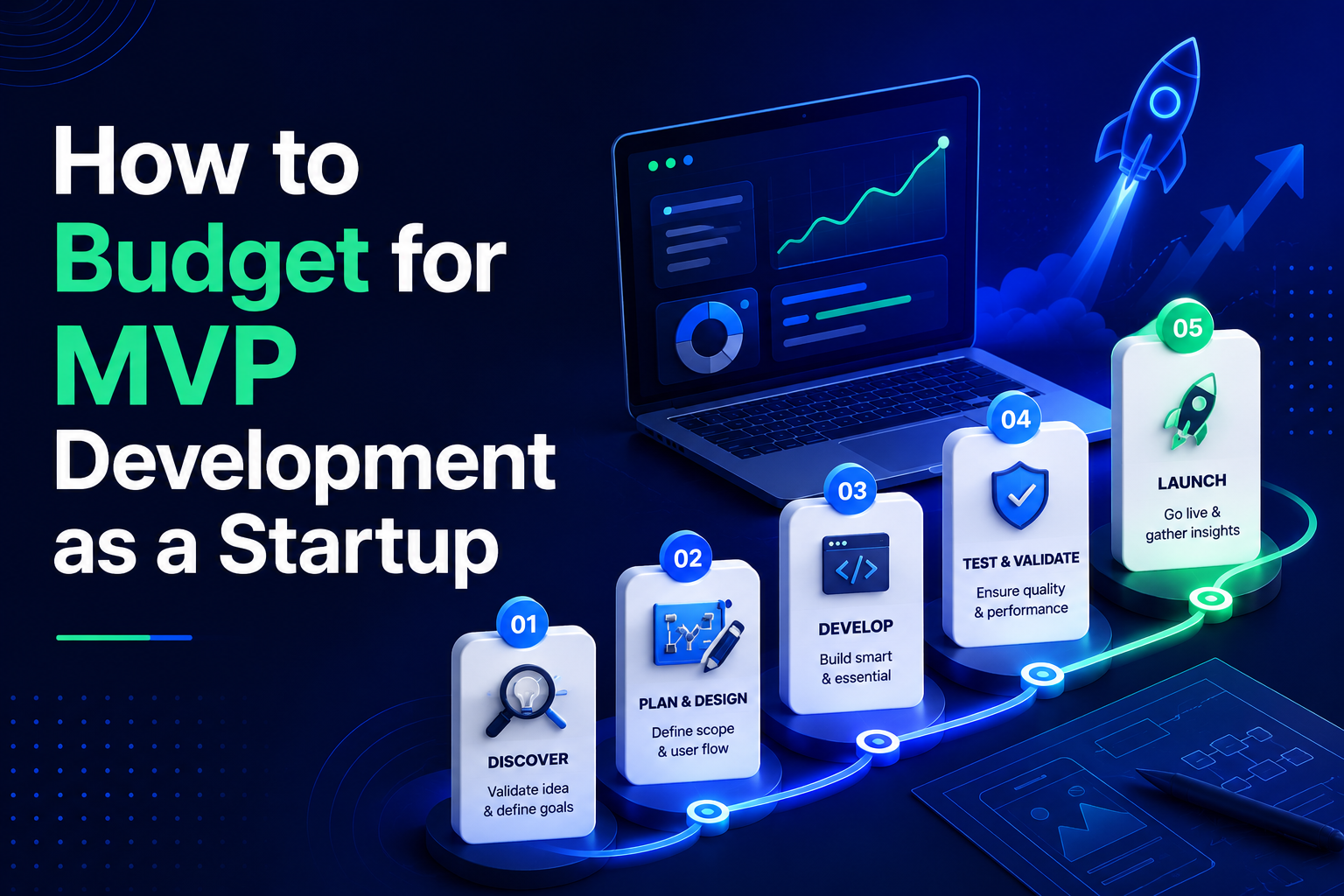
How to Budget for MVP Development as a Startup: A Practical Framework for Smarter Investment
Introduction: The Conversation Every Founder Gets Wrong Founders who run out of runway before reaching product–market fit rarely make one big, obvious mistake. More often, it comes down to a series of decisions that felt right at the time, but didn’t add up well in the end. Data from CB Insights consistently shows that running …
Introduction: The Conversation Every Founder Gets Wrong
Founders who run out of runway before reaching product–market fit rarely make one big, obvious mistake. More often, it comes down to a series of decisions that felt right at the time, but didn’t add up well in the end.
Data from CB Insights consistently shows that running out of cash and failing to raise new capital are among the top reasons startups fail—cited by 38% of founders in their analysis of startup post-mortems. However, this is often a symptom of a larger issue: 35% fail because they built something the market didn’t need. In many of these cases, the problem wasn’t just a lack of funds, but how those funds were burned without a clear system to validate whether the product was actually solving a problem.
This is where your MVP development budget becomes critical. Yet most advice still treats it like a pricing exercise—focused on team costs, hourly rates, or rough platform estimates. That approach overlooks the real role of early-stage spending.
A well-structured MVP development budget is not just about cost control—it’s a decision-making tool. It helps you:
Link every expense to a validation goal.
Sequence spending to maintain flexibility.
Evaluate whether your plan is designed to generate learning or to build a feature list.
The goal is not to spend less, but to spend with clarity—where every dollar has a defined purpose, a measurable outcome, and a clear decision checkpoint before the next “burn” begins.
While runway is typically measured in months, your survival is actually measured in cycles of learning. In the current 2025–2026 funding environment, a 12-month runway is deceptive when mapped against a standard technical roadmap:
The 6-Month “Black Hole”: A moderately complex build typically consumes 22–28 weeks (4 weeks for discovery, 12–16 for core dev, and 6–8 for initial iteration).
The “Evidence Gap”: This leaves a narrow 1-to-6-month window to generate the fundable traction required to bridge the next round.
The budget, therefore, acts as a primary filter for product strategy. Every dollar spent on over-engineered architecture or “nice-to-have” features isn’t just a financial loss; it is a direct theft of the time needed to pivot. Features built to impress rather than validate create “false positives” in user data, distorting the very insights you need to survive.
Effective founders treat their MVP budget as a learning system. By linking every expenditure to a specific hypothesis, you ensure that the burn rate produces more than just code—it produces the evidence required to secure your next phase of growth before the clock runs out.
Align MVP Budget With Business Goals and Validation Strategy
Stop treating your MVP budget as a procurement exercise; treat it as a capital allocation for risk reduction. Every dollar must be indexed against a specific assumption you need to disprove. For pre-seed ventures in 2026, this typically requires a $15K–$40K initial investment to validate a single core hypothesis. If a feature doesn’t generate evidence for that hypothesis, it is overhead.
Define the Validation Goal First
Validation goals dictate the feature set, which in turn drives complexity and cost. Reversing this sequence—starting with a fixed budget and “fitting” a scope—leads to diluted data or unreliable insights.
Three common MVP validation goals:
Validation Goal
What You’re Testing
Budget & Strategic Approach (2026)
Problem–Solution Fit
Do users recognize the problem and seek your solution?
Lean ($10K – $25K): Focused on UI/UX and workflows. Uses No-code/Low-code (Bubble, FlutterFlow) or Concierge models. Example: A high-fidelity prototype byImagineApps.
Technical Feasibility
Can the core technology (AI, heavy data, or hardware) perform under real conditions?
Scale ($60K – $150K+): Heavy backend engineering, AI model tuning, and performance benchmarks. Example: An AI-native enterprise build byIdeas2IT.
Market Demand
Will users perform a “high-intent” action (e.g., pay or sign a contract)?
Mid-Tier ($30K – $75K): Transaction-ready functionality with secure payments, auth, and data privacy. Example: A compliant B2B/Healthcare pilot byCabot Solutions.
Map to the “Minimum Feature Floor”
Your budget must meet the baseline expectations of your specific market to avoid “false negative” results:
B2B SaaS (Enterprise): Budget for SOC 2 compliance and SSO integrations early. Omission here prevents pilots with mid-market players.
Consumer Apps: Prioritize onboarding and UX polish. In 2026, “clunky” is interpreted as “untrustworthy,” which biases your retention data.
Marketplaces: Budget for dual-sided engagement. Use no-code to seed the supply side, but reserve capital to test the liquidity of the demand side simultaneously.
Anchor to a Single Validation Statement
Before requesting estimates, define your Decision Pivot Point:
The Goal: (e.g., Validate willingness to pay $50/mo).
The Metric: (e.g., 15% conversion rate from trial to paid).
The Pivot: (e.g., If <5%, we abandon the feature set and interview drop-offs).
Strategic Allocation Rule: To maintain a resilient runway, follow the 70-20-10 split: 70% on the Core Build (Discovery & Engineering), 20% on Post-Launch Iteration (Data-driven pivots), and 10% for Operations and Contingency (Hosting & Legal).
How to Budget for MVP Development as a Startup
To translate your business goals into a financial roadmap, you must stop budgeting by “feature list” and start budgeting by “Investment Pillars.” This framework ensures you don’t over-capitalize a hypothesis before it has market pull.
The 70-20-10 Allocation Model This model treats your total available runway as a 100% pie, divided into three functional zones:
1. The 70% Core Build (Discovery & Engineering): This is your “Get to Market” capital. It consolidates two formerly separate phases: Product Discovery (user research, wireframing, and technical architecture) and the Core Engineering of your “Golden Path.” By grouping these, you ensure that design and code are treated as a single, continuous workflow rather than siloed expenses.
2. The 20% Iteration Gap (Data-Driven Pivots): This is the most critical and most frequently ignored pillar. It is a reserved fund specifically for the first 90 days post-launch. Its purpose is to fix friction points identified by real user data—not your original assumptions. Without this 20%, your MVP is a “static bet” rather than a learning tool.
3. The 10% Safety Net (Ops & Contingency): This covers the “Cost of Doing Business.” It includes cloud infrastructure (AWS/Azure), third-party API fees (Stripe/Auth0), and a small buffer for “Known Unknowns”—technical hurdles that only appear once development is underway.
Prioritizing Core Features to Control MVP Development Costs
Feature creep [the gradual addition of features beyond the original scope] is the single most common reason MVPs exceed budget. It rarely happens because founders are reckless. It happens because every feature feels important when you’re emotionally invested in the product.
The antidote is a structured prioritization process applied before development begins — and revisited weekly during development.
The MoSCoW Method for MVP Feature Prioritization
The MoSCoW method is a widely used prioritization framework in product and project management. For MVP budgeting, it’s one of the most useful tools available.
Must Have: Features without which the product cannot function or the validation hypothesis cannot be tested. These are non-negotiable.
Should Have: Important but not critical for launch. These can be added in the second iteration post-launch.
Could Have: Desirable features that add value but won’t affect the core user experience or validation outcome at this stage.
Won’t Have (this time): Features deliberately excluded from the current scope. Putting things here isn’t failure — it’s strategy.
Assigning Cost Estimates to Feature Tiers
Once you’ve categorized features using MoSCoW, work with your development partner or technical lead to attach rough cost estimates to each tier. A practical approach:
Build only Must Haves for the initial launch
Use Should Haves as the roadmap for your first post-launch sprint
Review Could Haves only after your first round of user feedback
Revisit Won’t Haves after you’ve achieved your first validation milestone
This approach has a measurable impact. Teams that apply formal feature prioritization before development consistently report 20–40% lower development costs compared to teams that define scope loosely, according to project management research from the Standish Group’s CHAOS reports.
Practical takeaway: If a stakeholder argues for a feature that falls below “Must Have,” ask them: “Will the absence of this feature prevent us from testing our core hypothesis?” If the answer is no, it doesn’t belong in the MVP.
MVP Development Cost Breakdown: Where Your Budget Actually Goes
Understanding how to allocate your capital is the difference between a successful launch and a “zombie” startup. This breakdown reconciles the 70-20-10 Strategic Rule with functional development categories.
Verified Cost Breakdown by Category (2026 Standards)
Strategic Pillar
Functional Category
% of Total Budget
Verified Expert Insight
70% Core Build
Engineering (Front + Back)
55%
The Engine: Includes API architecture, database logic, and the core user journey.
Project Management
15%
The Gears: Critical for keeping 8–16 week timelines from slipping into expensive “scope creep.”
20% Design & QA
UI/UX Design
10%
The Interface: High-fidelity prototyping and user flow optimization.
Quality Assurance (QA)
10%
The Reliability: Testing for security vulnerabilities and cross-device performance.
10% Contingency
DevOps & Buffer
10%
The Safety Net: Cloud infrastructure (AWS/Azure) and emergency post-launch fixes.
Standardized Build Paths (2026):
Lean MVP (No-Code/AI-Hybrid): $10,000 – $25,000. Best for rapid demand validation.
Standard SaaS MVP (Custom Build): $35,000 – $80,000. Best for B2B tools requiring secure data and custom workflows.
Complex / Enterprise MVP: $100,000 – $250,000+. Required for regulated industries (FinTech/HealthTech) or heavy AI orchestration.
How MVP Development Timeline Impacts the 70% Core Build
Timeline and budget are mathematically linked; in software, speed is a purchase. An appropriately scoped Core Build typically requires 10–14 weeks to reach a production-ready state.
The “Under-engineered” Trap (<8 weeks): Compressing the timeline this far often increases costs by 20–40% due to parallel senior workstreams. It also creates technical debt that drains your 20% Iteration budget immediately after launch.
The “Over-engineered” Risk (>16 weeks): If you cannot launch the core value in 4 months, you are building a “Version 1.0,” not an MVP. This delays your “Speed to Learning” and increases market timing risk.
Managing Risk with Strategic Buffers
In the 70-20-10 model, a buffer is not “extra” money—it is a risk management instrument.
How to budget for MVP development unknowns:
The 10% Safety Net is for “Known Unknowns”: Unexpected technical hurdles, such as third-party API limitations or performance bottlenecks discovered during QA.
The 20% Iteration Fund is for “Market Unknowns”: Features you thought were “Must-Haves” that users ignore, or friction points in the onboarding process that weren’t visible in wireframes.
Treat these as separate line items with a documented approval process. This prevents “buffer bleed,” where contingency funds are accidentally spent on extra features before launch.
Common MVP Budgeting Mistakes That Drain Startup Capital
These aren’t theoretical mistakes. They’re patterns observed consistently across early-stage startup development — from accelerator cohorts, post-mortems, and product development retrospectives.
Mistake 1: Building Features for Investors Instead of Users
This is one of the most expensive and common mistakes. Founders add features they believe will impress investors or look good in demos — rather than features that test the core hypothesis with real users. The result is a more expensive product that’s less validated.
Investors don’t fund impressive demos. They fund evidence of demand. The leanest MVP with the strongest user validation data wins.
Mistake 2: Treating Design as Optional
A stripped-down MVP still needs to be usable. Skipping UX design [the process of making the product intuitive and easy to use] to save money often results in user confusion, poor activation rates [the percentage of users who complete a key action after signing up], and inconclusive validation data — because you can’t distinguish whether users didn’t like the idea or couldn’t figure out how to use the product.
Good design at the MVP stage doesn’t mean beautiful. It means functional, clear, and frictionless for the core workflow.
Mistake 3: Hiring Full-Time Engineers Before Product-Market Fit
Building an in-house team before you’ve validated your product is a budget decision that’s very hard to reverse. Full-time engineers come with salaries, benefits, equity expectations, and severance obligations. If the MVP doesn’t validate, you’re stuck with a team and no product direction.
Use contractors, agencies, or fractional talent for the MVP phase. Hire full-time after you have data that justifies the investment.
Mistake 4: Underestimating Ongoing Costs
Infrastructure, maintenance, security patches, and customer support don’t stop after launch — they begin at launch. Many founders budget only for development and then discover that running the product costs $3,000–$10,000 per month in tools, hosting, and engineering time before they’ve earned their first dollar in revenue.
Mistake 5: No Defined Scope Change Process
Every development engagement should have a written scope change protocol. Without one, “small additions” accumulate silently until the budget is 40% over and the timeline has slipped by two months. Every change request, no matter how small, should be documented, estimated, and approved before work begins.
Mistake 6: Choosing the Cheapest Option Without Evaluating Total Cost
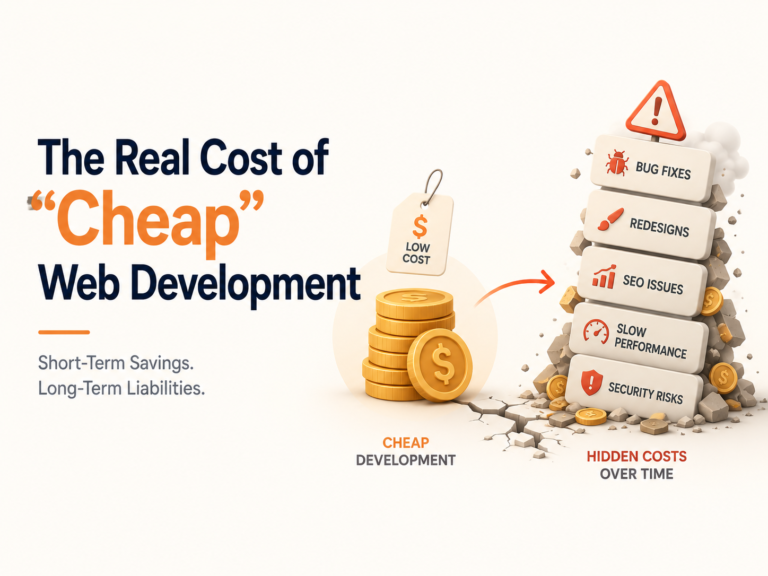
The lowest hourly rate doesn’t produce the lowest total cost. A team that charges $25/hour but requires three times as many hours, produces buggy code, or doesn’t communicate proactively will cost you more in rework, delays, and lost time than a team charging $75/hour that delivers cleanly the first time.
Evaluate development partners on past work, communication quality, and process rigor — not just rate cards.
Using a Phased Investment Model to Reduce Financial Risk
Sophisticated founders treat their budget as a series of “Investment Gates” rather than a single check. This mirrors how VCs fund startups—allocating capital only after specific risks are retired.
The Three-Gate Investment Model:
Gate 1: Discovery Gate (2–4 Weeks | $5K–$15K):
Objective: Finalize UI/UX wireframes and technical architecture.
Decision: Does the high-fidelity prototype resonate with test users? If yes, unlock the rest of the 70% Core Build capital.
Decision: Do users complete the core workflow without manual intervention? If yes, proceed to the 20% Iteration phase.
Gate 3: Validation Gate (4–8 Weeks Post-Launch):
Objective: Use the 20% fund to optimize based on data.
Decision: Is the cost to acquire a customer (CAC) sustainable? This determines if you raise a Seed round or pivot the model.
Budgeting Beyond MVP Launch: Iteration, Optimization, and Early Growth
The launch of an MVP is not the finish line. It’s the starting gun.
The mistake many founders make is treating MVP launch as a moment of completion — when in fact it’s the moment your real data collection begins. And data collection without a budget to act on it is a waste of the development investment you’ve already made.
What Post-Launch Budgeting Actually Covers
Product iteration: Fixing the things users don’t like, adding the features they ask for most, and improving the workflows that create friction. This is ongoing and should be planned for, not funded reactively.
Performance optimization: As your user base grows, your infrastructure costs grow. Queries that ran fine with 100 users may be slow with 10,000. Optimization engineering is real work with real costs.
Customer acquisition: You need budget for early marketing — not necessarily paid advertising, but content, community, partnerships, or sales outreach. Growth doesn’t happen by launching and waiting.
Customer support: Early users have questions. If you don’t have a support system, you’ll spend founder time answering them — which is the most expensive support model available.
Analytics and measurement: Understanding user behavior requires tools. Mixpanel, Amplitude, Heap, or even well-configured Google Analytics come with setup costs, monthly fees, and time investment to interpret correctly.
A Simple Post-Launch Budget Allocation Model
For a startup in the 3–6 months following MVP launch, consider this allocation as a starting framework:
Category
% of Monthly Budget
Product Iteration (engineering)
35–40%
Customer Acquisition
25–30%
Infrastructure & Tools
10–15%
Customer Support
10–15%
Analytics & Measurement
5–10%
Adjust these percentages based on your specific business model. A product-led growth company [one where the product itself drives user acquisition] may invest more in product and less in sales. A sales-led B2B product may flip that ratio.
Real-World Example: Lean MVP Budget Planning in Action
Let’s walk through a realistic, composite scenario that illustrates how the principles above apply in practice.
The Scenario
Company: A two-person founding team building a B2B SaaS tool that helps small accounting firms manage client document requests more efficiently.
Available budget: $120,000 (from personal savings and a friends-and-family round)
Target market: Accounting firms with 2–20 employees in the United States
Core hypothesis: If we make document collection and follow-up automated, accounting firms will save 5+ hours per client engagement, which they’ll pay $100–$200/month to achieve.
Phase 1: Discovery (Weeks 1–4)
Budget allocated: $12,000
Activities:
20 user interviews with accountants (conducted by founders)
Wireframe development with a freelance UX designer
Technical architecture review with a fractional CTO [a part-time technical advisor who fills the role of a Chief Technology Officer]
Competitor and market analysis
Output: Validated wireframes, confirmed feature scope (Must Haves only), and a technical architecture document. Three accountants agreed to serve as design partners [early users who provide structured feedback throughout development] in exchange for early access.
Phase 2: Core Build (Weeks 5–20)
Budget allocated: $72,000 (to a nearshore development agency with SaaS experience)
Must-Have features built:
Secure client portal for document uploads
Automated email reminders for missing documents
Accountant dashboard showing document status per client
Basic user authentication and role-based access [different permissions for accountants vs. their clients]
Stripe integration for subscription billing
Total build time: 14 weeks. Launched to 3 design partner firms.
Phase 3: Iteration (Weeks 21–28)
Budget allocated: $18,000
Based on design partner feedback:
Rebuilt the reminder email flow (users found the tone too aggressive)
Added a bulk upload feature (missed in initial scoping — a known unknown)
Fixed two critical bugs discovered under real usage
Added basic reporting so accountants could see time saved
Buffer remaining: $18,000 (15% of total budget), held in reserve for unforeseen costs in months 7–12.
The Outcome
By week 28, the product had 3 paying design partner accounts at $149/month, early-validation data showing 6.2 hours saved per client engagement on average, and enough documented user feedback to support a targeted outbound sales effort. The founding team then raised a $500,000 pre-seed round on the strength of this validated proof of concept — with $18,000 still in the bank.
What made this work:
Budget aligned to validation, not features
Phased investment with decision points
Design partners engaged before development, not after
Buffer preserved rather than spent on scope expansion
Choosing the Right Development Partner for Budget Efficiency
Your development partner is, arguably, your most consequential MVP budget decision. The right team turns your budget into a validated product. The wrong team turns it into a sunk cost.
The Four Development Team Models
In-House Team
Best for: Startups with sufficient funding and a clear long-term product roadmap
Best for: Founders without technical co-founders who need end-to-end product delivery.
Budget implication: Mid-range cost with structured process, typically $50–$150/hour blended rates
Advantage: These agencies have done this before; they know what an MVP needs and what it doesn’t
Nearshore/Offshore Development Firms
Best for: Cost-conscious founders with reasonable technical fluency to manage communication
Budget implication: Lowest cost, $25–$75/hour blended, but requires more management time
Caution: Time zone differences, communication gaps, and variable quality mean these teams work best when requirements are exceptionally clear
How to Evaluate a Development Partner
Don’t evaluate on rate alone. Evaluate on:
Portfolio relevance: Have they built products like yours, in your industry, at your complexity level?
Process clarity: Can they explain their development process, sprint structure, and QA approach without being prompted?
Communication habits: Do they respond quickly, ask smart questions, and flag concerns proactively? Early communication patterns predict project behavior.
Client references: Ask for two or three clients whose products are live. Call them. Ask whether the final cost matched the estimate.
Ownership structure: Who owns the code at the end of the engagement? This should be you, documented in a written contract before work begins.
The Red Flags That Cost Founders Money
A firm that agrees to everything without pushing back on scope or timeline
No documented QA process or testing protocol
Reluctance to provide references from completed projects
A contract with ambiguous intellectual property terms
“Fixed price” contracts with no defined change request process
Practical takeaway: Spend time in the selection process. A two-week investment in finding the right partner can save you $30,000–$50,000 in rework and delays down the line.
Long-Term Budget Strategy: From MVP to Sustainable Product Growth
A well-executed MVP is not the destination. It’s the evidence base from which you build the case for continued investment — from investors, customers, or your own savings.
Understanding how MVP budgeting evolves into a long-term product strategy is essential for founders who want to build companies, not just products.
The Funding Ladder: How Capital Requirements Evolve
Pre-MVP (Bootstrapped): $0–$50,000 — Founders funding discovery, no-code prototypes, and early user research from personal capital
MVP Build (Seed-ready or bootstrapped): $30,000–$250,000 — Development, launch, and initial iteration
Post-Validation (Pre-Seed or Seed): $250,000–$2,000,000 — Scaling the product, expanding the team, and acquiring users with validated product-market fit evidence
Growth Stage (Series A and beyond): $2M+ — Scaling proven channels, expanding product lines, entering new markets
Each stage requires a different budget philosophy. At the MVP stage, the philosophy is validate before scaling. At the growth stage, it’s scale what’s proven. Applying a growth-stage budget philosophy to an MVP-stage company is one of the most reliable ways to burn through capital without building a sustainable business.
Unit Economics and Why They Belong in Your MVP Budget Conversation
Even at the MVP stage, you should be building toward an understanding of your unit economics [the revenue and costs associated with a single customer or transaction]. Specifically:
CAC (Customer Acquisition Cost): How much does it cost to acquire one paying customer?
LTV (Lifetime Value): How much revenue will one customer generate over their lifetime with your product?
LTV:CAC ratio: A healthy SaaS business typically targets an LTV:CAC ratio of 3:1 or higher
Your MVP doesn’t need to achieve perfect unit economics. But it should generate enough data to form early estimates — because those estimates are what sophisticated investors will scrutinize in your seed pitch.
Building a Product Roadmap That Respects Budget Constraints
A product roadmap isn’t a wish list. It’s a prioritized, budget-informed plan for what you’ll build, in what order, and why.
After your MVP launch, your roadmap should be organized around three questions:
What does the data from real users tell us to build next?
What’s the smallest investment that would deliver the biggest impact on retention or revenue?
What can we delay without meaningful consequence?
This mentality — build less, learn more, invest in what’s proven — is the philosophy that separates startups with long runways from those that run out of money on the way to a good idea.
Frequently Asked Questions About MVP Development Budgeting
Costs vary by technical complexity and required compliance, but 2026 industry benchmarks from platforms like Clutch and GoodFirms suggest the following ranges:
Standard SaaS MVP: $30,000 – $75,000 (Core workflows with secure auth and payments)
Complex / AI-Native MVP: $80,000 – $150,000+ (Custom models, deep integrations, or high-compliance sectors)
For pre-seed startups, follow the 70-20-10 rule:
70% for the Core Build (Engineering and Discovery)
20% for post-launch iteration (responding to user data)
10% for operations and contingency
Absolutely. In 2026, tools like Bubble, FlutterFlow, and Glide are powerful enough to handle complex logic and API integrations. The decision depends on your goal: use no-code for market demand validation; move to custom code only when testing technical feasibility or proprietary high-performance architecture.
If your build timeline exceeds 16 weeks, you are likely building a “Version 1.0” rather than an MVP. A true MVP should focus on a single “Golden Path”—the one workflow that delivers 80% of the value. If you can’t launch that specific path in 3–4 months, your scope is likely diluted by “nice-to-have” features that distort your early data.
For most pre-Product-Market Fit (PMF) startups, specialized agencies or fractional talent are superior. They offer the speed of a pre-built process and the flexibility to scale down once the build is done. Transition to in-house hiring only after you’ve validated demand and secured the funding to support the high long-term carry cost of a full-time engineering team.
A standard 2026 software MVP takes 4–5 months to go from concept to live:
4 weeks — Discovery & Design
10–14 weeks — Core Development
2 weeks — QA & Deployment
Conclusion
MVP budgeting is an exercise in strategic discipline. It is the decision to spend exactly what is required to buy the next set of answers—no more, no less. The frameworks provided here—from phased investment gates to the 70-20-10 allocation—are designed to give you a decision-making infrastructure, not just a line item in a spreadsheet.
Your budget is the first real signal of how you operate as a founder. Make it signal clarity, discipline, and a relentless focus on validation.
Founders who invest two to three weeks in structured scoping often reduce total development costs by 20–30% before writing a single line of code.